This article was automatically translated from the original Turkish version.
History | 1917-11-02 | ||||||||
|---|---|---|---|---|---|---|---|---|---|
Place(s) | United Kingdom | ||||||||
Announcer | Arthur James Balfour (United Kingdom Secretary of State for Foreign Affairs) | ||||||||
Content | Commitment to establish a national homeland for the Jewish people in Palestine | ||||||||
Result(s) | The beginning of the processes that laid the groundwork for the establishment of the State of Israel in 1948 | ||||||||
Related Parties | Arab society in Palestine Zionist Movement United Kingdom | ||||||||
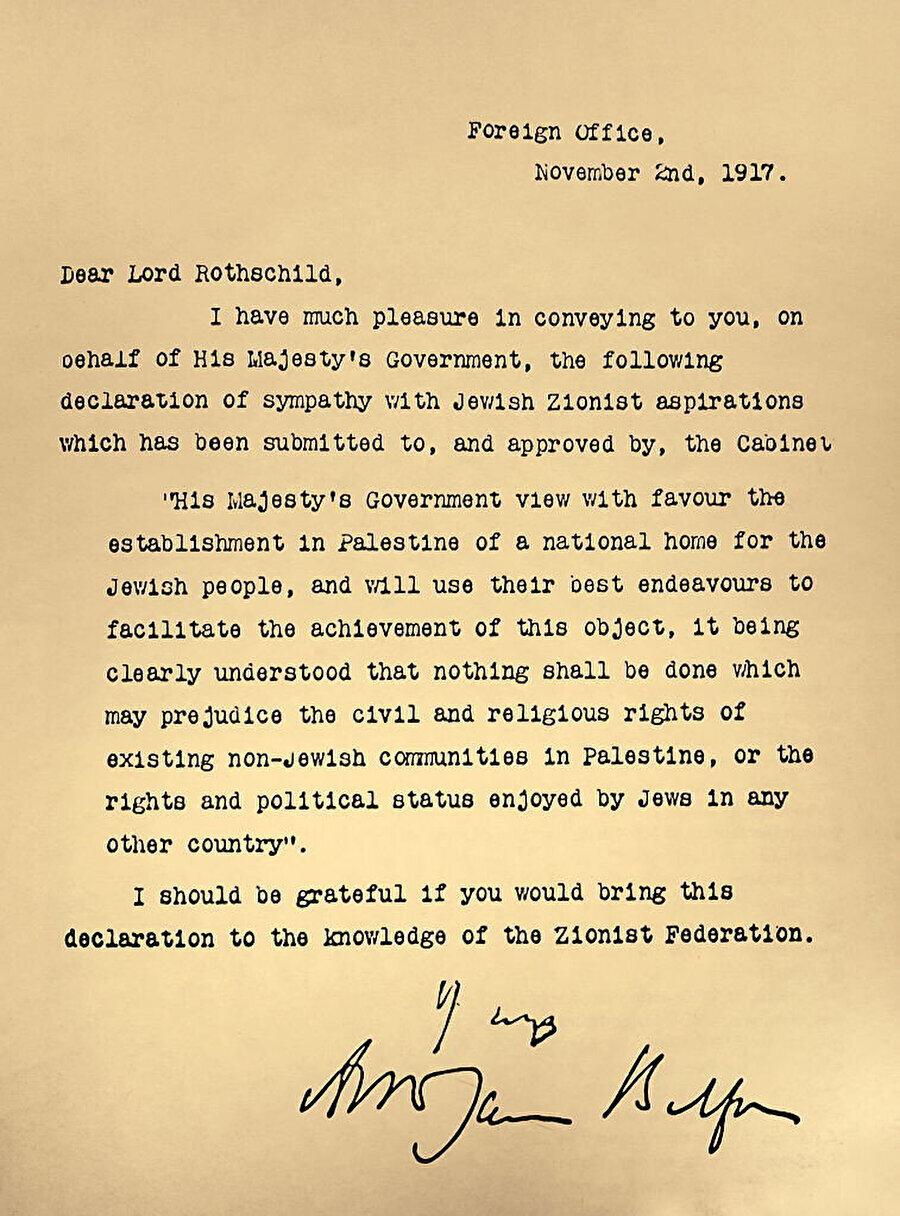
The Balfour Declaration is a letter dated 2 November 1917, written by British Foreign Secretary Arthur James Balfour to Lionel Walter Rothschild, expressing the British Government’s support for the establishment of a national home for the Jewish people in Palestine. This document was issued during World War I as part of Britain’s strategic policies against the Ottoman Empire, aiming to gain the support of the Jewish diaspora and bolster the Zionist movement. The declaration is regarded as a pivotal turning point in the establishment of the modern State of Israel and holds a significant place in the historical development of the Palestinian question.
The declaration emerged in 1917, at a critical stage of World War I. Palestine, then under Ottoman control, was seen by Britain as a strategically important region. Zionist leaders, particularly Chaim Weizmann, played a decisive role in shaping the declaration through their negotiations with the British government. Motivated by the belief that the settlement of Jewish immigrants in Palestine would serve its own interests, Britain pursued this policy. Additionally, the Cambon Declaration issued by France’s Jules Cambon on 4 June 1917, which expressed support for Jewish colonization, helped lay the groundwork for the Balfour Declaration. Britain took this step to counterbalance French influence in the Middle East and secure its own control over Palestine.
The text of the declaration reads as follows:
“Dear Lord Rothschild,
The Government of His Britannic Majesty views with favour the establishment in Palestine of a national home for the Jewish people, and will use its best endeavours to facilitate the achievement of this object, it being clearly understood that nothing shall be done which may prejudice the civil and religious rights of existing non-Jewish communities in Palestine, or the rights and political status enjoyed by Jews in any other country.
Yours faithfully,
Arthur James Balfour”
This text supports the idea of a Jewish national home but contains an ambiguous commitment regarding the rights of the Arab population in Palestine. The formulation was influenced by proposals from Zionist leader Nahum Sokolow, but the final version approved by the British Cabinet presented a more limited framework.
The drafting of the declaration was the result of efforts by Zionist leaders to persuade Britain. At the outset of the war, the idea that Jewish colonization in Palestine would serve British interests was put forward.
France’s Cambon Declaration played a role in this process by providing international backing, but Britain sought to strengthen its own position amid concerns over French influence in Lebanon and Syria. The Cabinet believed that a British-protected Jewish presence in Palestine would consolidate British control over the region.
The publication of the declaration elicited varied responses from different sectors. Zionist leaders, particularly Chaim Weizmann, viewed the declaration as recognition of Jewish nationalism and the right to establish a political center in Palestine, and regarded it as a principle of fundamental importance. Sir Mark Sykes argued that the declaration would accelerate Jewish migration to Palestine and make the future establishment of a Jewish state possible.
However, the Arab population of Palestine and certain international circles criticized Britain’s unilateral decision, arguing that the views of the Palestinians had been ignored. The approval of the United States and the Allied Powers contributed to the declaration’s influence on the course of the war.
The Balfour Declaration formed the basis of Britain’s mandate over Palestine in 1920 and encouraged Jewish immigration. This led to tensions between the Arab population and Jewish immigrants, marking the beginning of long-term conflicts. The declaration played a catalytic role in the establishment of the State of Israel in 1948, while simultaneously laying the foundation for the Palestinian question. British colonial strategies and power dynamics in the Middle East significantly shaped this process.
The declaration has been criticized as a product of imperialist policies. The Arab community contends that the rights of the Palestinians were violated, while Zionist circles have highlighted Britain’s inadequate implementation of the declaration. Academic studies note that the document provided the groundwork for ethnic and national conflicts in the Middle East.
Kılınç, Taha. Kudüs Yazıları. Ketebe Yayınları, 2024.
Uyanık, N. & Yavuz, H. (2023). “Balfour Deklarasyonu’nun İlan, Tepki ve Destekler”. *Kastamonu İnsan ve Toplum Dergisi / KTOOD*, 1(2), 207–222. https://dergipark.org.tr/tr/pub/kitod/issue/81030/1400625.
Yamaç, Müzehher, and Hazel Cartmill. "The Balfour Declaration." *Balkan Journal of Social Sciences / Balkan Sosyal Bilimler Dergisi* 7, no. 13 (2017): 135–143. https://dergipark.org.tr/tr/pub/bsbd/issue/34559/328223.
Yıldız, Ömer Faruk. "Halksız Vatana, Vatansız Halkı Yerleştirme Projesi: Balfour Deklarasyonu." *GZT Mecra*, November 2, 2022. https://www.gzt.com/mecra/halksiz-vatana-vatansiz-halki-yerlestirme-projesi-balfour-deklarayonu-3771710.

History | 1917-11-02 | ||||||||
|---|---|---|---|---|---|---|---|---|---|
Place(s) | United Kingdom | ||||||||
Announcer | Arthur James Balfour (United Kingdom Secretary of State for Foreign Affairs) | ||||||||
Content | Commitment to establish a national homeland for the Jewish people in Palestine | ||||||||
Result(s) | The beginning of the processes that laid the groundwork for the establishment of the State of Israel in 1948 | ||||||||
Related Parties | Arab society in Palestine Zionist Movement United Kingdom | ||||||||
No Discussion Added Yet
Start discussion for "Balfour Declaration" article
Historical Context
Text and Content
Preparation Process
Reactions and Support
Consequences and Effects
Criticisms and Debates