


This article was automatically translated from the original Turkish version.
+1 More
Family | Malvaceae (subfamily Bombacoideae) | ||||||||
|---|---|---|---|---|---|---|---|---|---|
Morphology | 5–25 m tall; trunk diameter up to 10 m; palmately compound leaves; nocturnal, pendulous flowers; capsule fruit | ||||||||
Ecological Adaptation | Thick trunk with water storage capacity (100,000+ L); drought tolerant; fire and fire-resistant | ||||||||
Anthropogenic Use | Fiber-like bark; edible leaves; fruit rich in vitamin C and fiber; medicinal use | ||||||||
Biological Activities | antidiabetic antimicrobial anti-inflammatory Antioxidant | ||||||||
Sustainability | Low juvenile regeneration; climate stress (drought); IUCN conservation need | ||||||||
The baobab tree (Adansonia genus) is a thick-trunked long-lived and majestic tree species native to the arid and semi-arid regions of Africa Madagascar and Australia. In particular the Adansonia digitata species is regarded as a multipurpose resource both biologically and culturally. These trees are notable for their monumental trunks durability water storage capacity and their traditional medicinal nutritional and ecological functions. Several species are threatened due to climate change habitat loss and human intervention. This article provides a comprehensive review under three main headings: morphology and systematics ecological adaptations and human uses.
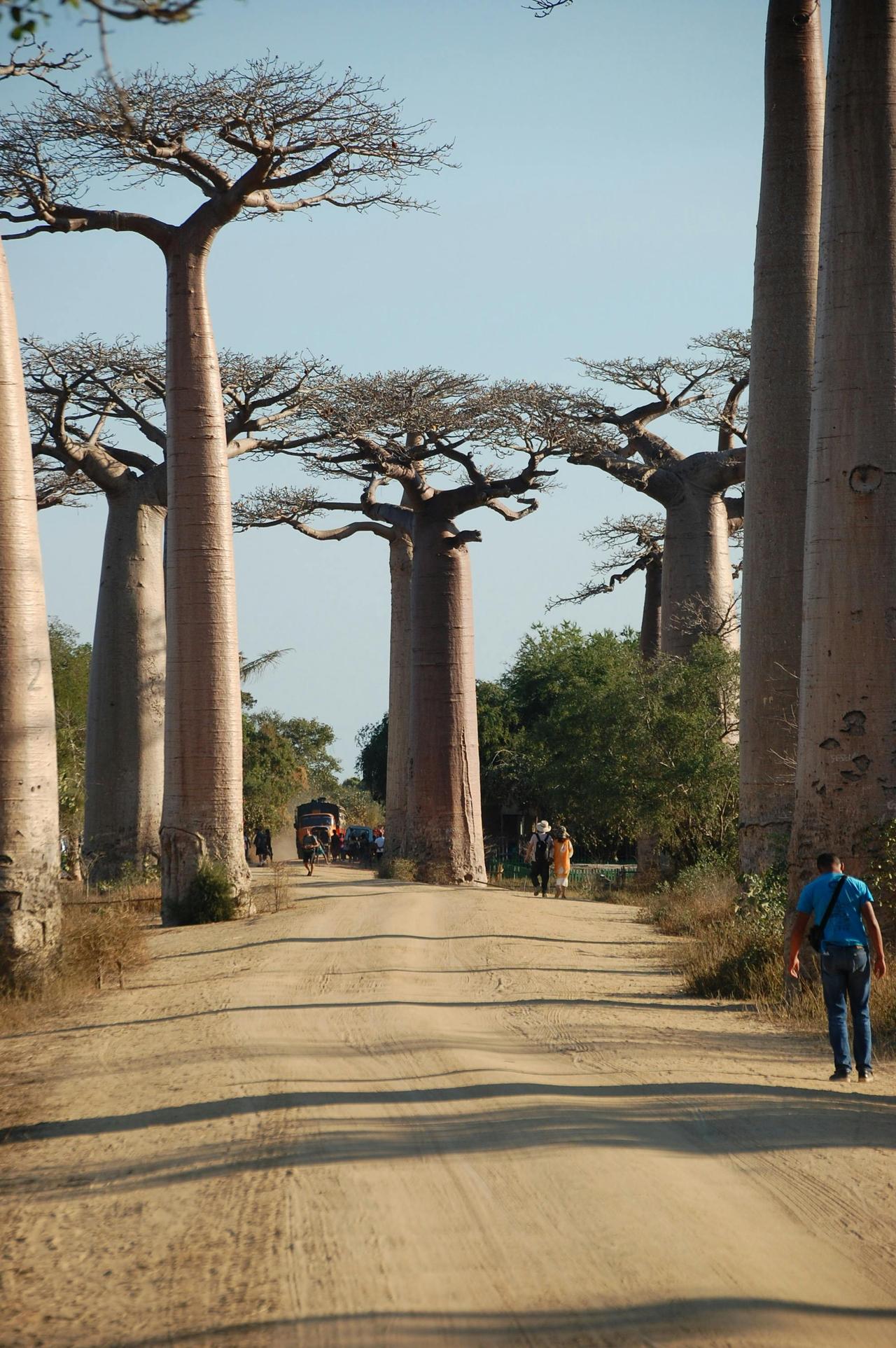
Baobabs are trees belonging to the genus Adansonia typically growing 6 to 25 meters tall with broad trunks that can become hollow over time and have a swollen structure. Their most characteristic features are the swollen trunk and wide crown form. The trunk diameter in A. digitata can reach up to 10 meters and some individuals remain standing for decades even after their interiors have become hollow. The trunk tissue is fibrous and well adapted for water storage depending on diameter.
Leaves are generally compound and palmate. Young shoots bear leaves while mature individuals have 5 to 11 leaflets. Flowers are typically large pendulous and white opening at night. In A. digitata flowers grow on long stalks and open once or twice during the night. Fruits are woody-capsuled with a pulp-filled interior.
The genus has been classified within the subfamily Bombacoideae (Malvaceae) based on genetic and phylogenetic analyses. Genetic studies reveal diversification driven by climatic adaptation and isolation processes between African and Malagasy species. Some Malagasy species have been identified as threatened by the IUCN.

Baobab tree (Adansonia genus) (Pexels)
Species found in Madagascar such as A. grandidieri and A. perrieri exhibit distinct structures and conservation statuses. A. grandidieri has a massive cylindrical trunk with horizontal branches while A. perrieri develops a more slender structure adapted to rainforest environments.
Australia’s native species A. gregorii is generally smaller single-trunked and depicted in historical drawings as being around 1000 to 2000 years old. In Africa A. digitata is an iconic species of savanna ecosystems distinguished by its drought adaptation and water storage structure.
Baobabs have evolved long-term survival strategies in tropical and subtropical dry regions. Their thick trunks serve as water reservoirs; recent measurements indicate that some individuals can store between 120 000 and 136 000 litres of water. This enables them to utilize stored water over extended periods without rainfall. During dry seasons they shed leaves to reduce transpiration.
The thick bark provides resistance to fire. While bark is thin in young individuals it thickens with age. Regeneration rates are higher in moist microhabitats such as riverine zones whereas regeneration is weak in dry habitats. Human activities including nomadic agriculture livestock grazing and climate change negatively impact population structures.
Ecologically baobabs are keystone species. They provide nesting sites for birds such as songbirds and fruit bats. Fruits contribute to seed dispersal. Seed passage through animal digestive tracts enhances germination rates. They also influence the soil organic matter cycle.
Baobab trees provide habitats for numerous vertebrate and invertebrate species. Hollow trunks serve as shelters for birds and insects. Seeds and fruits are collected by local communities and used as food sources.
Statistical analyses reveal a “bell-shaped” diameter distribution in baobab populations indicating a lack of juvenile regeneration. This is a warning sign for long-term population sustainability. Density of individuals along riverbanks is significant for assessing water access and diversity.
The baobab is a multipurpose tree across the African continent. Its bark is used to make rope baskets and cloth. Leaves are consumed as vegetables or in soups. Seeds yield oil and the fruit pulp is rich in vitamin C calcium and fiber. In traditional medicine the fruit leaves roots and bark are used for various applications including fever reduction treatment of diarrhea and wound dressing.

Use of baobab tree bark for rope basket and cloth production (generated by artificial intelligence)
Modern studies have demonstrated that baobab fruit possesses antioxidant anti-inflammatory antimicrobial and antidiabetic properties. Preclinical research shows modulation of glycemic response and a broad biological activity profile. Traditional remedies report the presence of tannins in the bark and the alkaloid “adansonin” with traditional use in conditions such as malaria.
Baobab fruit is regarded as an innovative food ingredient in international markets. Commercial products include fruit powders oils and herbal supplements. It is rich in dietary fiber and coloring agents. However it contains antinutrients such as phytates and tannins requiring proper processing. Overharvesting and habitat degradation limit commercial potential. In developing countries baobab products are considered alternative income sources in micro-enterprises and rural development projects.
Climate change deforestation unregulated harvesting and low regeneration rates are the primary threats to baobab populations. The IUCN has classified several Malagasy species as high-risk on the Red List. Vulnerable or endangered statuses underscore the necessity for conservation.
Sustainable management strategies include agroforestry systems integrated conservation based on local knowledge regeneration enhancement programs and preservation of genetic diversity. Riverbank buffer zones cultural stewardship and production planning are recommended.
Assogbadjo, A. E., Chadare, F. J., Manda, L., & Sinsin, B. (2021). A 20-Year Journey Through an Orphan African Baobab (Adansonia digitata L.) Towards Improved Food and Nutrition Security in Africa. *Frontiers in Sustainable Food Systems*, *5*. Accessed June 26, 2025. https://doi.org/10.3389/fsufs.2021.675382
Fischer, S., Jäckering, L., & Kehlenbeck, K. “The Baobab (Adansonia digitata L.) in Southern Kenya–A Study on Status, Distribution, Use and Importance in Taita–Taveta County.” Environmental Management 66, no. 3 (2020): 305–318. Accessed June 26, 2025. https://doi.org/10.1007/s00267-020-01311-7
Ismail, B. B., Pu, Y., Fan, L., Dandago, M. A., Guo, M., and Liu, D. “Characterizing the Phenolic Constituents of Baobab (Adansonia digitata) Fruit Shell by LC-MS/QTOF and Their In Vitro Biological Activities.” The Science of the Total Environment 694 (2019): 133387. Accessed June 26, 2025. https://doi.org/10.1016/j.scitotenv.2019.07.193
Munyebvu, F., Mapaure, I., and Kwembeya, E. “Abundance, Structure and Uses of Baobab (Adansonia digitata L.) Populations in Omusati Region, Namibia.” South African Journal of Botany 119 (2018): 112–118. Accessed June 26, 2025. https://doi.org/10.1016/j.sajb.2018.08.020
Rita, K., Bernardo, M. A., Silva, M. L., Brito, J., Mesquita, M. F., Pintão, A. M., and Moncada, M. “Adansonia digitata L. (Baobab Fruit) Effect on Postprandial Glycemia in Healthy Adults: A Randomized Controlled Trial.” Nutrients 14, no. 2 (2022): 398. Accessed June 26, 2025. https://doi.org/10.3390/nu14020398

Family | Malvaceae (subfamily Bombacoideae) | ||||||||
|---|---|---|---|---|---|---|---|---|---|
Morphology | 5–25 m tall; trunk diameter up to 10 m; palmately compound leaves; nocturnal, pendulous flowers; capsule fruit | ||||||||
Ecological Adaptation | Thick trunk with water storage capacity (100,000+ L); drought tolerant; fire and fire-resistant | ||||||||
Anthropogenic Use | Fiber-like bark; edible leaves; fruit rich in vitamin C and fiber; medicinal use | ||||||||
Biological Activities | antidiabetic antimicrobial anti-inflammatory Antioxidant | ||||||||
Sustainability | Low juvenile regeneration; climate stress (drought); IUCN conservation need | ||||||||
No Discussion Added Yet
Start discussion for "Baobab Tree (Adansonia digitata L.)" article
Morphological and Systematic Characteristics
Subspecific Variation and Distribution
Ecological Adaptations and Environmental Role
Contribution to Biodiversity and Population Dynamics
Anthropogenic Uses and Biological Functions
Products and Commercial Value
Conservation Threats and Sustainability