

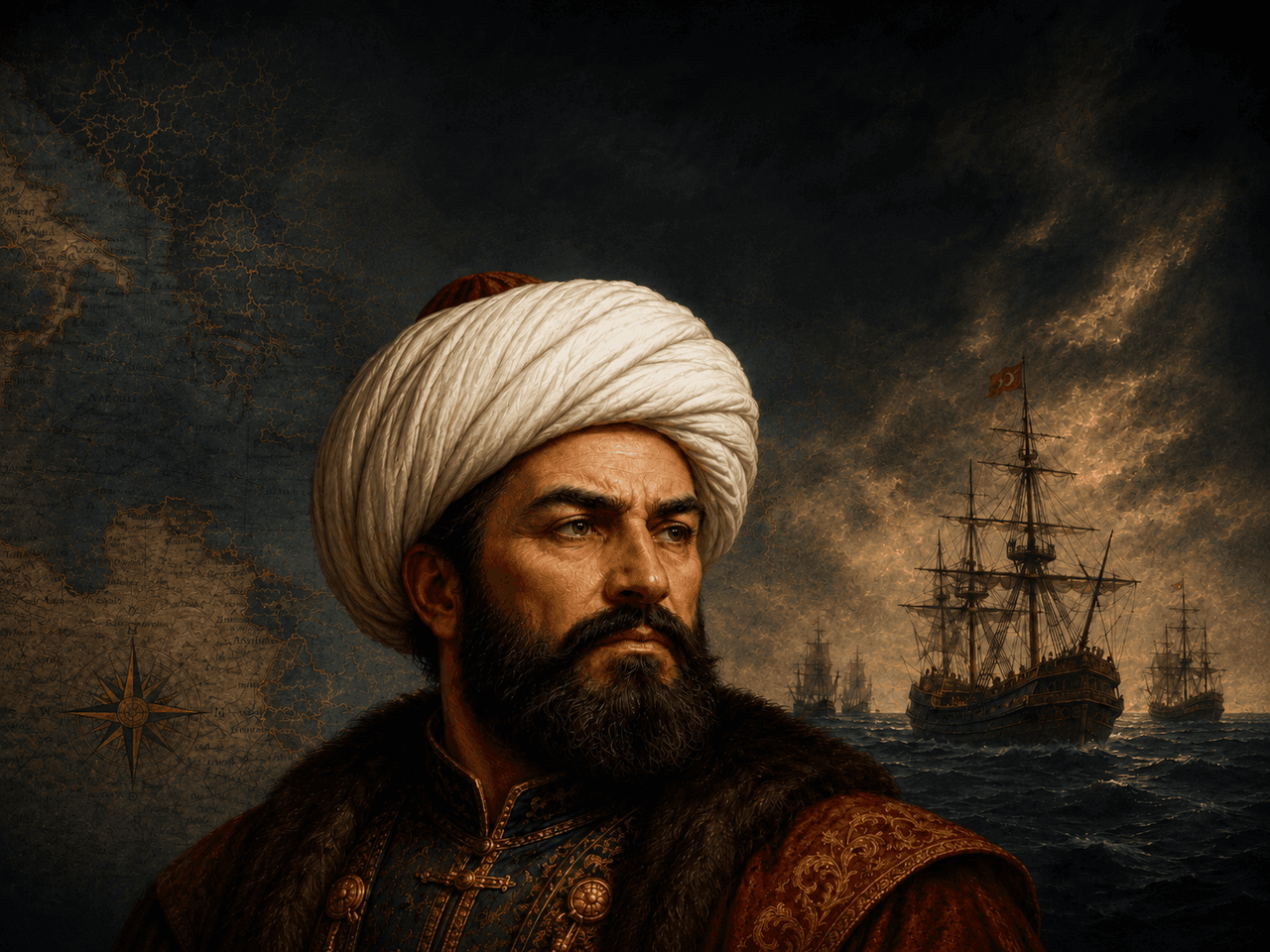

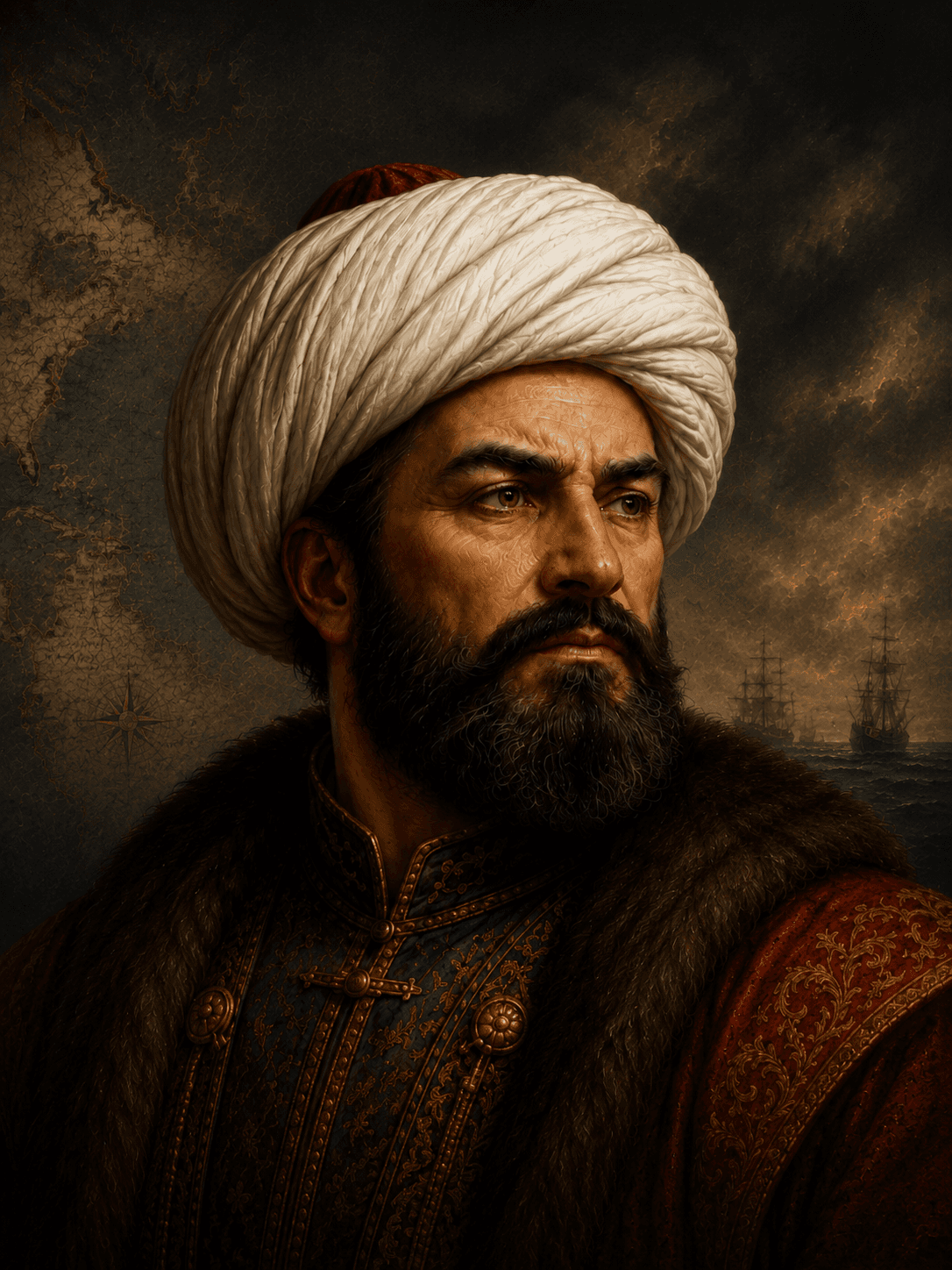
(Generated with Artificial Intelligence)
Barbaros Hayreddin Pasha
Real Name | Hızır Reis | ||||||||
|---|---|---|---|---|---|---|---|---|---|
Nicknames | Barbaros, Hayreddin (“The Blessing of the Faith”) | ||||||||
Birth | 1478, Lesbos | ||||||||
Death | July 4, 1546, Istanbul | ||||||||
Babası | Yakup Ağa (sipahi) | ||||||||
Siblings | Ishak Reis, Oruç Reis, İlyas Reis | ||||||||
Title(s) | Member of the Imperial Council (with the rank of vizier) Captain of the Ottoman Navy (1534–1546) Beylerbey of Algiers in the White Sea (1533) Bey of Algiers (1519) | ||||||||
Work | Seyyid Murâd's Gazavât-ı Hayreddin Paşa recounts the life and campaigns of the Pasha. | ||||||||
Tomb | Beşiktaş, Istanbul (constructed by Mimar Sinan) | ||||||||
Barbaros Hayreddin Paşa, a Turkish sailor and statesman who served as the Ottoman Empire’s admiral of the fleet and played a pivotal role in establishing Ottoman dominance in the Mediterranean during the 16th century.
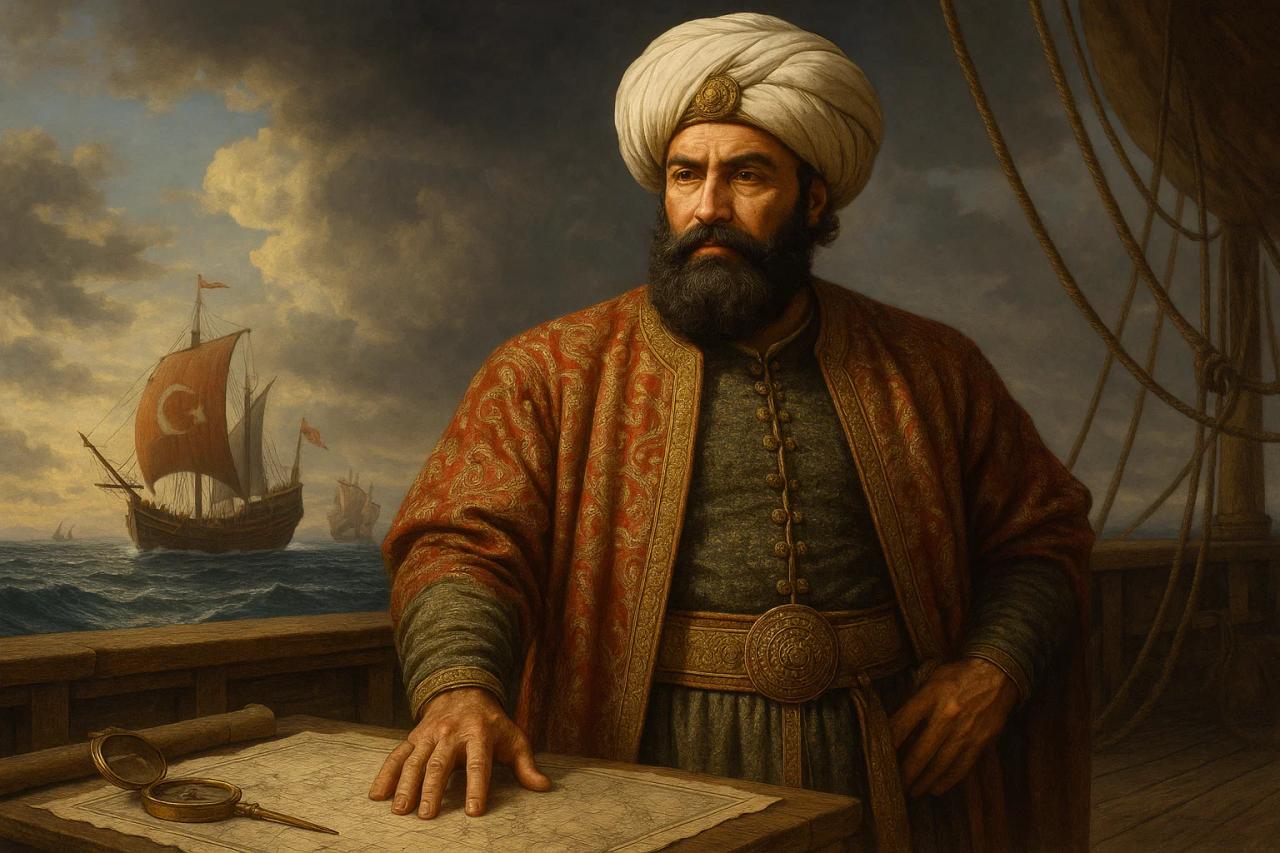
Representative Image of Barbaros Hayreddin Paşa (Generated by Artificial Intelligence)
Barbaros Hayreddin Paşa, born as Hızır Reis in 1478 on the island of Lesbos, was the youngest of four brothers, sons of Yakup Ağa, an Ottoman sipahi. His elder brothers were İshak, Oruç, and İlyas. In his youth, he built a ship and began engaging in trade between Lesbos, Thessaloniki, and Euboea. After his brother Oruç Reis was captured by the Knights of Rhodes and later rescued, the two brothers came under the protection of Prince Korkut. From 1504 onward, they began operating as “sea warriors” in the Mediterranean.
The Barbaros brothers established their base at the fortress of Halkülvâdî (La Goletta) in Tunisia and launched raids against Spain, Genoa, and France. They captured key North African cities including Şerşel, Algiers, Ténès, and Tlemcen, laying the foundations of the “Barbary Corsair States.” Europeans, noting Oruç Reis’s red beard, gave him the name “Barbarossa” (Redbeard). After Oruç Reis was martyred in battle against the Spanish in Tlemcen in 1518, the name was adopted by Hızır Reis and entered Turkish as “Barbaros.”
The Barbaros brothers gained fame not only through Ottoman support but also by transporting Muslim exiles from Andalusia (Moriscos) to North Africa. A significant portion of Algiers’ population descended from these migrants. Between 1520 and 1529, Hızır Reis gained complete control over Algiers and its surroundings; Algiers became so wealthy it was referred to as “the India of the Turks.”
After Oruç Reis’s death, Hızır Reis attempted to rule Algiers alone but soon realized he could not withstand the combined pressure of the Spanish and local opponents. In 1519, he sent an envoy to Yavuz Sultan Selim, declaring his allegiance and requesting that his territories be incorporated into the Ottoman Empire. Yavuz Sultan Selim accepted this request and sent Hızır Reis a formal appointment as sanjak bey, along with robes of honor, jewels, and a jeweled sword. He also provided 2,000 Janissaries, artillery, and ships. Thus, Algiers was formally incorporated into Ottoman territory, and Hızır Reis received the honorific title “Hayreddin” (Goodness of the Faith), becoming Bey of Algiers.
At the invitation of Kanuni Sultan Süleyman, Barbaros Hayreddin Paşa arrived in Istanbul in 1533 and was received with a grand ceremony. His views on Mediterranean policy impressed the Sultan. With the influence of Grand Vizier İbrahim Paşa, he was first appointed Beylerbeyi of Algiers and then in 1534, promoted to Kaptan-ı Derya (Commander-in-Chief of the Ottoman Navy). He also became the first Beylerbeyi of the newly established Eyalet of “Cezayir-i Bahri Sefid” (Islands of the Mediterranean). Thus, for the first time in Ottoman history, the office of Kaptan-ı Derya was combined with the rank of Beylerbeyi.
After becoming Kaptan-ı Derya, Barbaros Hayreddin Paşa’s first task was to reorganize the Imperial Shipyard (Tersane-i Amire) and initiate the modernization of the navy. He implemented fundamental changes in ship design, personnel training, and administration. He established the galley as the backbone of the Ottoman fleet due to its speed and maneuverability. Under his supervision, a new fleet of 84 vessels was constructed over the winter. Thanks to Barbaros’s initiatives, the shipyard became one of the most advanced shipbuilding and technological centers of its time, and the long-term institutional structure of the Ottoman Navy was established during this period.
Barbaros Hayreddin Paşa’s greatest victory was the Battle of Preveza on 28 September 1538, between the Ottoman Navy and a Holy League fleet composed of the Papal States, Venice, Genoa, Spain, Portugal, and the Knights of Malta. Against a Holy League fleet of over 300 ships commanded by Andrea Doria, the Ottoman fleet of 122 ships achieved a decisive victory. The Holy League lost 128 ships, while the Ottomans lost not a single vessel. In return, the Ottomans suffered approximately 400 levent casualties. This victory solidified Ottoman absolute dominance in the Mediterranean, which became known as an “Ottoman lake.”
At the request of King Francis I of France, who sought Ottoman assistance against Holy Roman Emperor Charles V, Kanuni Sultan Süleyman dispatched Barbaros Hayreddin Paşa to France in 1543. The Ottoman fleet of 154 ships anchored in the port of Toulon and joined forces with the French navy to capture the city of Nice. The Ottoman fleet spent the winter in Toulon, during which time the city’s administration effectively came under Ottoman control. This marked the first instance of an Ottoman fleet remaining for an extended period in the port of a Christian country.
Barbaros Hayreddin Paşa died in Istanbul on 4 July 1546. According to his will, he was buried in a türbe built by Mimar Sinan in Beşiktaş. His tomb became a site of visitation, where cannons were fired by the Ottoman Navy on every departure.
Barbaros endowed his wealth to educational and charitable causes. He constructed mosques, medreses, baths, and fountains in Istanbul and Algiers. In his will, he stipulated that the revenues from his properties be used exclusively for education and the needs of students.
The institutions established by Barbaros and the naval commanders he trained—Turgut Reis, Kılıç Ali Paşa, and Piyale Paşa—played vital roles in sustaining Ottoman naval power for many years. Sources describe Barbaros as tall and robust, with a fair complexion, and thick hair, beard, eyebrows, and eyelashes. He is also recorded as having been fluent in Greek, Arabic, Spanish, Italian, and French.
The life and campaigns of Barbaros are detailed in the prose and verse works titled Gazavât-ı Hayreddin Paşa by Seyyid Murâd. These works are exemplary of the Ottoman gazavatname tradition and hold historical value. The Gazavât-ı Hayreddin Paşa was translated into Spanish in 1578, later into Italian, and published in Palermo in 1887. The French translation published in Paris in 1837, however, is based on a 17th-century Arabic abridgment and does not correspond accurately to the original text.
AA (Anadolu Ajansı). “Osmanlı’yı Deniz İmparatorluğu Haline Getiren Barbaros Hayrettin Paşa.” Anadolu Ajansı. Accessed October 1, 2025. https://www.aa.com.tr/tr/kultur/osmanliyi-deniz-imparatorlugu-haline-getiren-barbaros-hayrettin-pasa/2629611
Anadolu Ajansı. “Osmanlı’nın Gücünü Akdeniz’e Taşıyan Paşa: Barbaros Hayrettin.” Accessed October 1, 2025. https://www.aa.com.tr/tr/kultur/osmanlinin-gucunu-akdenize-tasiyan-pasa-barbaros-hayrettin/3265764
Arıkan, Muzaffer, and Paulino Toledo. “Türk Deniz Tarihi ile İlgili Belgeler IV: II. İspanya, Kuzey Afrika ve Barbaros Hayrettin Paşa.” *OTAM Ankara Üniversitesi Osmanlı Tarihi Araştırma ve Uygulama Merkezi Dergisi* 5 (June 1994): 491–527. https://doi.org/10.1501/OTAM_0000000224
Bilgin, Feridun. “Mekan ve İnsan: Gelibolu ve Barbaros Hayreddin Paşa (Osmanlı Devleti’nin Akdeniz Hakimiyeti).” *Çanakkale Araştırmaları Türk Yıllığı* 11, no. 14 (December 2013): 17–31. https://dergipark.org.tr/tr/pub/canakkalearastirmalari/issue/4001/52834
De Bunes Ibarra, Miguel Angel, and Mehmet Necati Kutlu. “Barbaros Hayreddin Paşa ve Magrib’in Osmanlılaşması.” *OTAM Ankara Üniversitesi Osmanlı Tarihi Araştırma ve Uygulama Merkezi Dergisi* 12 (April 2001): 261–79. https://doi.org/10.1501/OTAM_0000000476
Gallotta, Aldo. “Gazavat-ı Hayreddin Paşa.” *Türkiye Diyanet Vakfı İslâm Ansiklopedisi.* Accessed October 1, 2025. https://islamansiklopedisi.org.tr/gazavat-i-hayreddin-pasa
Gallotta, Aldo. “Gazavat-ı Hayreddin Paşa.” Trans. Salih Akdemir. *Belleten* 45, no. 180 (October 1981): 473–500. https://dergipark.org.tr/tr/pub/ttkbelleten/issue/70722/1137701.
Gallotta, Aldo. “Seyyid Murad’ın ‘Gazavât-ı Hayreddin Paşa’ Adlı Eseri.” *Erdem* 4, no. 10 (1988): 127–164. Accessed October 1, 2025. https://dergipark.org.tr/tr/pub/erdem/issue/44560/552874
Tarakçı, Nejat. *Barbaros Hayrettin Paşa’nın 470. Ölüm Yıldönümü.* TASAM. Accessed October 1, 2025. https://tasam.org/Files/Icerik/File/BarbarosHayrettinPasa_pdf_e07ae721-177d-42cb-a2d7-49d4f8c6b0e1.pdf
Turan, Şerafettin. “Barbaros Hayreddin Paşa.” *Türkiye Diyanet Vakfı İslâm Ansiklopedisi.* Accessed October 1, 2025. https://islamansiklopedisi.org.tr/barbaros-hayreddin-pasa
Vatin, Nicolas. “Arabes et Turcs au Maghreb dans les années 1513–1520 d’après les Ġazavat-ı Ĥayrü-d-din Paşa.” *Osmanlı Araştırmaları* 40 (December 2012): 365–397. Accessed October 1, 2025. https://dergipark.org.tr/tr/pub/oa/issue/10938/130738

(Generated with Artificial Intelligence)
Barbaros Hayreddin Pasha
Real Name | Hızır Reis | ||||||||
|---|---|---|---|---|---|---|---|---|---|
Nicknames | Barbaros, Hayreddin (“The Blessing of the Faith”) | ||||||||
Birth | 1478, Lesbos | ||||||||
Death | July 4, 1546, Istanbul | ||||||||
Babası | Yakup Ağa (sipahi) | ||||||||
Siblings | Ishak Reis, Oruç Reis, İlyas Reis | ||||||||
Title(s) | Member of the Imperial Council (with the rank of vizier) Captain of the Ottoman Navy (1534–1546) Beylerbey of Algiers in the White Sea (1533) Bey of Algiers (1519) | ||||||||
Work | Seyyid Murâd's Gazavât-ı Hayreddin Paşa recounts the life and campaigns of the Pasha. | ||||||||
Tomb | Beşiktaş, Istanbul (constructed by Mimar Sinan) | ||||||||
No Discussion Added Yet
Start discussion for "Barbaros Hayreddin Pasha " article
Early Life and Initial Years at Sea
Entry into Ottoman Service and Annexation of Algiers
Rise to Admiral of the Fleet and Arrival in Istanbul
Reorganization of the Ottoman Navy
The Battle of Preveza (1538)
Campaign in France and Wintering in Toulon (1543–1544)
Death and Legacy