


This article was automatically translated from the original Turkish version.
Baroque architecture is an architectural style that emerged in the early 17th century in Rome, Italy, and quickly gained widespread popularity across Europe. It developed in opposition to the balanced, measured, and rational approach of Renaissance architecture, offering an aesthetic that prioritized movement, depth, and emotional impact. This style was shaped not only by artistic preferences but also by the religious and political conditions of the era.
The Catholic Church’s Counter-Reformation played a decisive role in the development of Baroque architecture; within this context, architecture became a tool for reinforcing religious belief and fostering social engagement. At the same time, absolute monarchies adopted the Baroque style to express their political legitimacy visually and structurally. Buildings constructed in this vein were equipped with design elements that reflected the grandeur and continuity of power.
Baroque architecture is not merely a period-specific aesthetic expression; it is also regarded as a multifaceted mode of representation that transformed the perception of space and influenced the foundations of modern architectural understanding.
The historical origins of Baroque architecture are directly linked to the religious and political transformations in Europe at the end of the 16th century. In particular, the Catholic Church’s Counter-Reformation movement, launched in response to the Protestant Reformation, played a decisive role in the emergence of the Baroque style. During this period, art was viewed not merely as an aesthetic production but as a communicative instrument aimed at guiding and strengthening faith.
In this effort to revitalize Catholicism, all visual arts, especially architecture, were employed to deepen religious experience, enhance emotional engagement, and create powerful visual impressions on the faithful. Particularly in structures developed under the leadership of the Jesuit Order, sensory and spiritual effects were brought to the fore through dramatic use of light, dynamic spatial arrangements, and elaborate decorative programs.
Baroque architecture was not limited to religious buildings; it was also widely adopted in the representative structures of absolute monarchies. As seen in examples such as the Palace of Versailles in France, the Baroque style was used to express the splendor of political authority and centralized power. Thus, Baroque architecture functioned both as an ideological instrument for strengthening Catholic faith and as an architectural language reflecting the representational power of European monarchies.
In Baroque architecture, form and spatial composition follow a design that transcends classical order, emphasizing movement, theatricality, and dramatic effect. Architectural designs of this period were shaped not by static symmetry and geometric simplicity but by dynamic arrangements intended to engage and guide the viewer’s senses. Floor plans were predominantly organized in oval, circular, elliptical, or crossed forms, allowing spaces to move beyond linear axes and become centralized or multi-focused. This approach enabled space to be perceived not merely as a structure facilitating passage but as a staged experience.
In terms of mass organization, architectural elements were evaluated not only according to their structural functions but also with attention to their visual and symbolic effects. Columns, niches, arches, projections and recesses, undulating facades, and curved lines were enriched through interplays of light and shadow to impart vitality and a sense of motion to the structure. Staircases were designed not merely as functional elements connecting floors but as structural components that directed visitors spatially and enhanced dramatic narrative. Concave-convex transitions in vaults and domes reinforced the Baroque architectural sensory impact by creating a continuous impression of flow and movement within the space.
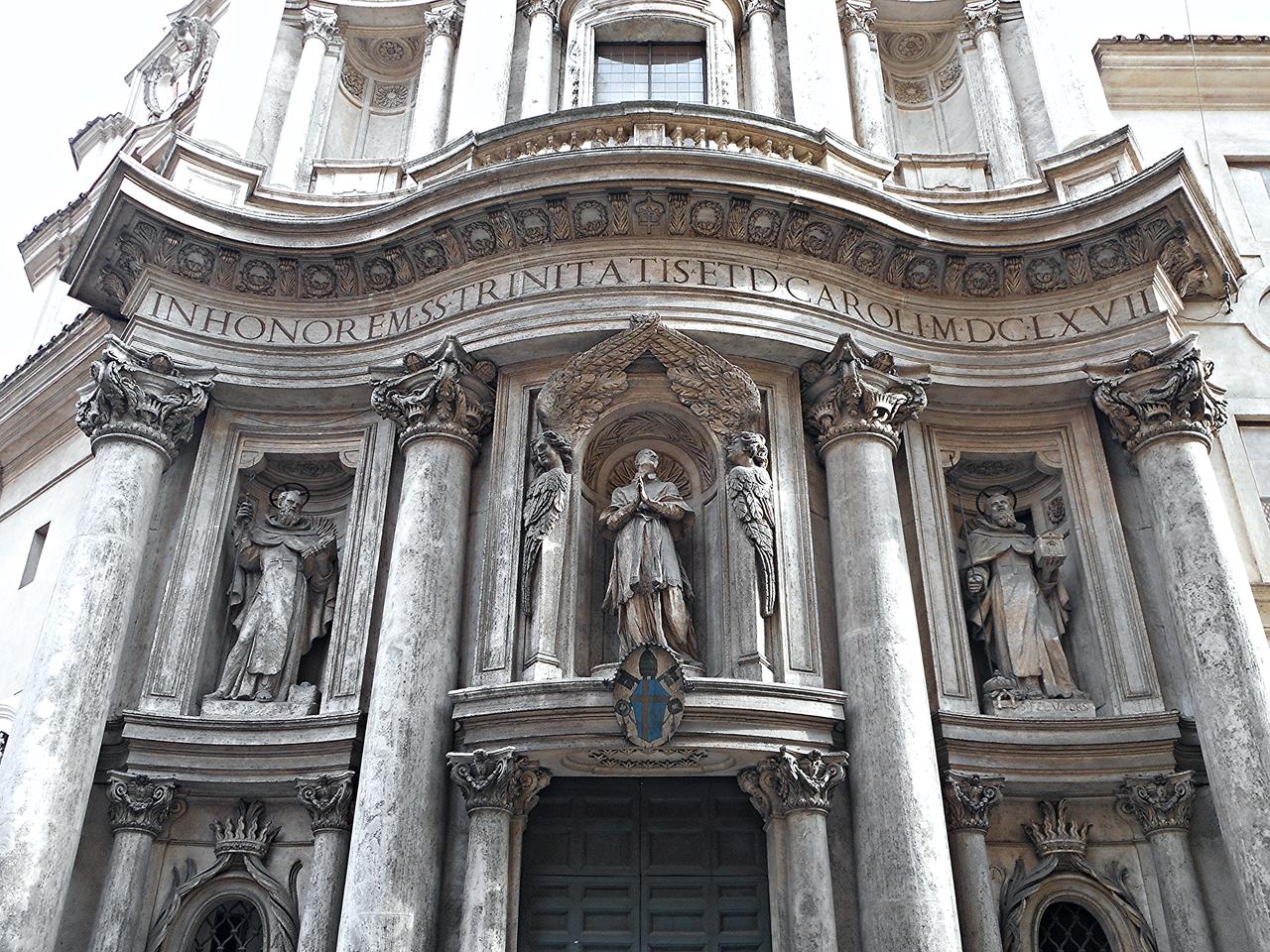
San Carlo alle Quattro Fontane (Flickr, Carlo Raso)
The complex surface play and rhythmic transitions created within the interior of Borromini’s San Carlo alle Quattro Fontane reflect the formal characteristics of Baroque aesthetics; while Bernini’s Sant’Andrea al Quirinale demonstrates the emotional dramatization of Baroque architecture through its dramatic centralization, oval plan arrangement, and powerful perspective effects.

Sant’Andrea al Quirinale (Pexels, Ozan Tabakoğlu)
One of the most distinctive features of Baroque architecture is the intensity of its decorative approach and its holistic integration with other art forms. Nearly every surface—from facades to interiors, ceilings to structural elements—was adorned with stylized motifs such as rosettes, cartouches, scallop shells, acanthus leaves, volutes, and S- and C-shaped curves. This decorative approach transformed architecture from a mere structural arrangement into a nearly autonomous decorative composition. Gilded details, reliefs, and dramatic sculptural groups expanded the physical boundaries of buildings, creating a sensory-rich and compelling atmosphere.
This decorative sensibility was not confined to Western Europe; it also influenced Ottoman architecture in the 18th century. Examples such as the Mihrişah Valide Sultan Fountain in Istanbul reveal the fusion of Baroque and Rococo motifs with local aesthetic traditions.
Baroque architecture treats architectural design as an integrated artistic practice that merges sculpture and painting. As seen in the works of Gian Lorenzo Bernini, architectural forms achieve unity with ceiling frescoes, while statues placed between columns complement and complete the spatial composition. Thus, Baroque architecture synthesizes architecture with plastic and visual arts to create a multi-layered and immersive narrative environment surrounding the visitor.
In Baroque architecture, light is not merely an element for illumination but is regarded as a component that intensifies, directs, and adds layers of meaning to the building’s dramatic effect. During this period, light was intricately integrated with the geometry and spatial organization of the structure, becoming an effective element on both physical and symbolic levels. The placement of windows was not accidental but strategically determined to control the entry of light into interior spaces. This allowed certain areas to be emphasized while others were left in shadow, producing a dramatic theatrical effect. Light directed beneath vaults, apses, or oval domes was used to highlight the sacred or symbolic meanings of the space.
The contrast between light and shadow was employed not only for illumination but also to enhance the plasticity of architectural volumes. This effect was further strengthened by the use of trompe-l'œil (optical illusion) techniques in Baroque ceiling frescoes. The extension of real architectural boundaries through painted illusions—such as ceilings depicted as opening to the sky—expanded the perception of space toward infinity, a hallmark of Baroque architecture. These perspective manipulations were not limited to frescoes but were also applied in the placement of architectural elements. The optical elongation of corridors, the close spacing of columns, or the creation of artificial depth effects produced impressions of space that diverged from its actual dimensions, representing key visual manipulation techniques of Baroque architecture.
Beyond being viewed as a historical style, Baroque architecture has also been a subject of debate in modern architectural theory. Thinkers such as Gilles Deleuze have interpreted the Baroque as a philosophical conceptual framework, while researchers like Mehtap Serim have linked its aesthetics of excess and ambiguity to modernity. Today, complex geometries and lighting techniques inspired by Baroque forms can be observed in digital architectural environments.
Ercan, Yıldız Duman. "Antikçağ Barok Sanatın Avrupa Barok Sanatına Yansıması." Master's thesis, Pamukkale Üniversitesi, 2016. Accessed May 30, 2025. https://gcris.pau.edu.tr/bitstream/11499/1206/1/Y%c4%b1ld%c4%b1z%20Duman%20Ercan.pdf
Flickr. “Front of San Carlo alle Quattro Fontane Church (1667) in Rome (Detail) - Architect Francesco Borromini (Bissone 1599-Rome 1667) JPG.” Accessed May 30, 2025. https://flic.kr/p/D5XxJf
Halıcı, Esra, and Hüseyin Yurttaş. "Barok-Rokoko Üsluplarının Mimari Süslemedeki Gücü." *Anasay*, pp. 3-28, 2022. Accessed May 30, 2025. https://dergipark.org.tr/en/download/article-file/2186152
Kanlıçay, Sinem Sevinçtav. "Barok-Rokoko Yorumlu 18. Yüzyıl İstanbul Çeşmelerinde Kompozisyon, Motif ve Terimler (1740-1797)." Master's thesis, İTÜ, 2010. Accessed May 30, 2025. https://polen.itu.edu.tr/bitstreams/e1d6e011-bfcc-44ce-b445-84bb86ead940/download
Pexels. “Ceiling of Dome of SantAndrea al Quirinale Church in Rome, Italy JPG.” Pexels. Accessed May 30, 2025. https://www.pexels.com/photo/ceiling-of-dome-of-santandrea-al-quirinale-church-in-rome-italy-20419787/
Serim, Mehtap. Bir Modernlik Zemini: Barok Aşırılık. İstanbul: Metis Yayınları, 2020.
Ülger, Kani. “Gotik, Rönesans ve Barok Dönem Resim Sanatının Heykel ve Mimari Disiplinleriyle Etkileşiminin Sanat Eserleri Odağında İncelenmesi.” *Art and Society* 21 (2024): 127–150. Accessed May 30, 2025. https://dergipark.org.tr/tr/download/article-file/3600372

No Discussion Added Yet
Start discussion for "Baroque Architecture" article
Historical Context
Architectural Form and Composition
Decorative Arts and Interdisciplinary Unity
Light, Shadow, and Perspective
Contemporary Approaches