

This article was automatically translated from the original Turkish version.
EDIT
Bartın White Baklava is a baked dessert unique to the city of Bartın in Türkiye’s Black Sea region, prepared using traditional methods and registered with a geographical indication mark. On 9 October 2020, the product received geographical indication registration from the Bartın Municipality and has become an integral part of the regional identity due to its historical and cultural ties to the area.
The production of Bartın White Baklava can only be carried out within the boundaries of Bartın province. The product’s association with the region depends on the continued mastery of traditional production methods. Accordingly, all stages of production must be conducted within the geographical boundary.
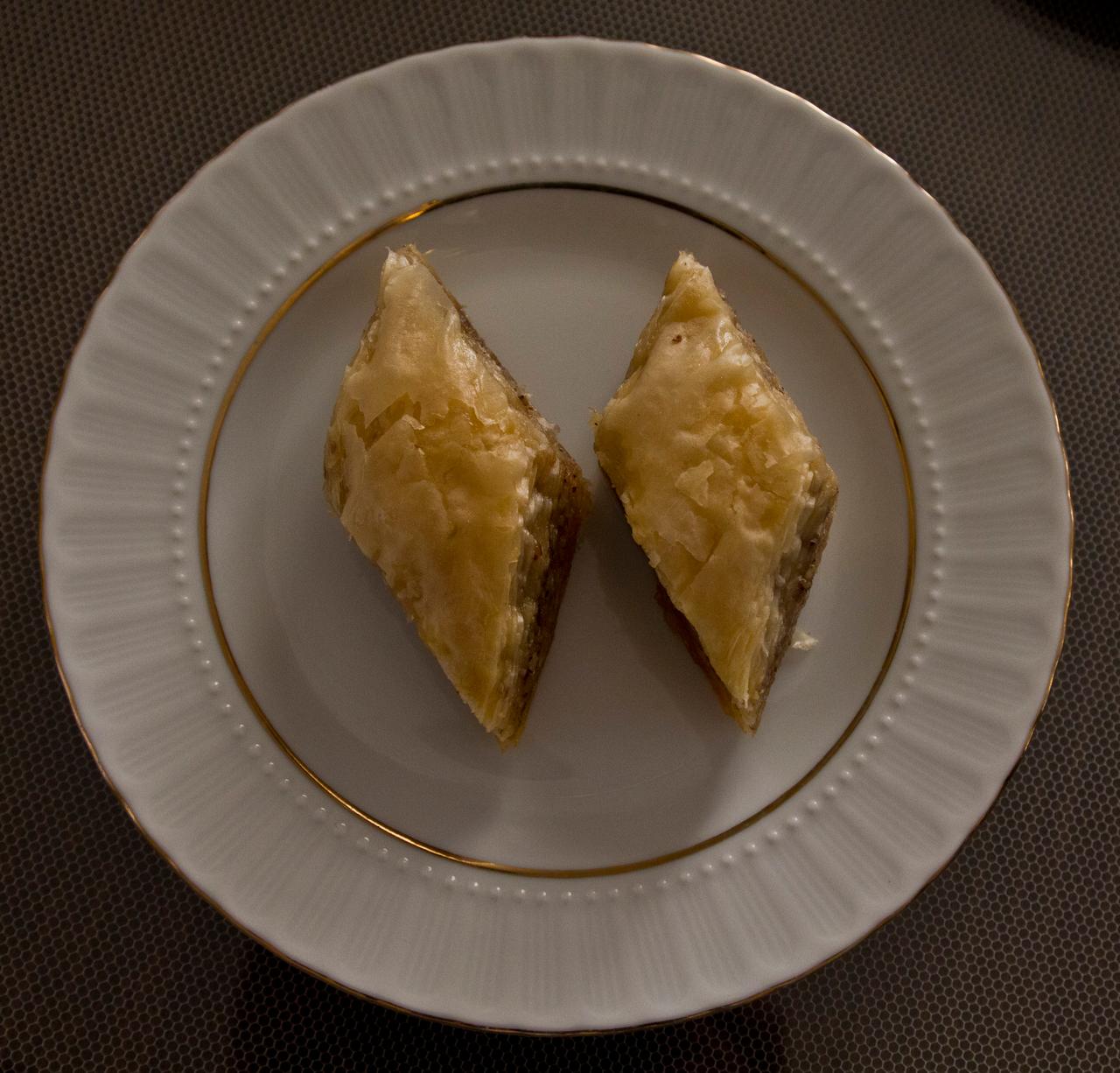
Bartın White Baklava is a dessert made with a filling of walnuts and starch, cut into rhombus shapes and left to dry overnight, then brushed with butter and baked for an extended period at controlled temperatures. Its most distinctive feature is that, unlike classic baklava, its surface is not browned and retains a white appearance. This characteristic is achieved through precise control of baking time and temperature.
This dessert, originally made in small ovens in the gardens of homes in Bartın about a century ago, has gradually become a regional symbol. Its continued production using the same traditional method today demonstrates the cultural continuity and strong connection to local craftsmanship.
The production of Bartın White Baklava consists of the following stages: dough preparation, filling preparation, layering, cutting, drying, baking, and syrup soaking.
The dough is made by kneading wheat flour, egg, milk, preferably yogurt, water, and liquid oil until it reaches the softness of an earlobe. The rested dough is divided into pieces the size of a tangerine and rolled out with the help of starch into thin sheets so transparent that text can be read through them.
The filling is prepared by mixing coarsely ground walnut pieces with starch. Three layers of dough without filling are laid on a greased tray. Subsequent layers are sprinkled with the walnut-starch filling, and the final ten layers are placed on top without filling. The dessert is then cut into rhombus shapes and left to dry overnight.
The next day, melted butter is brushed over the top. The butter penetrates between the layers. The dessert is baked for two to three hours at a controlled temperature of 150–175 °C, ensuring the surface does not brown.
The syrup is made from water, sugar, and a few drops of lemon juice. It is poured over the dessert while thick and cold. After absorbing the syrup and cooling, the dessert is ready to serve.
The production and use of the geographical indication mark are monitored by experts designated by the Bartın Provincial Directorate of Agriculture and Forestry, the Bartın Provincial Directorate of Culture and Tourism, and the Bartın Chamber of Commerce and Industry under the coordination of the Bartın Municipality. Monitoring is conducted annually on a regular basis but may also be carried out at any time upon request or complaint. During inspections, special attention is paid to the quality of ingredients, production stages, and compliance with the geographical indication mark.
Turk Patent and Trademark Office. "Bartın Beyaz Baklavası Coğrafi İşaret Tescil Belgesi." Accessed October 19, 2025. https://ci.turkpatent.gov.tr/Files/GeographicalSigns/47156082-6c0c-4082-8010-f596e420b6ce.pdf.
Turkish Patent and Trademark Office. "Bartın Beyaz Baklavası." Geographical Indications Portal. Accessed October 19, 2025. https://ci.turkpatent.gov.tr/cografi-isaretler/detay/38665.

No Discussion Added Yet
Start discussion for "Bartın White Baklava" article
Geographical Boundaries and Production Conditions
Product Characteristics
Preparation Method
Monitoring