This article was automatically translated from the original Turkish version.
Name(s) | Bartın Wire Wrapping | ||||||||
|---|---|---|---|---|---|---|---|---|---|
Product Type | Handcraft product (processing) | ||||||||
Geographical Indication Type(s) | Mahreç mark | ||||||||
Registration Number | 1019 | ||||||||
Application Date | 2020-10-26 | ||||||||
Registration Date | 2022-02-04 | ||||||||
Registering Authority | Bartın Provincial Directorate of Culture and Tourism | ||||||||
Bartın İşi Tel Sarma is a traditional craft product in which motifs are embroidered onto fabric using silver wire through the wrapping technique. This craft developed within the boundaries of Bartın Province and is protected under geographical indication due to its historical background, production technique, and the skill it demands. The product has been registered as a certification mark under Law No. 6769 on Industrial Property.
The geographical history of this craft extends back to the late 18th century. The high level of craftsmanship required and the transmission of knowledge across generations have established a strong association between the product and Bartın Province. Therefore, all production stages are required to be carried out within the defined geographical boundaries.
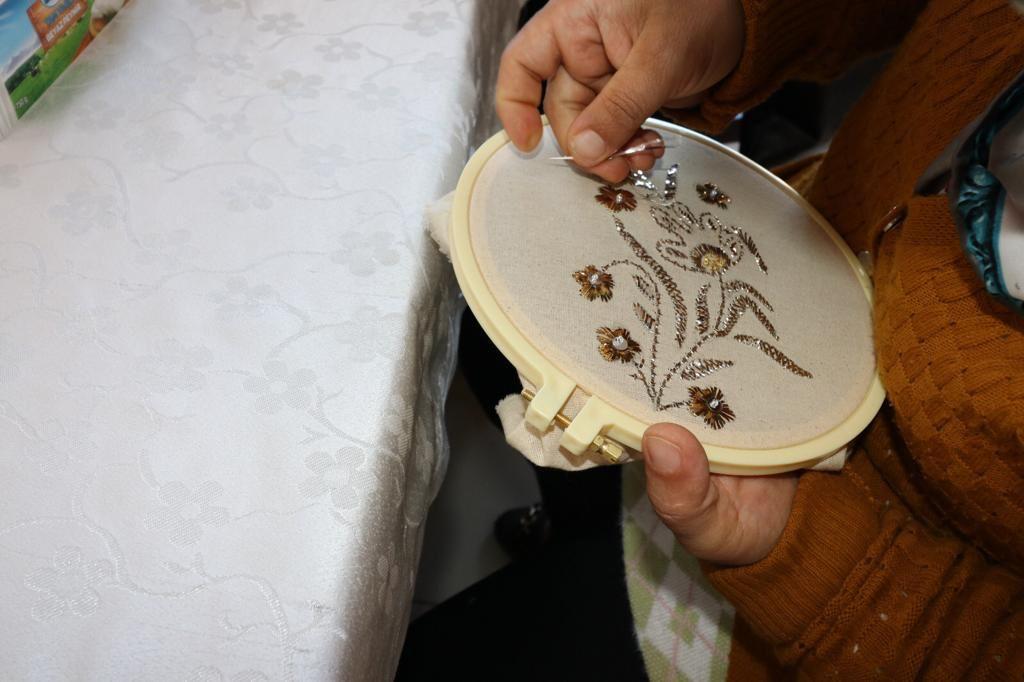
This technique involves applying flat silver alloy wire onto fabric using the wrapping method. When first applied the wire appears silver white but gradually oxidizes to a faint yellowish tone over time. Common designs include geometric patterns, white embroidery, simple needlework motifs, and Turkish-style motifs. While traditional historical examples are predominantly preferred as models, patterns from kilims, lace, and counted-thread embroidery are also utilized.
The embroidery is typically applied to soft, smooth fabrics such as silk, fine crepe, linen, and silk-blend cotton, which allow the needle to pass easily. Fringed examples may also be produced upon request.

Example of Tel Sarma (Bartın Governorate)
The production process employs tools and materials such as a measuring ruler, drawing pencil, tracing paper, carbon paper, spool or bobbin, silver alloy wire thread, and a needle. The process consists of preparing and transferring the design onto the fabric, wrapping the wire to create the embroidery, cleaning the edges, and ironing.
In the design transfer technique, motifs are drawn directly onto the fabric and then embroidered, with the aim of making the original lines invisible after completion. During the edge cleaning stage, decorative elements such as antique work, Turkish-style patterns, and fringe detailing are applied. This step includes techniques for folding edges and turning corners.
Traditional techniques such as fishbone stitch, straight wrapping, herringbone wrapping, Christ’s eye, musabak, and mat weave are applied during production. After completion, the product is ironed at low temperature with a protective fabric placed on the reverse side to prepare it for use.
This craft product is classified under the group “Handicraft Products Other Than Carpets, Kilims and Woven Textiles” and was registered on 4 February 2022 following an application submitted on 26 October 2020. The registered owner is the Bartın Provincial Directorate of Culture and Tourism. Monitoring is carried out regularly by a monitoring authority established under the coordination of the relevant institution.
Bartın Kalkınma Agency. "Bartın İşi Tel Sarma." Accessed January 10, 2026. https://www.bakab.gov.tr/bartin-isi-tel-sarma/
Bartın Valiliği. "Bartın İşi Tel Sarma Coğrafi İşaret Tescil Belgesi Almaya Hak Kazandı." Accessed January 10, 2026. https://www.bartin.gov.tr/bartin-isi-tel-sarma-cografi-isaret-tescil-belgesi-almaya-hak-kazandi
Turk Patent and Trademark Office. *Bartın İşi Tel Sarma Coğrafi İşaret Tescil Belgesi (PDF). Tescil No: 1019*, February 4, 2022. Accessed January 10, 2026. https://ci.turkpatent.gov.tr/Files/GeographicalSigns/b982d471-0648-418a-845c-fad937af3a69.pdf

Name(s) | Bartın Wire Wrapping | ||||||||
|---|---|---|---|---|---|---|---|---|---|
Product Type | Handcraft product (processing) | ||||||||
Geographical Indication Type(s) | Mahreç mark | ||||||||
Registration Number | 1019 | ||||||||
Application Date | 2020-10-26 | ||||||||
Registration Date | 2022-02-04 | ||||||||
Registering Authority | Bartın Provincial Directorate of Culture and Tourism | ||||||||
No Discussion Added Yet
Start discussion for "Bartın Wire Wrapping" article
History and Geographical Connection
Product Definition and Distinguishing Features
Production Process and Techniques Used
Wire Wrapping and Edge Cleaning Techniques
Needle and Embroidery Techniques
Geographical Indication Registration and Monitoring