


This article was automatically translated from the original Turkish version.
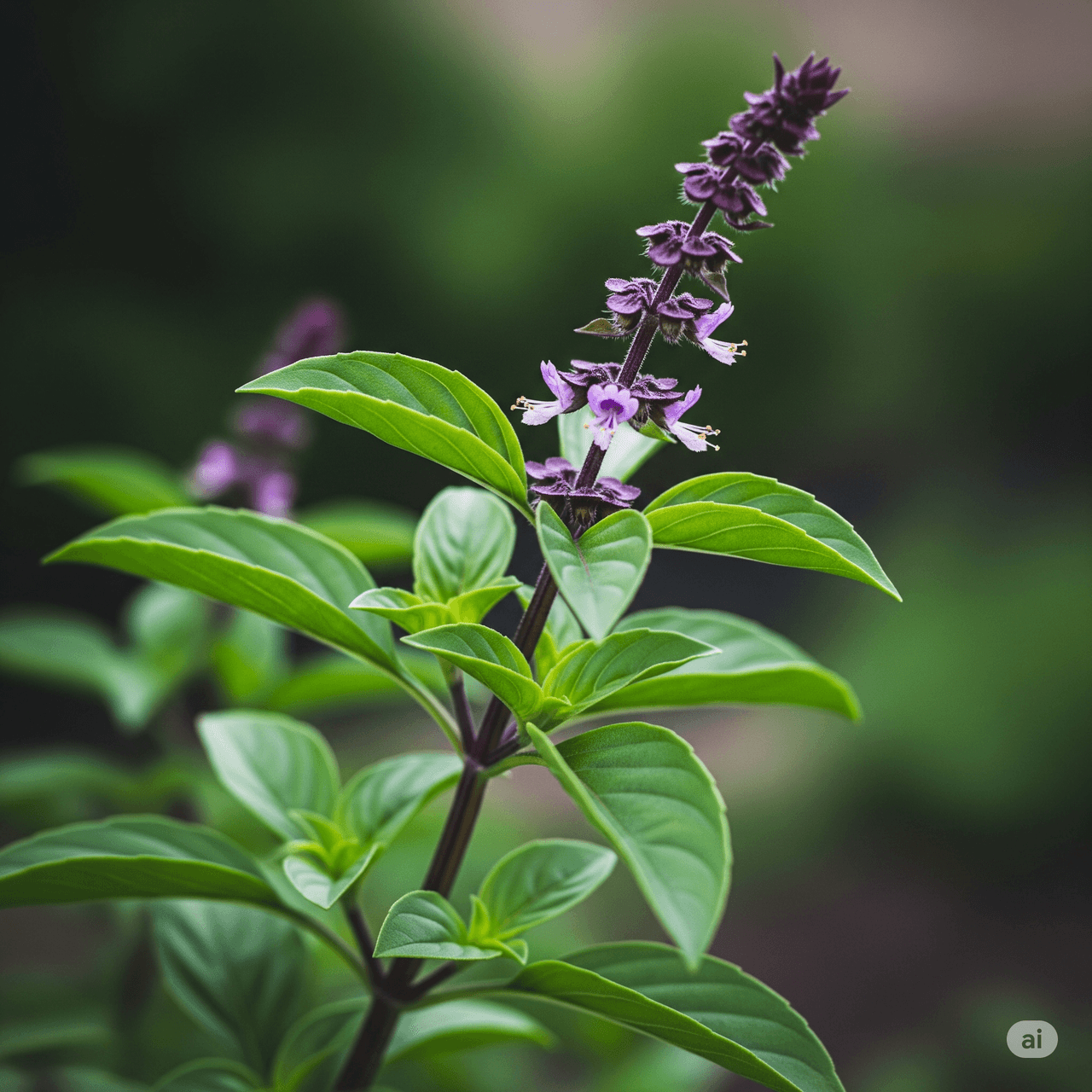
Common Name | Basil | ||||||||
|---|---|---|---|---|---|---|---|---|---|
Scientific Name(s) | Ocimum basilicum | ||||||||
Family | Lamiaceae | ||||||||
Natural Distribution | Tropical and subtropical regions | ||||||||
Height(s) | 30–60 cm | ||||||||
Leaf Characteristics | Oval, opposite arrangement, smooth or slightly toothed edges | ||||||||
Habitat | Sunny well-drained soils | ||||||||
Traditional Use | Digestive issues, Headache, Cough, Skin diseases | ||||||||
Basil (Ocimum basilicum) is a plant known for its aromatic and medicinal properties and belongs to the Lamiaceae (mint) family. Naturally growing in tropical and subtropical regions, this plant is widely used in kitchens around the world and also holds an important place in traditional medicine. Due to the volatile oils and other phytochemical compounds present in its leaves, it exhibits various pharmacological effects.
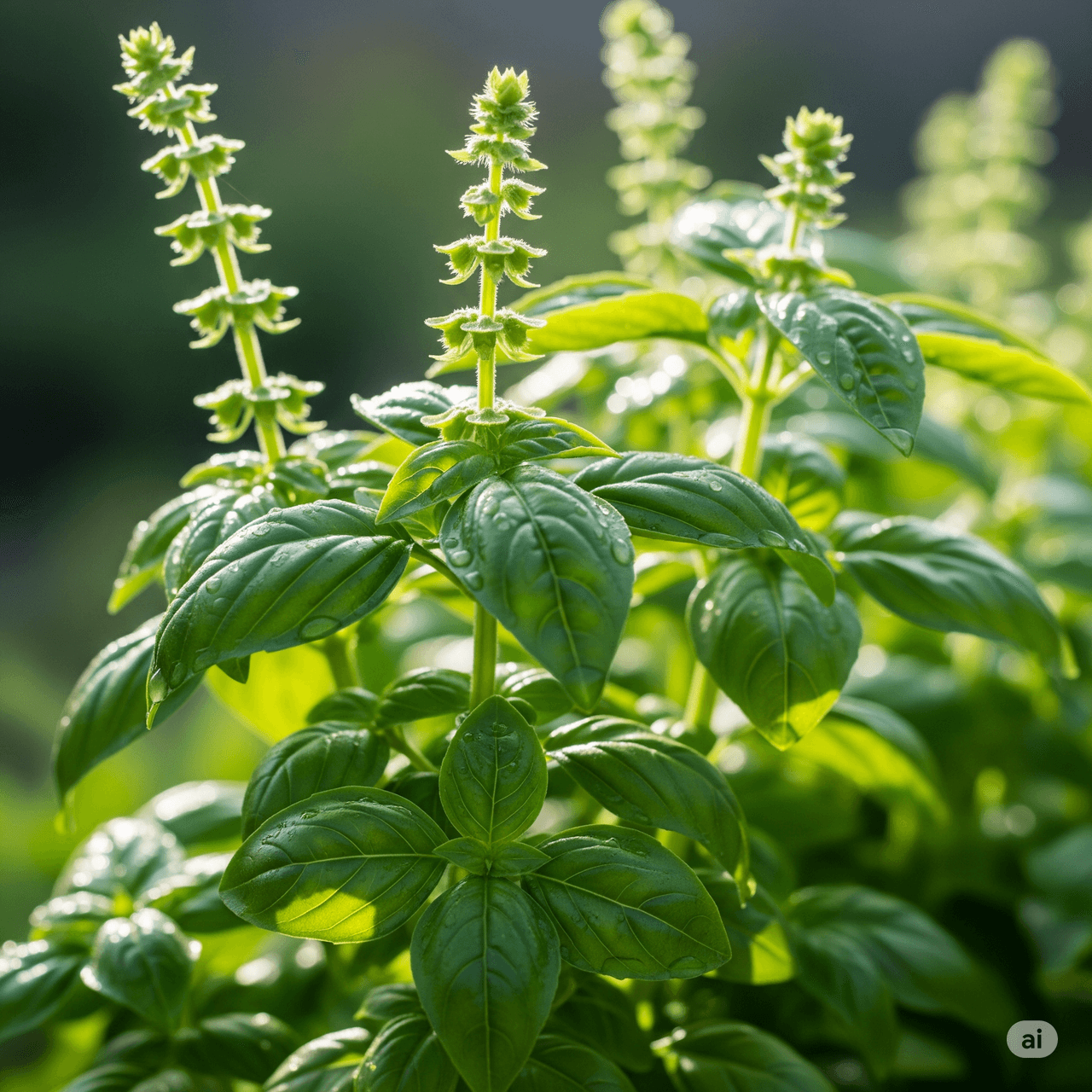
Basil (Generated by Artificial Intelligence)
Basil is typically an annual plant reaching a height of 30–60 cm. Its leaves are arranged oppositely and are oval in shape with smooth or slightly toothed margins. The flowers are small and white or purplish in color, arranged in spikes. The stem is quadrangular and usually green. Different varieties of basil exhibit variation in leaf color, aroma profile and growth habits.
Basil prefers warm and sunny environments. Well-drained soils rich in organic matter are ideal. Propagation from seed is common and usually carried out in spring. It shows rapid growth when provided with adequate water and nutrients. It can also be cultivated in greenhouses or indoor settings.
Basil contains various volatile oils and phytochemical compounds. Major components include linalool, eugenol, methyl chavicol and 1,8-cineole. Other bioactive compounds such as flavonoids, tannins and saponins are also present. These constituents form the basis of basil’s pharmacological effects.
Basil is a plant with multiple pharmacological properties. Its antibacterial, antifungal, antioxidant and anti-inflammatory effects are supported by scientific studies. Additionally, hepatoprotective, immunomodulatory and antidiabetic effects have been reported. These effects are associated with the volatile oils and other phytochemical compounds contained in basil.
In traditional medicine, basil has been used to treat various ailments. It is commonly employed for digestive disorders, headaches, coughs and skin conditions. In some cultures, it has also been used to promote mental balance and to dispel negative energies.
Aminian, A. R., Mohebbati, R., and Boskabady, M. H. (2022a). The Effect of Ocimum basilicum L. and Its Main Ingredients on Respiratory Disorders: An Experimental, Preclinical, and Clinical Review. *Frontiers in Pharmacology*, *12*. https://doi.org/10.3389/fphar.2021.805391
Dhama, K., Sharun, K., Gugjoo, M. B., Tiwari, R., Alagawany, M., Yatoo, M. I., Thakur, P., Iqbal, H. M., Chaicumpa, W., Michalak, I., Elnesr, S. S., & Farag, M. R. (2021). A Comprehensive Review on Chemical Profile and Pharmacological Activities of Ocimum basilicum. *Food Reviews International*, *39*(1), 119–147. https://doi.org/10.1080/87559129.2021.1900230

Common Name | Basil | ||||||||
|---|---|---|---|---|---|---|---|---|---|
Scientific Name(s) | Ocimum basilicum | ||||||||
Family | Lamiaceae | ||||||||
Natural Distribution | Tropical and subtropical regions | ||||||||
Height(s) | 30–60 cm | ||||||||
Leaf Characteristics | Oval, opposite arrangement, smooth or slightly toothed edges | ||||||||
Habitat | Sunny well-drained soils | ||||||||
Traditional Use | Digestive issues, Headache, Cough, Skin diseases | ||||||||
No Discussion Added Yet
Start discussion for "Basil (Ocimum basilicum)" article
Botanical Characteristics
Growing Conditions
Chemical Composition
Pharmacological Effects
Traditional Uses