


This article was automatically translated from the original Turkish version.
+2 More
Bayburt Ulu Camii is a place of worship dating from the Seljuk period, located in the city center of Bayburt in Türkiye’s Black Sea Region. One of the most significant representatives of Seljuk architectural heritage in the city, it is particularly renowned for its rare surviving examples of brick-and-tile decorative elements. Built in the 13th century, the mosque has undergone various damages and numerous restorations over the centuries. Although much of its original structure was demolished over time, it was reconstructed in 1970 in strict adherence to its original plan and has retained its status as one of the city’s iconic structures within the cultural heritage.
Scholars hold differing views regarding the exact date of construction and the patron of the building. Some archival records indicate that the mosque was commissioned between 1202 and 1225 by Erzurum Melik Muğisiddin Tuğrulşah, while the more widely accepted view holds that it was constructed during the reign of Anatolian Seljuk Sultan II. Gıyaseddin Mesut (1282–1298). The structure is also said to have originally been built as a kervansaray during the Seljuk period and later converted into a mosque. After the region came under Ottoman administration in 1514, it continued to function as a waqf property. The original structure was demolished in 1970; however, the minaret, some muqarnas piers supporting the dome over the mihrap area, and two doorways have preserved their original form.
Bayburt Ulu Camii follows the common Anatolian Seljuk mosque plan type known as the “longitudinal nave plan”. This rectangular structure was built using a rubble masonry system with cut stone materials. Access to the main prayer hall is provided through two wooden doors with stone surrounds and arches on the eastern facade. The minaret, situated in the northeast corner of the building, exhibits the characteristics of the classical Seljuk brick minaret type. Rising on a square stone base, the minaret features an octagonal base section and a cylindrical shaft.
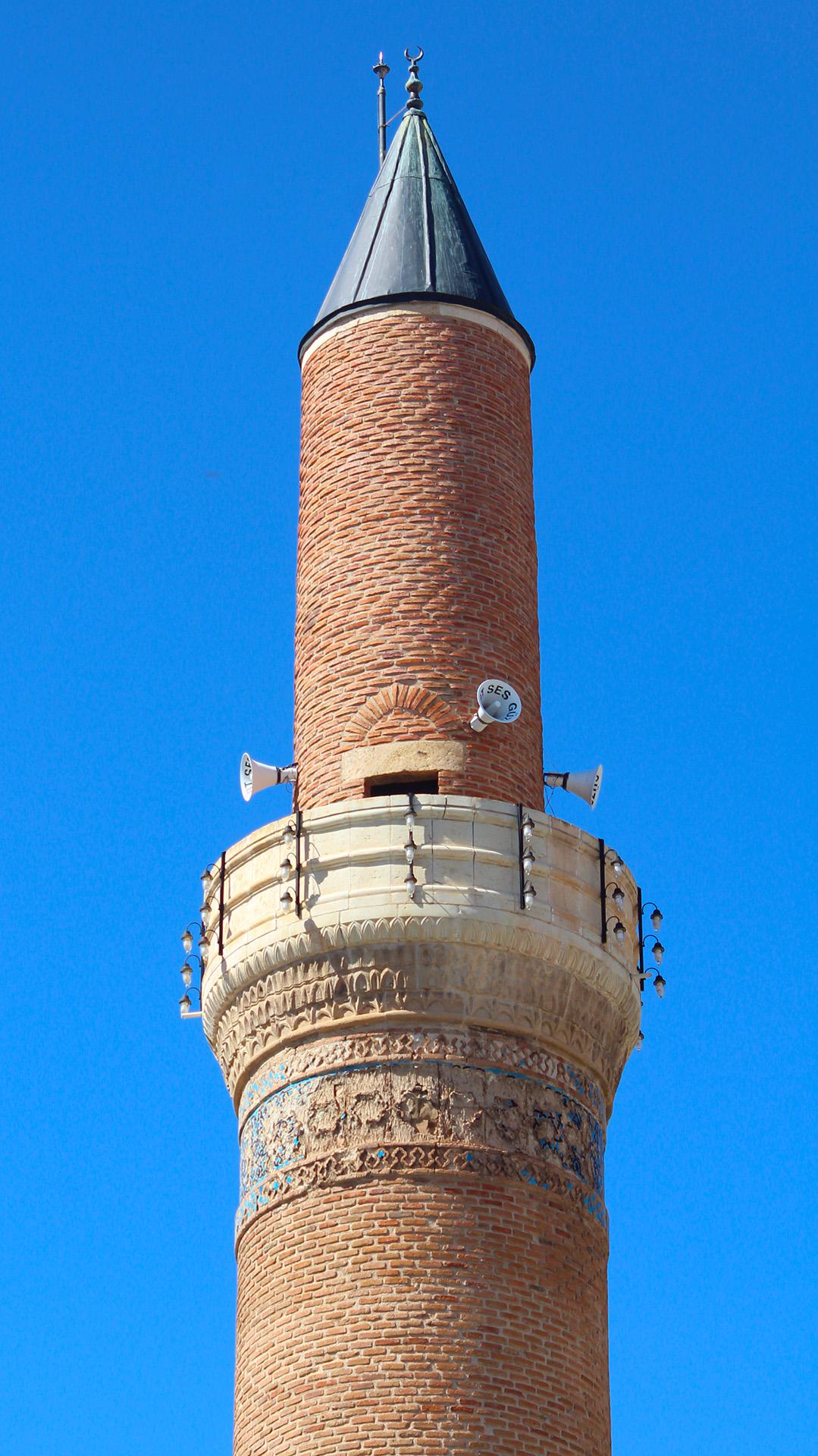
View of the Bayburt Ulu Camii Minaret(Cultural Inventory)
Bayburt Ulu Camii holds significant importance in art history as Bayburt’s only surviving Seljuk-era tiled structure. The tile decorations are concentrated on the blind niches of the octagonal base of the minaret and on the band beneath the balcony. These decorations employ the “brick-and-tile mosaic” technique, in which turquoise and black tile pieces are arranged alongside brick units to form geometric compositions. On the broad band beneath the balcony, vegetal motifs resembling woven and floral Kufic script appear without inscriptions; in the niches of the base section, geometric patterns such as the “chark-i felek” are created by the shifting of bricks and tiles. These decorative elements show strong similarities to the minarets of the Erzurum Çifte Minareli Medrese in terms of materials and technique.
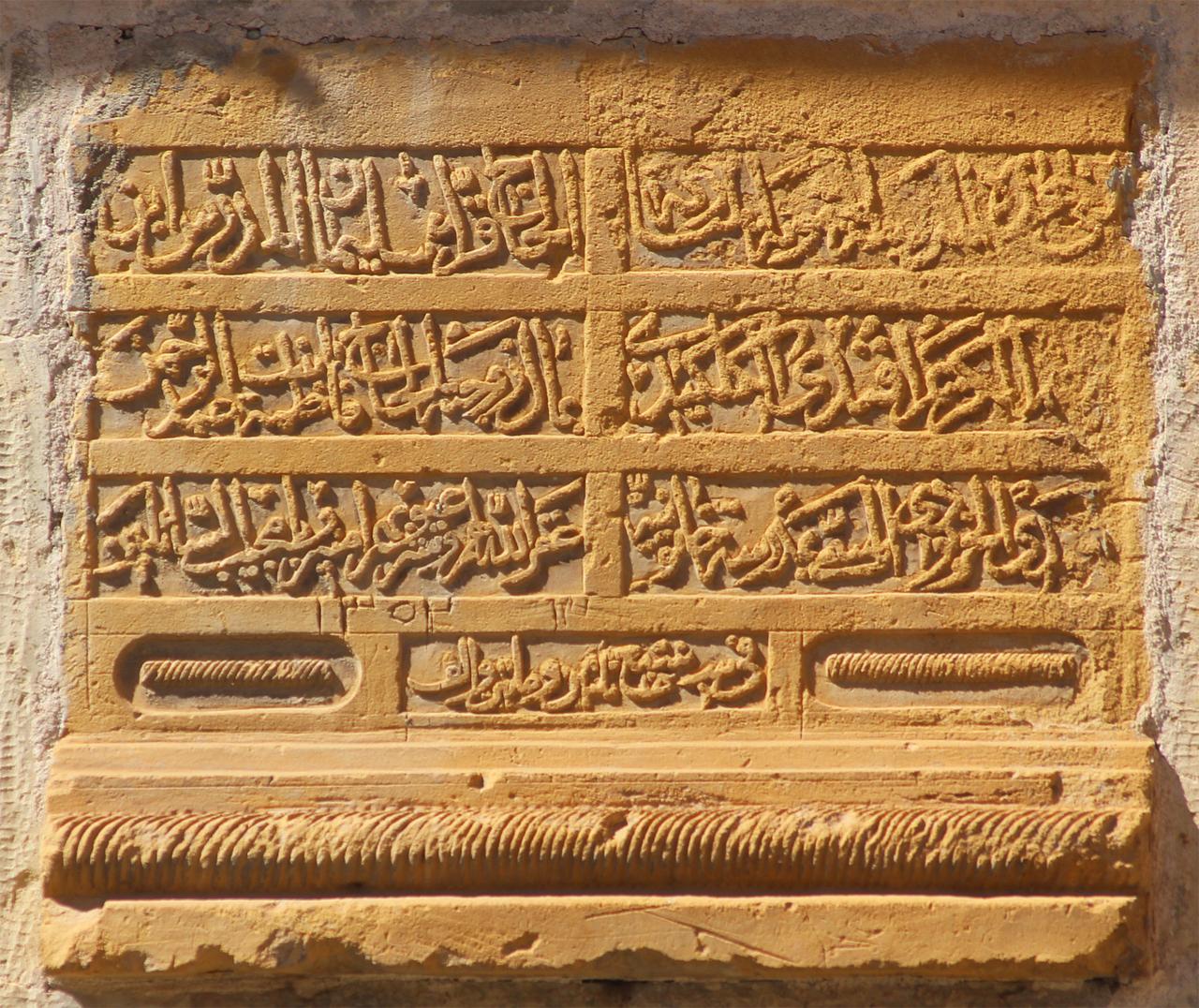
Visual Related to Bayburt Ulu Camii(Cultural Inventory)
Although the original foundation inscription of the mosque is not extant, seven inscriptions from various periods remain on the structure. Among these are an Arabic inscription dated 1222 from a kümbet, a medrese inscription dated 1820, and two Ottoman-era decrees concerning the employment regulations of women. According to 18th-century archival records, the mosque was administered through the waqf system and employed sixteen different personnel positions, including imam, khatib, muezzin, cüzhan, and fetihhan. Appointments were typically carried out through a hereditary system from father to son. In the mosque’s courtyard, there is also a cemetery dating to the Ottoman period, consisting of four sanduka tombs with fez-shaped and palm-leaf decorated gravestones.
The minaret and decorative program of Bayburt Ulu Camii carry the refined artistry of Seljuk architecture like the delicate engravings on the lid of a jeweler’s box, while the main body of the structure serves as a sturdy vessel preserving this precious heritage across centuries.
Bayburt Valiliği. "Bayburt Camileri." Accessed January 6, 2026. https://www.bayburt.gov.tr/bayburt-camileri.
Bayburt Üniversitesi Open Access System, “Bayburt Ulu Camii (Cami-i Kebir)'nin 18. Yüzyılda İnsan Kaynakları Yönetimi,” author: Gazi Özdemir, *Sosyal, Beşeri ve İdari Bilimler Alanında Araştırma Makaleleri-1* (2019): 679-702, Accessed January 6, 2026, https://openaccess.bayburt.edu.tr/items/aeb0f5fb-3523-4b37-a9f3-d64a31fd9a4e.
Culture Inventory, "Bayburt Ulu Cami," October 13, 2025, Accessed January 6, 2026. https://kulturenvanteri.com/yer/bayburt-ulu-camii/.
DergiPark, "Bayburt Ulu Camii Minaresinin Çini Özellikleri," author: Nevin Ayduslu, *Sanat Dergisi*, no. 20 (2011): 117–128, Accessed January 6, 2026. https://dergipark.org.tr/tr/pub/ataunigsfd/article/33567.
Türkiye Kültür Portalı. "Bayburt Ulu Camii - Bayburt." Accessed January 6, 2026. https://www.kulturportali.gov.tr/turkiye/bayburt/gezilecekyer/bayburt-ulu-camii.

No Discussion Added Yet
Start discussion for "Bayburt Grand Mosque" article
History and Construction
Architectural Features
Minaret and Tile Decorations
Inscriptions and Administrative Structure
