


This article was automatically translated from the original Turkish version.
Bearing is a machine element that supports rotational or linear motion by reducing friction between two surfaces. It is commonly used in systems involving rotational motion and enables the transmission of both radial and axial loads. Bearings play a critical role in mechanical engineering applications in terms of energy efficiency, durability, and precision. Their fundamental components include an inner ring, outer ring, rolling elements (balls or rollers), and a cage.
Bearings contribute to the efficient and long-term operation of moving parts in mechanical systems. Therefore, selecting the correct bearing during the design process is essential for system performance. Bearings are classified into different types based on their ability to carry radial or axial loads in addition to rotational motion.
The history of the bearing extends back to Ancient Egypt, where people used round objects to transport heavy loads. It is known that logs were employed to move large stone blocks during this period. These methods are regarded as precursors to modern bearing technology.
The concept of the bearing was first illustrated in mechanical drawings by Leonardo da Vinci. His 15th-century sketches depicted systems resembling ball bearings. However, the industrial production of modern bearings occurred at the end of the 19th century, alongside advancements in metalworking technologies. During this period, the growth of the iron and steel industry and the widespread adoption of mass production made bearing manufacturing possible. By the early 20th century, bearing production accelerated in industrialized nations, and bearing technologies diversified and evolved with the expansion of the automotive, aerospace, and machinery sectors.
Bearings fundamentally consist of four main components: inner ring, outer ring, rolling elements, and cage. The inner ring typically supports the rotating shaft, while the outer ring is mounted to the stationary part of the system. The rolling elements rotate between these two rings to reduce friction. The cage ensures that the rolling elements remain properly spaced and do not come into contact with each other. The primary function of bearings is to minimize energy loss and heat generation by replacing sliding friction with rolling friction. When rolling friction replaces sliding friction, system efficiency increases and a longer service life is achieved.
Bearings are generally classified according to the type of load they can carry, operating conditions, and geometric structure. Based on these classifications, various bearing types have been developed. The most common bearing types are as follows:
Ball bearings are known for their low coefficient of friction and high rotational speeds. These bearings can support both radial and axial loads and are preferred in compact, high-speed applications. Subtypes include deep groove ball bearings, angular contact ball bearings, and self-aligning ball bearings.
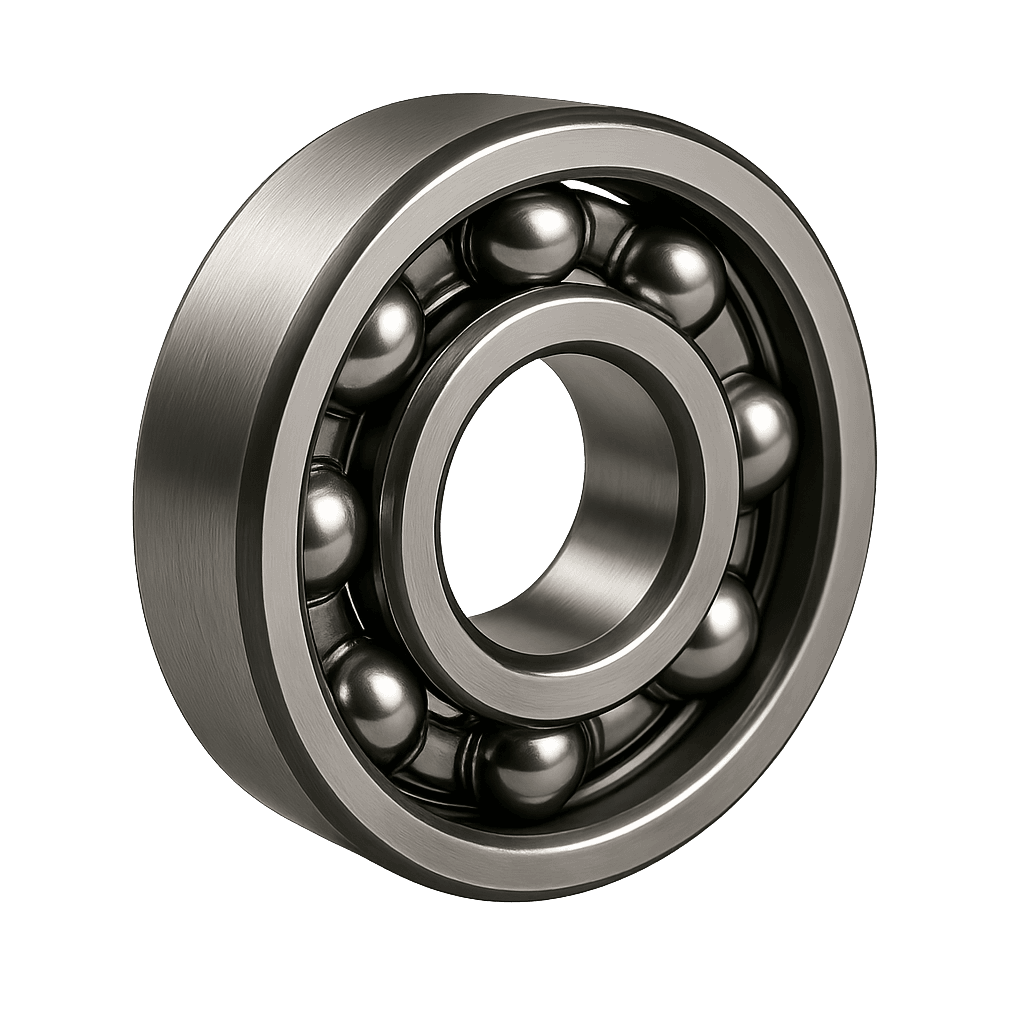
Ball Bearing (Generated by Artificial Intelligence)
Roller bearings use cylindrical, tapered, spherical, or needle-shaped rollers as rolling elements. These bearings are notable for their high load-carrying capacity. Cylindrical roller bearings are suitable only for radial loads. Tapered roller bearings can carry both radial and axial loads. Spherical roller bearings can accommodate small misalignments between the inner and outer rings.
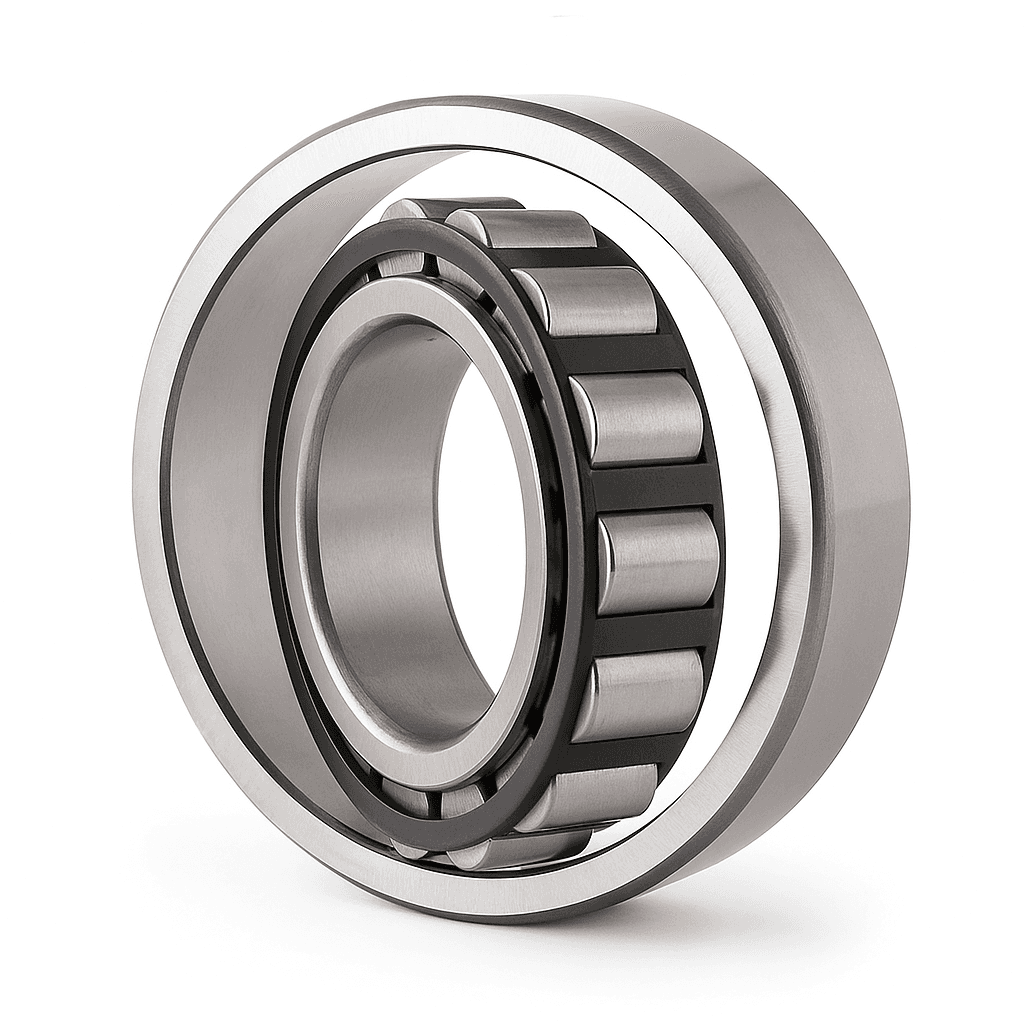
Roller Bearing (Generated by Artificial Intelligence)
These bearings are specifically designed to carry axial loads. They are typically preferred for low-speed applications. Thrust bearings can be manufactured in both ball and roller types.

Thrust Bearing (Generated by Artificial Intelligence)
They use very thin and long cylindrical rollers. This allows high load capacity in confined spaces. Their compact design makes them suitable for applications with limited space, such as automotive components and small electric motors.

Needle Bearing (Generated by Artificial Intelligence)
The material used in bearing manufacturing directly affects bearing performance. Commonly selected bearing materials include:
Proper lubrication is essential for the efficient operation of bearings. Lubrication serves to reduce friction, prevent wear, control bearing temperature, and inhibit corrosion.
Lubrication methods are divided into two main categories:
A large proportion of bearing failures are caused by external factors. Most of these failures can be prevented through proper maintenance and installation practices.
Common failure causes:
Bearing damage may manifest as surface cracks, deformation of rolling paths, pitting (surface spalling), color changes, and increased noise. Early detection of such failures prevents further damage to the system. Modern maintenance techniques include vibration analysis, oil analysis, and temperature monitoring.
Bearings are used in every type of machine or device with rotating components. They have a wide range of applications:
The type, size, material, and lubrication method of the bearing vary depending on the application.
Bearing technology is undergoing transformation, particularly through advances in digitalization and sensor technologies. Modern systems now incorporate "smart bearings" equipped with sensors that measure parameters such as temperature, vibration, speed, and load in real time. This enables predictive maintenance and preemptive intervention before failure occurs. Bearings resistant to high temperatures, moisture, chemicals, and magnetic fields are also being developed. Additionally, lubrication-free (dry-running) bearings are being engineered to reduce maintenance needs and minimize environmental impact. Thanks to advances in materials science, high-performance products such as ceramic bearings are becoming more widespread. These developments extend bearing life and improve the energy efficiency of machines.
American Bearing Manufacturers Association. “American Bearings.” Accessed July 19, 2025. https://americanbearings.org/.
Bearing World. “BearingWorld | The World's Largest Bearing Community.” Accessed July 19, 2025. https://bearingworld.org/.
Koyo JTEKT. "Bearing Trivia 1st Series: Bearing Trivia 1." Accessed July 19, 2025. https://koyo.jtekt.co.jp/en/bearing-column/bearing_trivia_1st_series/bearing_trivia_1st_series_01.html.
Makina Mühendisleri Odası (MMO). "Rulmanlar ve Uygulamaları." PDF file. Accessed July 19, 2025. https://www.mmo.org.tr/sites/default/files/4a528955b84f584_ek.pdf.
Şahin, E. “Rulmanların Sınıflandırılması ve Uygulama Alanları.” *Mühendis ve Makina*, no. 56343, 2025. Accessed July 19, 2025. https://dergipark.org.tr/tr/pub/muhendismakina/issue/56343/749835.

History
Structure and Working Principle
Types of Bearings
Ball Bearings
Roller Bearings
Thrust Bearings
Needle Bearings
Material Properties
Lubrication and Cooling
Bearing Failures
Applications
Technological Developments