


This article was automatically translated from the original Turkish version.
Bekir Genç, one of approximately three thousand villagers taken captive from the villages of Erzurum during the retreat of the Russian army in the First World War, is the only Siberian veteran who survived four years of captivity and returned to his village.
During his captivity, he lost all his family members, endured countless trials, and remained steadfast. Upon returning to his village, he found it reduced to ruins. He traveled to neighboring villages to reunite with surviving relatives. For eight years, he carried building materials from nearby villages to his own, reconstructing it brick by brick. When news spread that the village had been rebuilt, the remaining relatives and villagers returned. As in the past, gatherings in the Konak Odası resumed. Bekir Genç did not merely rebuild his village; he continued to embody the spirit of Islamic civilization. By reviving the tradition of the Konak Odası—where history and science were discussed—he restored both the physical and cultural life of the village. He is also the grandfather of Nurullah Genç, poet and writer and Professor Dr. Nurullah Genç, and the main protagonist of the book Yollar Dönüşe Gider, in which his Siberian memories were recorded.
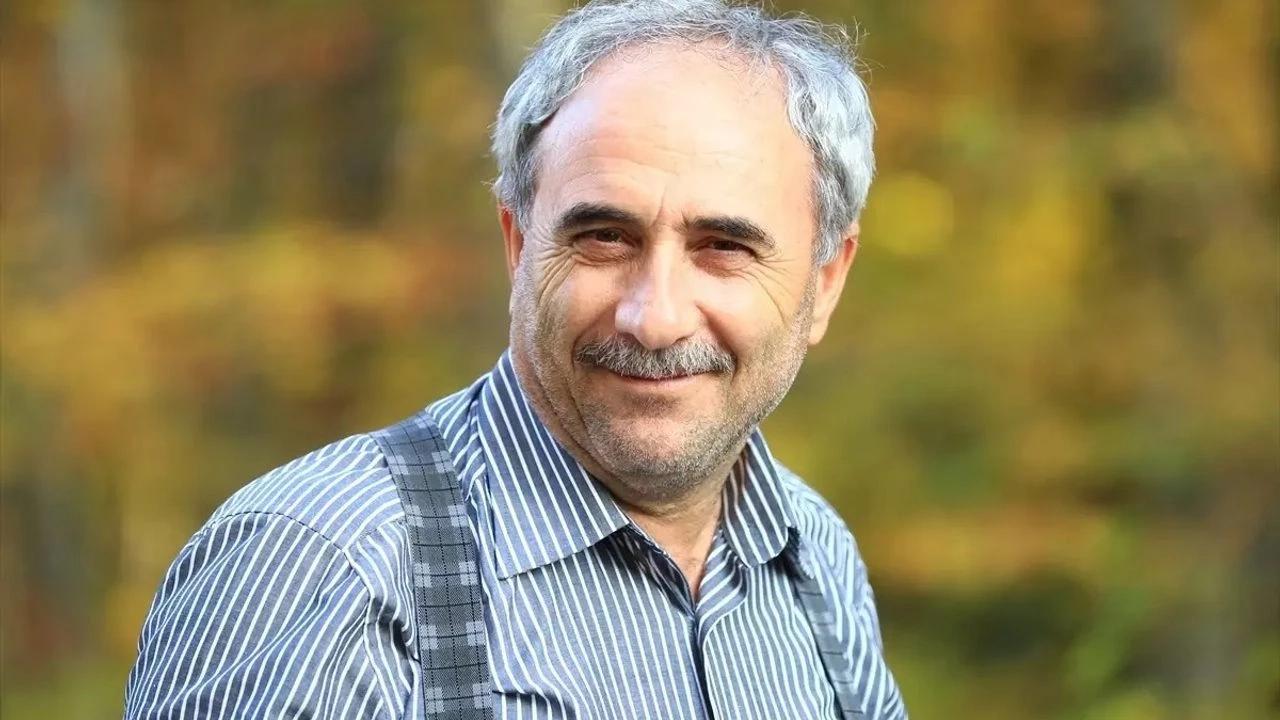
Bekir Genç’s Grandson, the Poet and Writer Prof. Dr. Nurullah Genç.
Bekir Genç was born in 1900 in the village of Pinaduz, part of the Horasan district of Erzurum. His mother was Gülsüm Hanım and his father Ali Bey. His childhood and early youth were spent not in an ordinary village setting, but in the “Konak Odası” of Pinaduz, which served as the cultural center of the region.
These gatherings, which began after the evening prayer and lasted until around ten at night, were known for the brewing of tea and the transformation of the space into an informal educational hub. The Konak Odası functioned as a school where stories, folktales, and epics (Battalgazi epics, battles of Hz. Ali) were recited; historical texts and poetry were read; music was performed; philosophical discussions on historical events took place; and learned conversations flourished.
Growing up in this rich environment, Bekir Genç became a conscious and wise individual with a remarkable memory: he memorized more than half of the Qur’an and two or three collections of poetry, and remained deeply connected to his history and the values of Islamic civilization until his death.
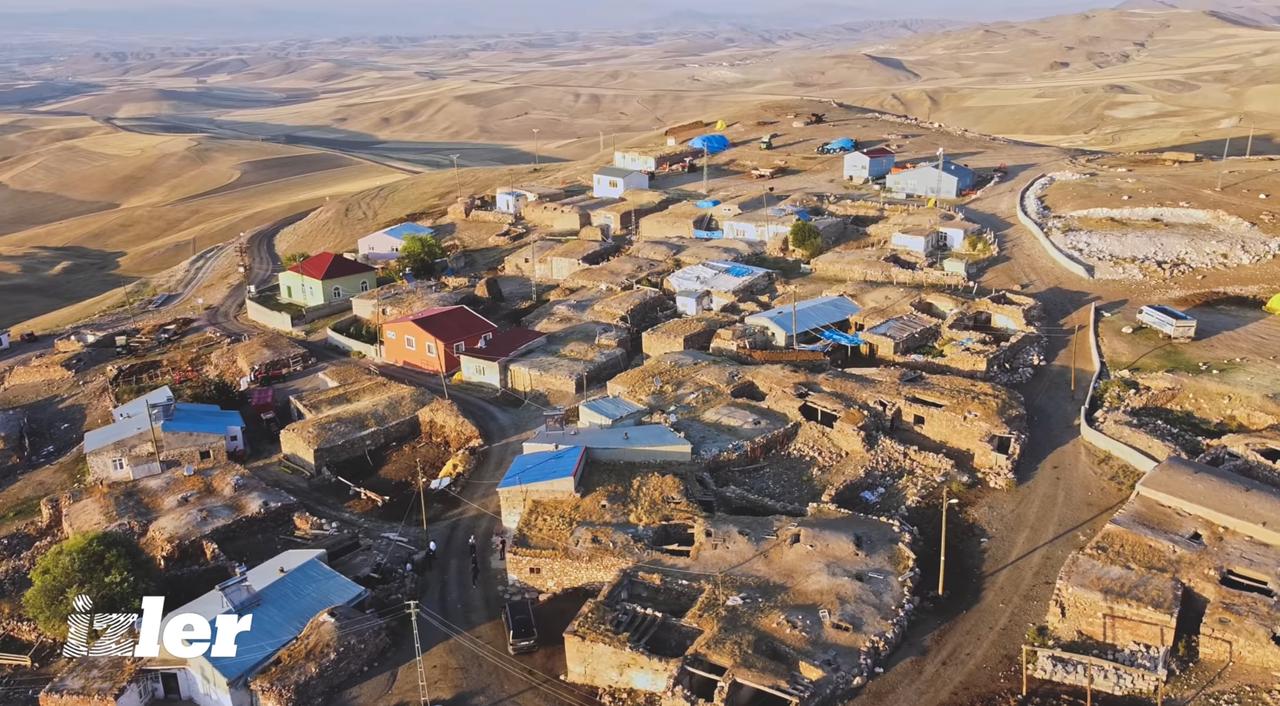
Pinaduz Village.
During the First World War, as the Russians withdrew, nearly three thousand villagers from Erzurum and surrounding regions were captured and taken to Russia. At age eighteen, Bekir Genç was torn from his homeland and, after days of travel, arrived at a prisoner camp near Astrahan on the shores of the Caspian Sea. Of the three thousand, only about two hundred survived the journey, due to a typhus outbreak. Among the dead was his father, Ali Bey.
The two hundred survivors spent one and a half years in the Astrahan camp, eating only a quarter loaf of bread in the morning and another quarter at night, while cutting trees. When the tree-cutting work ended, the remaining two hundred were sold off to different regions. Unfortunately, none of them ever received news of one another again.
While being transported by train under harsh conditions to Astrahan, the bodies of those who died along the way were thrown from the wagons by Russian soldiers. During this tragic journey, Bekir Genç’s father, Ali Bey, also died. Genç tried to prevent his father’s body from being thrown out, and in doing so, was beaten by a Russian soldier.
Upon arriving at the Astrahan camp, Bekir Genç faced a painful encounter: the camp’s night watchman was the very soldier who had thrown his father’s body from the train and beaten him. Through an interpreter, the soldier asked Genç why he had tried to hold onto his father’s body. Genç replied that he was not merely trying to hold on to him, but to lay him gently to rest as one would a loved one, whispering a prayer: “My Lord, we are going to a place unknown. I entrust him to you; cover him with stone and earth, and do not let him become food for wolves or birds.” This deeply moved the soldier, who had himself recently lost his father.
Moved by this emotion, the soldier offered to do Bekir Genç a favor. In the freezing conditions of Siberia, where prisoners received only half a loaf of bread per day and cut trees under brutal conditions, Genç did not ask for food or clothing. Instead, seeking to honor the values of his own civilization and to help others, he made this request: to learn Russian.
He asked the soldier to teach him the language—not merely to survive, but to understand people, regardless of nationality (Turk, Russian, or English), and to extend help to anyone in need. The soldier accepted this noble request. As a result, within approximately one and a half years, Bekir Genç attained fluency in Russian at a native level.
After the harsh camp period, the remaining approximately two hundred prisoners were sold off and their captivity formally ended. From then on, each prisoner lived separately.
Bekir Genç was sold to Ivan Gavrilov, a wealthy local administrator of the Kilyuç Nahiye. Genç cared for Gavrilov’s horses, plowed fields during harvest, and faithfully carried out all assigned duties. Although periodically tested, he consistently proved his honesty and integrity.
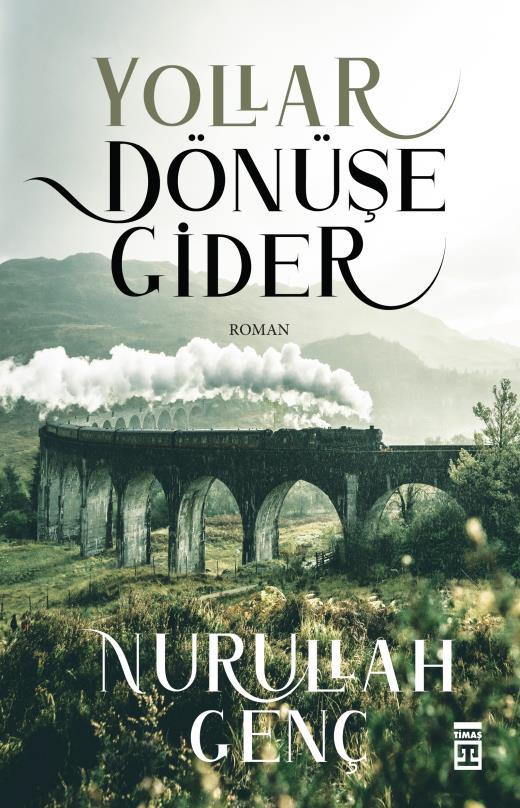
The book Yollar Dönüşe Gider, recounting Bekir Genç’s life. Author: Nurullah Genç.
Having learned Russian in Astrahan, he could now communicate with the household and neighbors, and reached a level of proficiency that allowed him to read the novels of Tolstoy and Dostoevsky in their original language. While faithfully fulfilling his duties for Ivan Gavrilov, Genç requested permission to use his free time to assist the elderly and needy in the nahiye.
Through his actions, he embodied the generosity, moral integrity, and steadfastness of the Turkish people. The people of Kilyuç Nahiye, who had previously held prejudices against Turks, gradually changed their views because of Bekir Genç. He became a well-known and respected figure in the region.
Semion Andreiç, who had lost his son in the 93 War (1877–1878 Ottoman-Russian War) and whose father had been blinded as a result of the conflict, harbored deep hatred toward Turks. Upon learning that a Turkish prisoner had arrived in the nahiye, he plotted to kill him. He first attempted to burn down the stable where Bekir Genç slept at night. After several failed attempts, he continued trying to murder him, but each time his violent actions failed. Upon learning of the man’s intentions, Bekir Genç avoided him.
One day, Bekir Genç heard that Semion Andreiç Uzelkov was drowning in a nearby swamp. Remembering how Hz. Omar had revived the Prophet Muhammad (peace be upon him) when he went to kill him, Bekir Genç recited the same prayer: “My Lord, bring to life the one who came to kill me!” and set out. When he arrived, Semion Andreiç Uzelkov was submerged up to his chin, his arms buried in the swamp, awaiting death. Bekir Genç tied a pole to a rope and threw it toward Andreiç; the pole stopped just before his chin.
Facing death, Semion Andreiç instinctively grabbed the pole with his teeth and was thus rescued by Bekir Genç. When he learned that a Turk had saved him, he was astonished, and his prejudice against Turks vanished completely.
After recovering, he invited Bekir Genç and Ivan Gavrilov to a meal. At the meal, he declared that, like Ivan Gavrilov, he now wished to be responsible for Bekir Genç’s safety and protection. Those who heard this incident began to see Bekir not as a prisoner, but as a revered and extraordinary human being.
After the swamp incident, Bekir Genç’s standing in the nahiye rose further. A tempting offer was made to secure his freedom: taking advantage of the destruction of population records during the Bolshevik Revolution, he was offered the identity of Semion Andreiç Uzelkov’s son, who had died in the war.
He was offered vast lands and herds of livestock, and the chance to live as a free Russian citizen in the nahiye. But Bekir Genç rejected these immense material opportunities with the following historic reply: “A person without a homeland or family is not free. I cannot be free here with these privileges; I cannot speak of liberty until I reunite with my family and my homeland.”
Moved by this unwavering resolve, the local people and authorities honored his wish and began preparing for his journey home.
While waiting for winter to end before returning home, Bekir Genç joined villagers from eight to ten neighboring villages to grind wheat at a high-altitude communal mill. On the return journey, a dispute arose among the villagers, who did not wish to remain at the rear of the caravan of about one hundred sleds due to the danger. Bekir Genç volunteered, saying, “I am already a prisoner,” and took the last sled.
During the journey, he saw a sled ahead plunge into a ravine. While others hesitated to stop in the freezing cold, Bekir Genç halted, risked his own life, and used a Russian shovel to clear snow and rescue the trapped person with great effort.
The rescued man, determined never to forget Bekir Genç’s face, asked for his amulet and departed.
Months later, as Bekir Genç arrived at the train station to return home, he was about to board the relatively empty sixth car when he was recognized by the man he had saved—now wearing a fur hat and traveling in the third car. Although Bekir Genç did not immediately recognize the man because he had not taken the amulet that day, the man, feeling a debt of gratitude, showed his ticket to the attendant and insisted that Bekir Genç join him in the third car.
As the train slowly crossed a massive bridge over a chasm that had been bombed during the Bolshevik Revolution and recently repaired, the bridge suddenly collapsed. The three rear cars—including the sixth car, which Bekir Genç had originally planned to board—plunged into the ravine, killing everyone inside.
From this tragic disaster, in which the bodies were covered with lime and earth for a week, Bekir Genç narrowly escaped thanks to the invitation of the man he had saved. After this event, he adopted as a lifelong philosophy the words: “The hand you extend to help is, in truth, your own hand.”
After four years of captivity, Bekir Genç, the only one among three thousand to return home, arrived in Pinaduz village after long efforts to find it, only to discover it completely destroyed and in ruins. Overcome with grief, he sat for hours at the village’s edge weeping, until he noticed smoke rising from a single chimney and found his only surviving relative, his aunt Asiye.
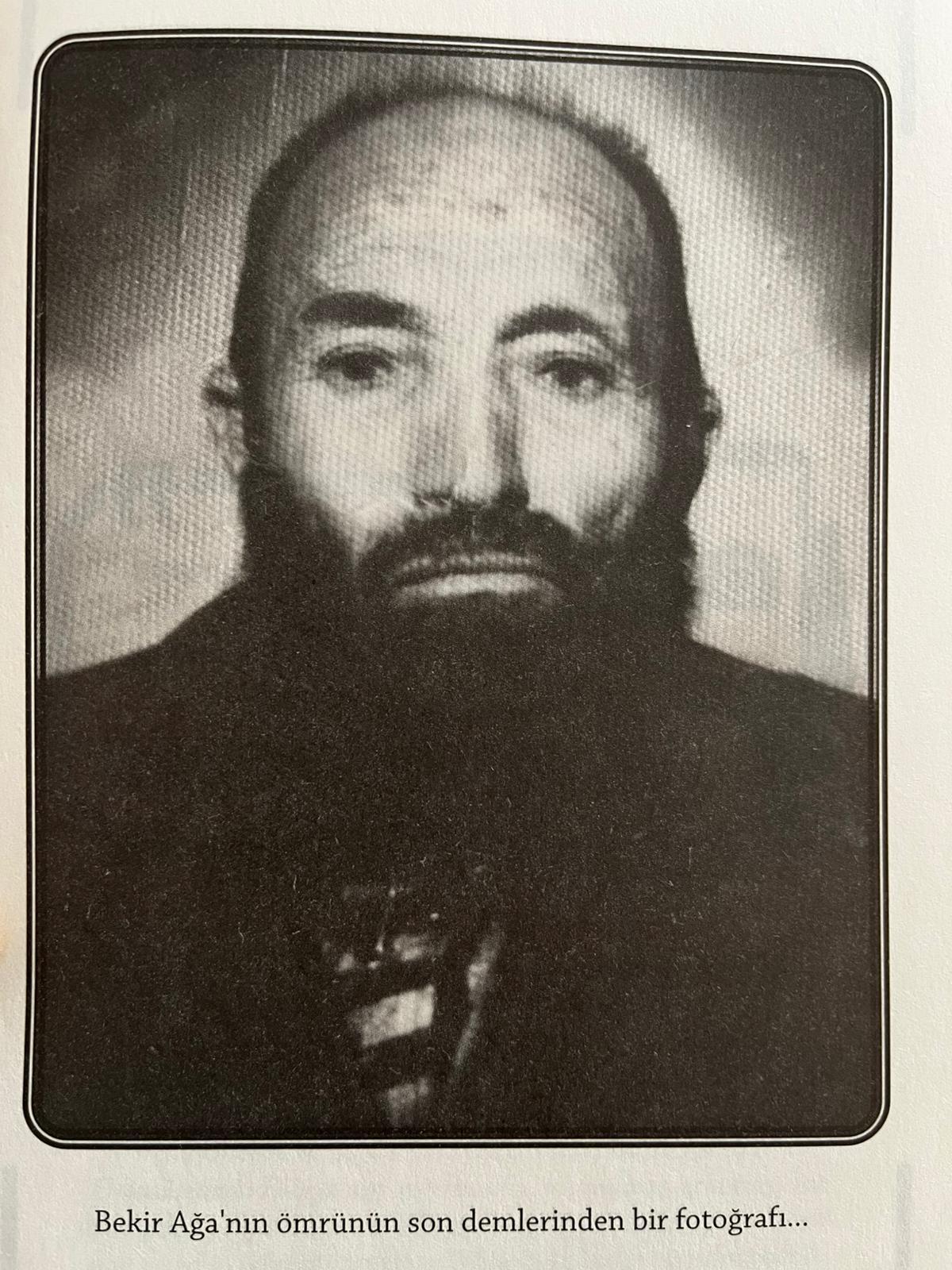
One of the Last Photographs of Bekir Ağa’s Life.
Shortly before arriving at his village, when Bekir Genç first reached Erzurum, his native-level Russian earned him great admiration from the local pasha and other interpreters. He was even offered a high-paying position as an official state interpreter. But after seeing the condition of his village and family, he firmly refused, saying: “My village is in ruins, and I must rebuild it. A state cannot stand if its villages are destroyed; without villages, there are no towns; without towns, there are no cities.”
Impressed by this steadfast and patriotic stance, the local pasha gifted him a single hive of bees to help him restart life in his village. After marrying Gülçehre, the daughter of his aunt in the neighboring village of Harçlı, Bekir Genç walked two hours each day—except during harsh winters—for eight full years, rebuilding his village stone by stone.
In the corner of the first structure he built—the “Guest Room”—he placed a bookshelf with scholarly works such as Siyer-i Nebi and Ahmediye-Muhammediye, thereby reviving the cultural life of the village. He also multiplied the single hive of bees gifted by the pasha into ninety hives over the years. During honey harvests, he divided the honey into four portions: for the poor, neighbors, guests, and finally his own family, teaching generosity through his actions.
Until his death in 1971, Bekir Genç spent 45 years every day standing on his roof, watching the valley. Whenever he saw a weary traveler or struggling animal, he sent his sons with honey, oil, and water to help them. But the true meaning of this long vigil became clear in 1967, when his nephew Şakir, who had disappeared at age four, returned to the village from Denizli.
After days of weeping and reuniting with his nephew, Bekir Genç turned to his sons, who had urged him, “Enough, you have destroyed yourselves…” and spoke the words that would enter history: “You do not know what it means to lose your homeland and family. Do you think I spent 45 years looking over the valley only to help travelers or animals? I looked toward the horizon for an entire lifetime, wondering: Will one more of the three thousand who left with me return?”
When Bekir Genç died in 1971, he left behind not only a village reborn from its ashes, but also a vast spiritual legacy woven from mutual aid, compassion, loyalty, and unwavering love for the homeland. His virtuous conduct—extending a hand even to his enemies during captivity, welcoming travelers in the guest room, and distributing honey with delicate justice—became a school of kindness.
Bekir Genç’s epic life, filled with hardship, heroism, and lessons in humanity, has been immortalized through literary works by his grandson, Professor Dr. Nurullah Genç, most notably the novel Yollar Dönüşe Gider. At the same time, Bekir Genç’s life philosophy and original methods of raising his children and grandchildren continue to serve as guides and sources of inspiration for later generations, studied in academic papers and educational models today.
Note: The accuracy of all information in this article has been verified and approved by Nurullah Genç.
His Upbringing and Childhood
The Early Years of Captivity
Years of Captivity and Learning Russian
Kilyuç Nahiye
Semion Andreiç Uzelkov and the Swamp Incident
Offer of Freedom and Understanding Liberty
The Journey Home: The Sled and Bridge Incident
Return to His Village, Reconstruction and Revival
