


This article was automatically translated from the original Turkish version.
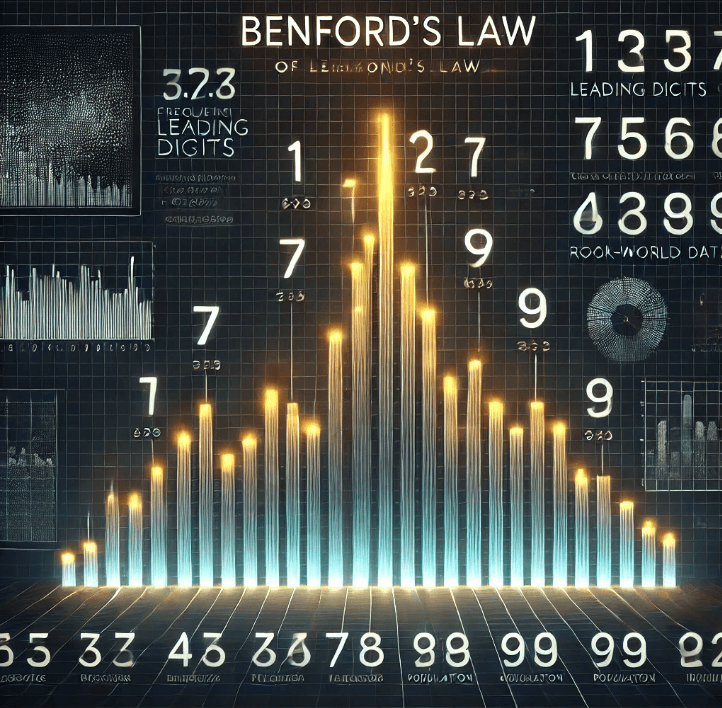
Benford's Law is an observation that in many naturally occurring sets of numerical data data, the distribution of digits follows a specific pattern. In particular, it has been observed that the leading digits of such data conform to a particular probability distribution. First noted by Simon Newcomb in 1881 and later systematically studied by Frank Benford in 1938, this law applies to a wide range of fields, from financial data to statistical records.
Benford's Law determines the probability that a number has a leading digit d using the following formula:

Here, d represents digits from 1 to 9. According to this formula, the probabilities of occurrence for each digit are as follows:

This distribution shows that digits do not occur with equal probability (i.e., not approximately 11.1% each), but rather smaller digits appear more frequently.
Benford's Law is used in a variety of fields:
Several theories explain why Benford's Law holds for many datasets:
Benford's Law does not apply to all datasets. In particular:
Although Benford's Law is a powerful vehicle in large-scale data analysis, it must be interpreted with caution in every case.
Benford, F. (1938). "The Law of Anomalous Numbers." Proceedings of the American Philosophical Society, 78(4), 551-572.
Berger, A., and Hill, T. P. (2015). An Introduction to Benford’s Law. Princeton University Press.
Fewster, R. M. (2009). "A Simple Explanation of Benford’s Law." The American Statistician, 63(1), 26-32.
Hill, T. P. (1995). "A Statistical Derivation of the Significant-Digit Law." Statistical Science, 10(4), 354-363.
Nigrini, M. J. (2012). Benford’s Law: Applications for Forensic Accounting, Auditing, and Fraud Detection. Wiley.

Mathematical Explanation
Applications
Theoretical Explanations
Limits and Criticisms