


This article was automatically translated from the original Turkish version.
+1 More
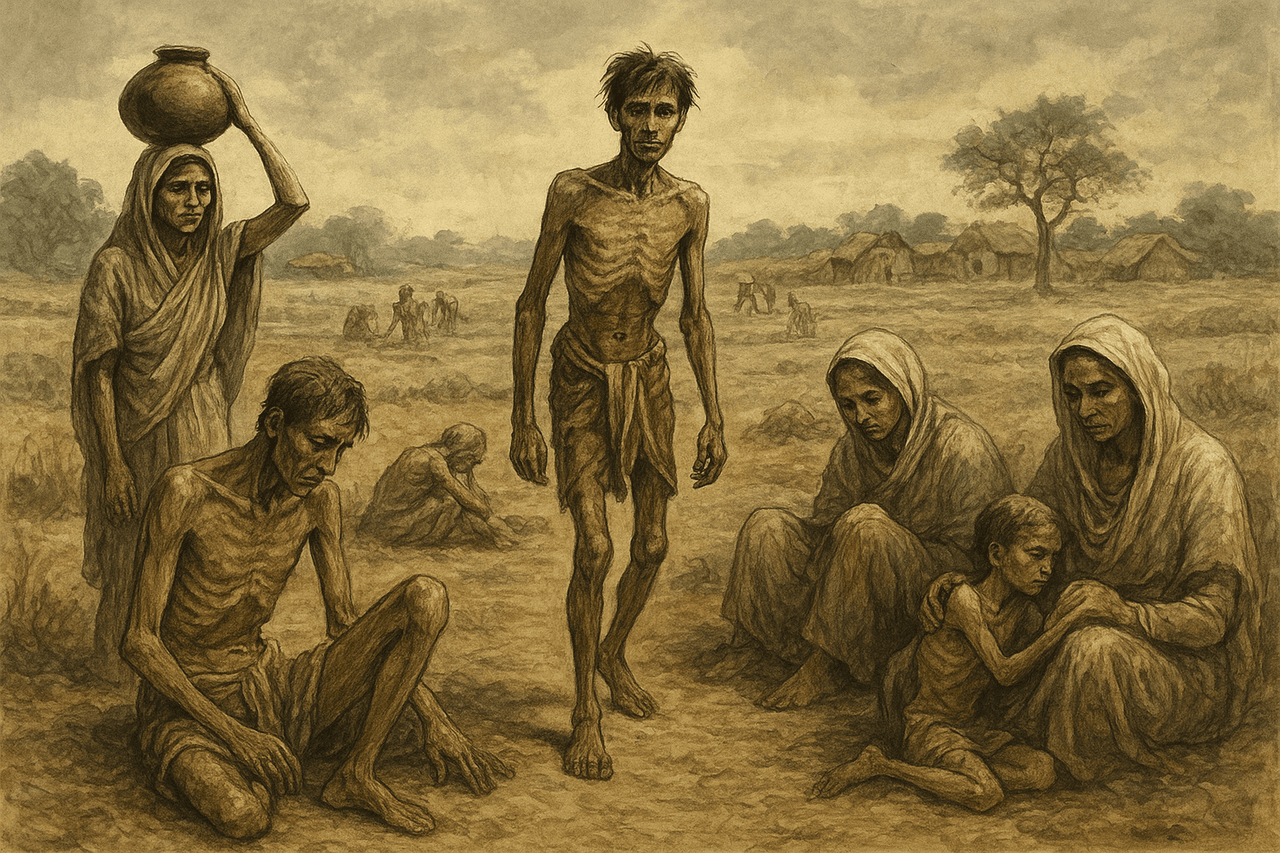
(Generated by Artificial Intelligence)
Bengal Famine (1770)
History | 1769–1773 (Peak year: 1770) | ||||||||
|---|---|---|---|---|---|---|---|---|---|
Region(s) | Bengal Eyaleti under the administration of the British East India Company in India (modern-day India and Bangladesh) | ||||||||
Causes | Severe drought, heavy taxation and grain exports, inadequate relief policies | ||||||||
The Bengal Famine was a widespread famine that occurred in the Bengal region under the administration of the British East India Company (EIC) between 1769 and 1773. The year 1770 is regarded as the peak of the famine. The event is considered one of the most devastating socio-economic disasters in South Asian history. The famine resulted not only from natural conditions but also from the economic and administrative policies implemented by colonial rule.
The most fundamental natural cause of the famine was severe drought and the failure of the monsoon rains beginning in 1769. Bengal’s agricultural system, which was based on rice cultivation, depended on regular rainfall, and the drought led to a significant decline in rice production. This situation directly exposed a large portion of the rural population to food shortages and starvation. The impact of the drought rapidly worsened living conditions for small peasants and families engaged in subsistence farming.
The second dimension of the 1770 Bengal Famine relates to colonial administrative and economic practices. After the EIC acquired the diwani rights in Bengal in 1765【1】, the company implemented fundamental changes to the tax collection system. Tax rates were kept extremely high, forcing peasants to surrender a large portion of their harvests to the state. This prevented peasants from retaining sufficient food for their own survival.
Additionally, the liberalization of food trade and the company’s permission for rice storage and export led to a rapid rise in prices on local markets. The purchasing power of small peasants and artisans declined sharply, and their economic resilience was largely destroyed. The refusal to defer tax debts and the continued pressure for tax collection caused many producers to go bankrupt and abandon their land.
The Bengal Famine affected not only Bengal but also the regions of Bihar and Orissa, causing widespread starvation across a vast geographic area. Estimates suggest that approximately one third of the regional population perished. Causes of death included direct starvation as well as epidemics that spread rapidly due to malnutrition—cholera, smallpox, and plague. Large areas of farmland remained uncultivated, leading to a collapse of the local economy.
The famine caused lasting fractures in the social fabric beyond mere economic devastation. Intense migration movements emerged among peasants and laborers, who were forced to seek refuge in regions outside Bengal. Traditional social support mechanisms in rural communities collapsed, and networks of aid and mutual assistance became dysfunctional. A large segment of the population expressed resentment toward the East India Company and local administrators. This social breakdown laid the groundwork for anti-colonial movements in Bengal in subsequent decades.
Although the East India Company implemented relief and intervention policies during the early stages of the famine, these measures proved inadequate compared to the scale of the crisis. Food aid reached only a limited number of areas, and no tax exemptions or delays in collection were granted. Some studies note that the company’s revenues actually increased during the famine. After the famine ended, the company administration introduced limited reforms to its revenue system; however, these adjustments were insufficient to compensate for the social and economic collapse caused by the famine.
The 1770 Bengal Famine is regarded as one of the first major famines in Indian history caused by colonial economic policies. Agricultural productivity never fully recovered over many years, and the massive population loss created severe labor shortages. The region’s economic strength weakened and its foreign trade balance was disrupted. The EIC’s policies were perceived by the local population as exploitative, leading to increased criticism of British rule. The reconstruction of Bengal’s social structure took decades, and social cohesion and settlement patterns only gradually reformed over the long term.
Felekoğlu, Huriye. “1970’lerden Sonra Kapitalizm’in Hindistan Tarım Sektörüne Etkisi.” *International Journal of Humanities and Education* 10, no. 23 (2024): 293–302. Accessed October 19, 2025. Erişim Adresi.
Günarslan, Hüseyin. “İngiliz Kolonisi Bengal’de Kıtlıklar / Famines in the British Colony of Bengal.” *Asya Araştırmaları Dergisi* 3, no. 2 (2023): 197–215. Accessed October 19, 2025. Erişim Adresi.
Günarslan, Hüseyin. “İngiliz Sömürge Dönemi’nde Hindistan’da Yaşanan Kıtlıklar.” *Avrasya İncelemeleri Dergisi* 9, no. 2 (2020): 203–225. Accessed October 19, 2025. Erişim Adresi.
Kangallı, Sinem Güler, Umut Uyar, and Selçuk Buyrukoğlu. “OECD Ülkelerinde Ekonomik Özgürlük: Bir Kümeleme Analizi.” *Uluslararası Alanya İşletme Fakültesi Dergisi / International Journal of Alanya Faculty of Business* 6, no. 3 (2014): 95–109. Accessed October 19, 2025. Erişim Adresi.
[1]
1765 yılında Mughal (Babür) İmparatoru II. Şah Alem tarafından, Bengal, Bihar ve Orissa bölgelerinde vergi toplama ve mali idareyi yürütme hakkının resmen Doğu Hindistan Şirketi’ne verilmesini tanımlar.

(Generated by Artificial Intelligence)
Bengal Famine (1770)
History | 1769–1773 (Peak year: 1770) | ||||||||
|---|---|---|---|---|---|---|---|---|---|
Region(s) | Bengal Eyaleti under the administration of the British East India Company in India (modern-day India and Bangladesh) | ||||||||
Causes | Severe drought, heavy taxation and grain exports, inadequate relief policies | ||||||||
No Discussion Added Yet
Start discussion for "Bengal Famine (1770)" article
Causes of the Famine
Natural Factors
Administrative and Economic Factors
Scope and Impact
Company Policies and Responses
Long-Term Consequences