

This article was automatically translated from the original Turkish version.
+2 More
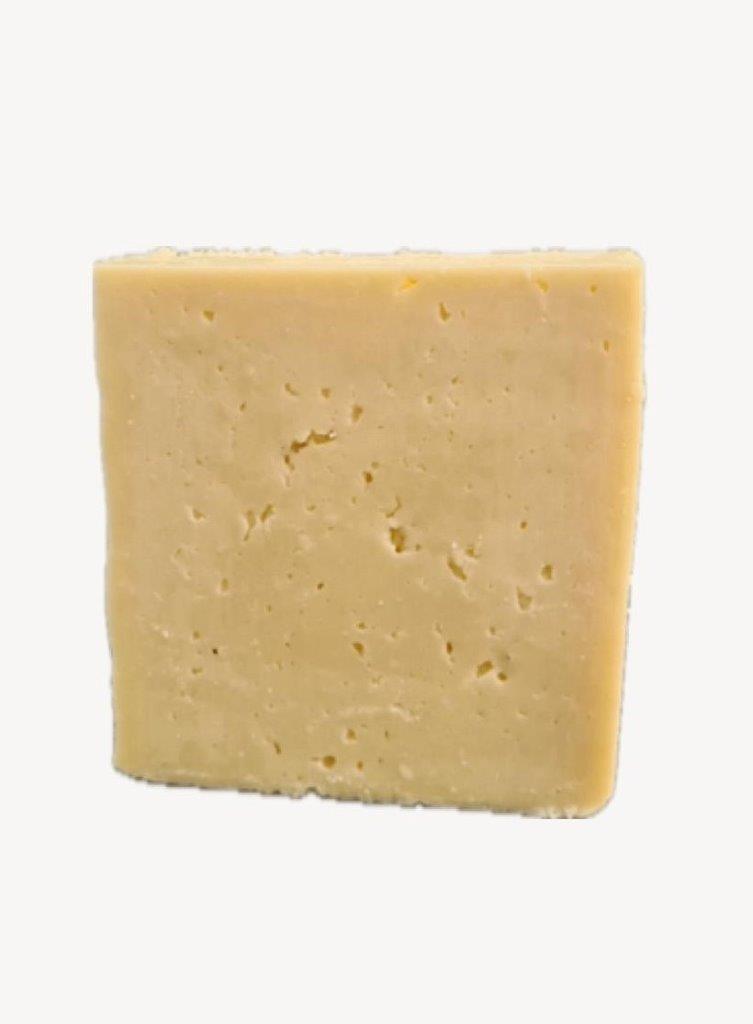
Bergama Tulum Cheese is a full-fat, semi-hard, and porous cheese produced in the Bergama district of İzmir Province, particularly from the milk of cows, sheep, and goats grazing on the Kozak Plateau. Only cow’s milk or specific mixtures of cow, sheep, and goat milk may be used in its production. This cheese has its origins among the Yörüks, who migrated from Central Asia and settled in the Bergama region. Today, it is matured using the brine method in tin containers and derives its distinctive aroma from terpenes and ester compounds found in the local flora.
The origins of Bergama Tulum Cheese trace back to the Yörüks, who migrated from Central Asia to Anatolia and settled around Bergama. Historically, this cheese was matured by pressing it into animal hides, a practice that gave rise to its name “tulum cheese.” Today, it is matured in tin containers using the brine method. The climatic and botanical characteristics of the geographical region indirectly influence the composition of the milk, thereby shaping the unique qualities of the product.
The Kozak Plateau lies at an elevation of 500–1000 meters above sea level, receives heavy rainfall during winter months, and is covered with pistachio pine forests. The plateau hosts 244 plant taxa belonging to 147 genera across 47 plant families. Among these, two endemic plant species are found: Stachys cretica subsp. smyrnaea (izmirdeliçayı, Lamiaceae) and Stipa cacuminis (egekılaçı, Poaceae). The milk of animals grazing on these plants is used in the production of Bergama Tulum Cheese. The animals’ diet on this unique vegetation provides the volatile compounds responsible for the cheese’s distinctive aroma profile.
Two milk compositions are used in the production of this cheese:
Use of Cow’s Milk Only or Mixed Milk in the following proportions:
These milks are obtained exclusively from animals grazing on the Kozak Plateau. The animals’ feed sources contribute to variations in the aroma profile of the final product.
The production process of Bergama Tulum Cheese consists of four main stages:
After milking, the milk is cooled to +4 °C and transported to the facility. After removal of coarse impurities, the milk undergoes thermal treatment at 58–60 °C for 15 minutes. It is then cooled to 35–38 °C. Commercial cheese starter culture (approximately 150–200 ml per ton of milk) is added, and coagulation occurs within 50–60 minutes. The curd is cut with a curd knife to the size of a chickpea. Subsequently, 3–5 liters of hot water (50–60 °C) are added. This step aims to further shrink the curd, facilitate whey separation, and preserve thermophilic microorganisms in the environment.
After cutting, the curd is left to settle in the whey for a period, after which the whey is drained. The remaining mass is wrapped in a cendere cloth and pressed for approximately two hours. The drained cheese is cut into blocks (approximately 11×11×21.5 cm) and cooled with cold water. This stage is critical for controlling acidity; excessive acid development may cause the cheese to crumble easily.
The cheese blocks are portioned and salted with approximately 10% dry salt. They then enter the pre-maturation phase known as “göz açma.” The cheeses are stored in tin containers and turned daily, then re-salted. During this phase, the formation of “bird’s eye”-sized pores within the cheese mass is monitored. The eye formation process lasts 3–5 days at ambient temperature (20–22 °C).
After pre-maturation, brine with a salinity of 14–17 °Baumé is added to the containers, which are then sealed. The brine is prepared by subjecting the whey produced during cheese-making to thermal treatment at 85 °C for 15 minutes. The cheeses stored in the containers are matured for at least four months at a temperature of 4–7 °C.
The composition of Bergama Tulum Cheese varies according to the milk source but falls within defined ranges:
One of the distinguishing characteristics of Bergama Tulum Cheese is its aroma, derived from the local plant flora on which the animals graze. Terpenes and their derivatives (e.g., α/β-pinene, o/p/m-cymene, limonene, p/m-cresol, α-guaiene, α-kubebene, geraniol, (+)-citronellal, β-caryophyllene, pterin, δ-cadinene, α-humulene, β-selinene, farnesene, α-longipinene, isobisabolol, camphene, dihydromyrcene, phytene) contribute significantly to the cheese’s unique aroma.
Some esters present among the volatile compounds enhance the cheese’s aroma profile with a “fruity” character. Acids contribute to distinct taste and aroma notes:
Some of the volatile compounds measured in Bergama Tulum Cheese include:
Bergama Tulum Cheese is packaged with the designation “Bergama Tulum Cheese” and the official geographical indication emblem. When packaging does not allow for their display, these designations and the emblem must be visibly displayed within the production facility.
All stages of production must take place within the administrative boundaries of Bergama district, İzmir Province. Procedures carried out within this geographical boundary—from milk collection to maturation—play a decisive role in linking the product to its geographical indication. Maturation must last at least four months.
The production processes and quality of Bergama Tulum Cheese are monitored by a minimum three-member inspection body composed of representatives from the Bergama District Directorate of Agriculture and Forestry, the Bergama Municipality, and the Bergama Chamber of Commerce, under the coordination of the Bergama Chamber of Commerce. Inspections are conducted at least once annually as routine checks, and may also be carried out at any time upon complaint or need.
The following criteria are used in inspections:
The inspection body may, when necessary, obtain expert support or procure services from public or private institutions. The registering authority conducts legal proceedings to protect the rights associated with the geographical indication.
Turk Patent and Trademark Office. "Bergama Tulum Peyniri Coğrafi İşaret Tescil Belgesi." PDF file. Accessed July 13, 2025. https://ci.turkpatent.gov.tr/Files/GeographicalSigns/2a9767e9-bce2-4065-be97-f502060c2027.pdf.
Turkish Patent and Trademark Office. "Bergama Tulum Peyniri." Accessed July 13, 2025. https://ci.turkpatent.gov.tr/cografi-isaretler/detay/1527.

No Discussion Added Yet
Start discussion for "Bergama Tulum Cheese" article
History and Geographical Connection
Milk Used in Production
Production Process
Fresh Cheese Production:
Resting and Pressing:
Dry Salting and Pre-Maturation (Eye Formation):
Brining and Maturation:
Chemical and Biochemical Properties
Composition
Cheese Made from a Mixture of Sheep, Goat, and Cow Milk
Cheese Made Exclusively from Cow’s Milk
Aroma Compounds
Packaging and Use
Geographical Boundary and Production Conditions
Inspection