

This article was automatically translated from the original Turkish version.
+1 More
The Bermuda Triangle is the name given to a triangular region in the western Atlantic Ocean, bounded by Miami (Florida), the Bermuda Islands, and Puerto Rico. This area has gained notoriety due to claims of numerous ships and aircraft mysteriously disappearing within its boundaries.
Bermuda Triangle theories first gained popularity in the mid-20th century, particularly after the 1945 disappearance of five American military aircraft during a routine training flight. This incident drew widespread public attention, and many subsequent disappearances were linked to the region, receiving extensive media coverage.
Theories about the Bermuda Triangle vary widely. Some are based on scientific explanations such as magnetic field disturbances, methane gas eruptions, sudden weather changes, and strong ocean currents. Others advocate speculative ideas involving aliens, time travel, and supernatural forces. To date, scientific investigations have shown that most of the disappearances in the region can be attributed to natural causes or human error.
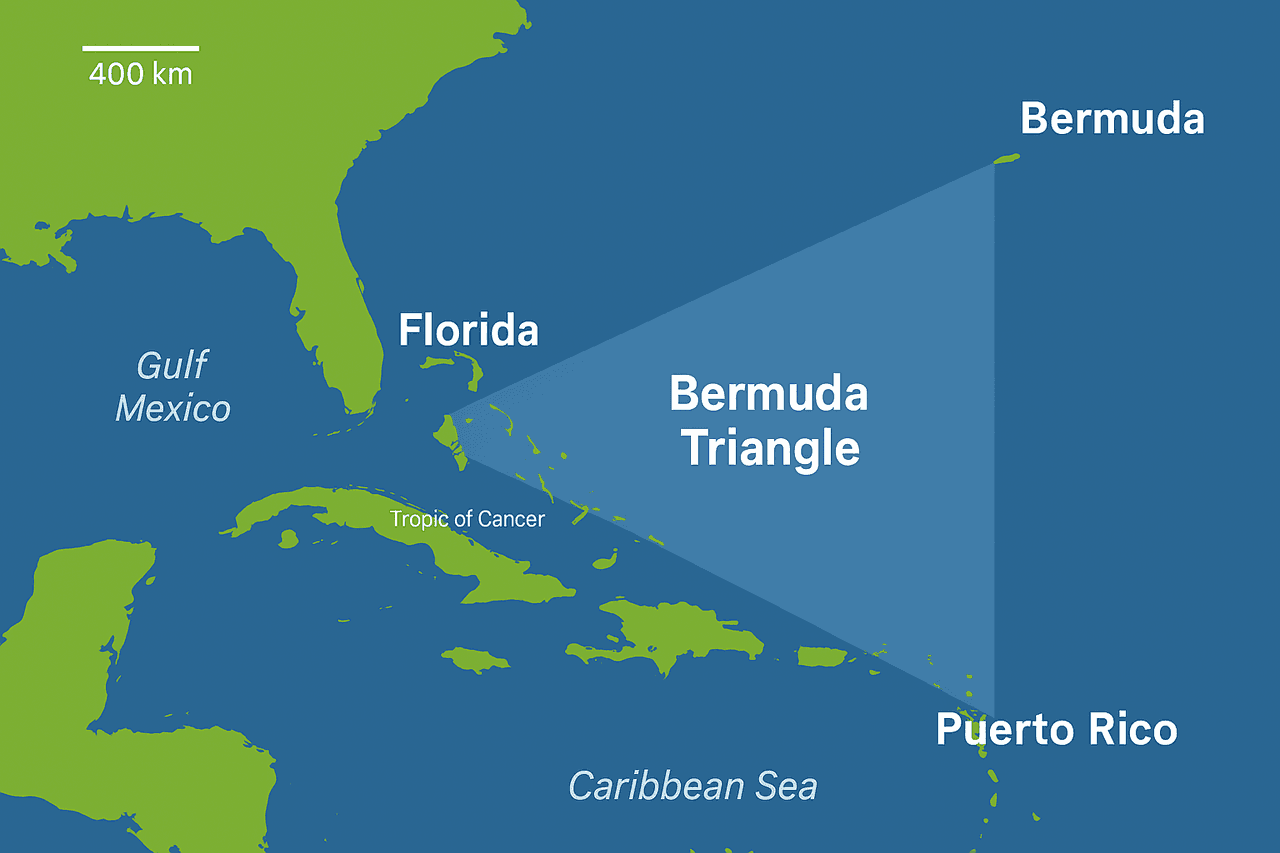
The Area Known as the Bermuda Triangle (Generated by Artificial Intelligence.)
The logbooks kept by Christopher Columbus during his first Atlantic crossing in 1492 are among the earliest written records associated with the historical mystery now known as the Bermuda Triangle. In his journals, Columbus described sudden deviations of the magnetic compass, unexplained lights appearing in the sky, and a fireball descending onto the ocean surface—observations that laid the foundation for later centuries associating this region with supernatural phenomena.
One of these observations is recorded in his entry dated 11 October 1492. He noted that the compass needle deviated from true north. At the time, the concept of magnetic declination was not scientifically understood, so such deviations were interpreted by sailors as having mystical significance (Gaddis 1964). That same night, Columbus reported seeing a strange light stationary over the ocean; its source was never identified. He also recorded in his logs a fireball that reportedly fell onto the sea surface (Robinson 2006).
When evaluated from a modern scientific perspective, these observations have natural explanations. The compass deviation may be linked to magnetic anomalies in the region; the luminous phenomena could be attributed to atmospheric reflections or meteors.
The Bermuda Triangle lies within a tropical climate zone and frequently experiences storms, hurricanes, and sudden weather changes throughout the year. Such weather events pose significant risks to ships and small aircraft. Sudden reductions in visibility and rapid shifts in wind direction and speed can lead to dangerous accidents and disappearances. In some cases, these weather events develop so quickly that they are not recorded in official logs, contributing to the perception of the incidents as “mysterious.”
Some researchers have suggested that the Bermuda Triangle may be one of the rare regions where Earth’s magnetic north coincides with geographic north. This could cause compass deviations, leading pilots or captains to navigate in the wrong direction and potentially resulting in disappearances or crashes. Although this theory has weakened over time, even a minor error in navigation instruments can have fatal consequences in open ocean environments.
The majority of accidents are attributable to human error. Inadequately trained crews, incorrect route planning, radio communication failures, and miscalculations of fuel consumption can all lead to the loss of aircraft or vessels. It is well known that even minor oversights in military flights or civilian maritime transport can have serious consequences. In many cases, the final communications from missing vessels mentioned difficulties with navigation or equipment malfunctions.
Methane gas hydrates accumulated on the seafloor can suddenly rise to the surface under specific geological conditions. This gas reduces water density, making it harder for ships to stay afloat and potentially causing them to sink rapidly. Additionally, bubbles from such gas eruptions can disrupt radio signals and sever communications. Although this theory cannot account for all incidents, it remains one of the scientifically grounded explanations.
The Bermuda Triangle region contains some of the deepest ocean trenches and strongest ocean currents in the world. The wreckage of a sunken ship or downed aircraft can be swiftly carried away by these currents or pulled into the depths. This makes it difficult to locate debris, contributing to the perception of the region as “mysterious.” Furthermore, these extreme depths make search and recovery operations technically challenging and prohibitively expensive.

Visual Showing Ocean Current Speeds in the Bermuda Triangle (Lamont)
Some theories regarding the Bermuda Triangle are entirely unscientific and speculative. Explanations such as alien abductions, time travel, portals to parallel universes, or the influence of lost civilizations like Atlantis fall into this category. These theories appear mostly in literary works, documentaries, and films. While they reinforce the region’s mystique among the public, they lack scientific evidence and are not accepted by academic circles.
Over the past approximately 500 years, at least 50 ships and 20 aircraft have disappeared within the area defined as the Bermuda Triangle. In most of these cases, no wreckage or traces of the crew have ever been found. A significant number of incidents occurred under favorable weather conditions with no distress calls made (Robinson 2006).
One of the most famous cases associated with the region is the 1872 discovery of the 103-meter sailing ship Mary Celeste, found abandoned. However, the ship was not located within the Bermuda Triangle but off the coast of Portugal. Nevertheless, it remains part of the legend (Gaddis 1964).
One of the most extensively investigated incidents linked to the region is the “Flight 19” event of 5 December 1945. Five TBM Avenger torpedo bomber aircraft departed from Florida on a two-hour training flight. Their last radio communication occurred at 16:00; neither the aircraft nor their 27 crew members were ever found. The U.S. Navy report stated that the planes had vanished “as if they had flown to Mars.”
Due to its mysterious disappearances in maritime and aviation history, the Bermuda Triangle has acquired a significant place in modern mythology. The unexplained events in the region have given rise to numerous rumors and legends, and have become widely represented in popular culture. As a result, the Bermuda Triangle has transcended its status as a mere geographical area to become a symbolic and cultural phenomenon (Gaddis 1964).
The Bermuda Triangle has been the subject of countless works across literature, cinema, television programs, and documentaries. Especially from the mid-20th century onward, non-scientific explanations involving supernatural forces, alien abductions, and paranormal activity gained popularity. This has reinforced the region’s image as mysterious and dangerous (Robinson 2006).
The Bermuda Triangle has also influenced tourism. Its mysterious reputation has attracted some tourists, contributing modestly to the local economy. At the same time, the disappearances have heightened safety concerns in maritime and aviation industries, prompting a more cautious approach to operations in the region (Gaddis 1964).
Another dimension of its cultural impact lies in its persistent presence in media and popular science discourse. These debates have required a balance between scientific research and speculative claims. While scientists have sought to explain events in the region through meteorological, geological, and physical factors, popular narratives have emphasized mystery and fantastical elements (Robinson 2006).
Accessed November 26, 2025.
Economic Times. "The Bermuda Triangle Mystery: What Causes Ships and Planes to Vanish in the Devil’s Triangle?" Accessed May 28, 2025.
History.com. "Aircraft Squadron Lost in the Bermuda Triangle." Accessed May 28, 2025.
History.com. "The Mysterious Disappearance of Flight 19." Accessed May 28, 2025.
India Today. "Bermuda Triangle Mystery: Flight 19 Disappearance Still Puzzling Investigators." Accessed May 28, 2025.
Lamont-Doherty Earth Observatory, Columbia University. “How Will Climate Change Impact Gulf Stream?” Lamont-Doherty Earth Observatory. Accessed May 28, 2025. https://lamont.columbia.edu/news/how-will-climate-change-impact-gulf-stream.
Naval History and Heritage Command. "Exorcizing the Devil’s Triangle." Accessed May 28, 2025.
Naval History and Heritage Command. "Flight 19." Accessed May 28, 2025.
The New York Times. "FDR’s Feature on Bermuda." Accessed May 28, 2025.

Christopher Columbus’s Observations in the Bermuda Region: Historical Foundations of the Legend
Possible Causes of Disappearances in the Bermuda Triangle
Weather Conditions
Magnetic Field Anomalies
Human Error
Methane Gas Eruptions
Currents and Deep Ocean Trenches
Speculative Theories
Disappearances and Notable Incidents in the Bermuda Triangle
Cultural Impact of the Bermuda Triangle