


This article was automatically translated from the original Turkish version.
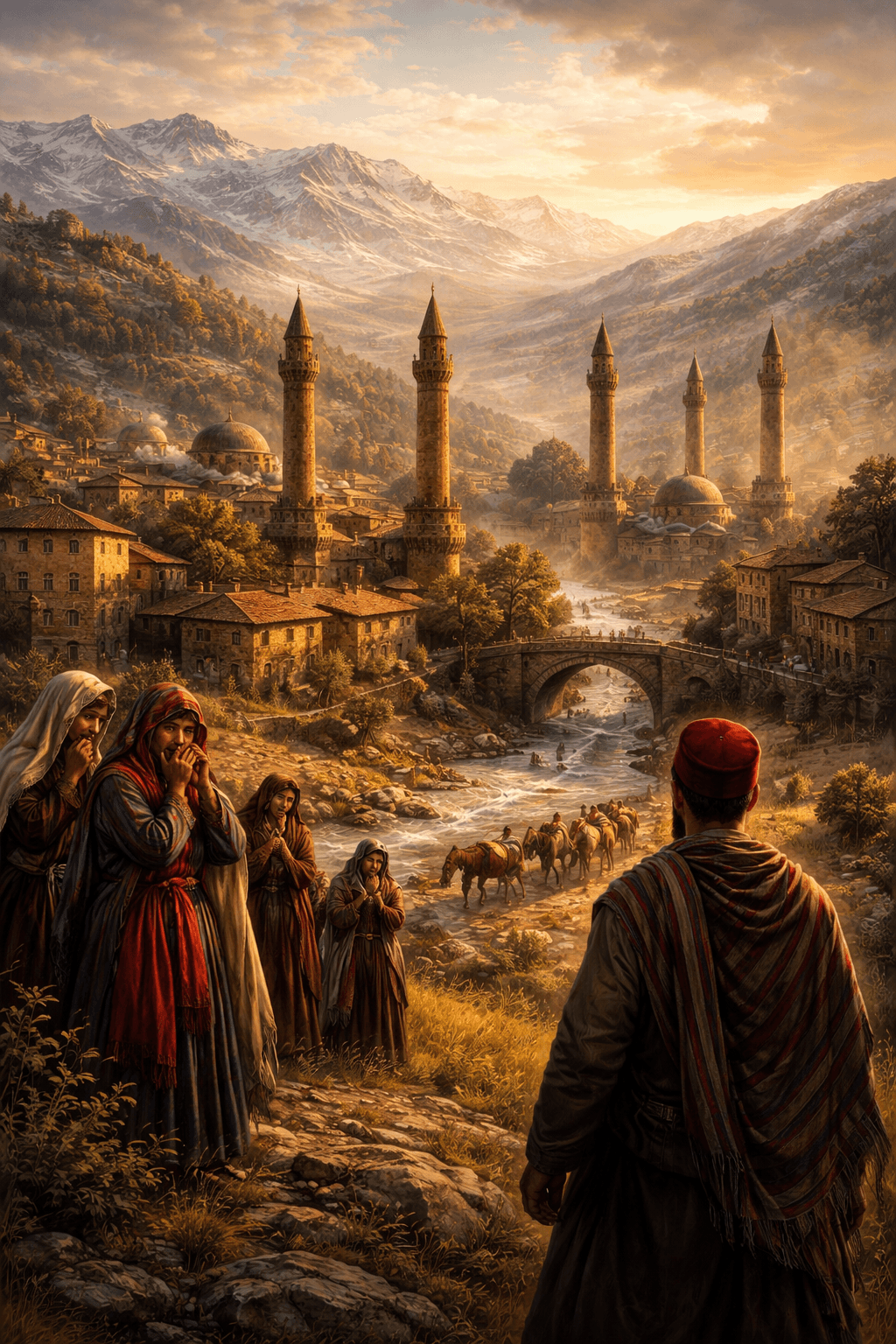
Bitlis'te Beş Minare (Türkü) (yapay zeka ile oluşturulmuştur)
Registration Number | 2226 | ||||||||
|---|---|---|---|---|---|---|---|---|---|
Type(s) | Ağıt (Narrative folk song) | ||||||||
Region(s) | Bitlis | ||||||||
Collector | Muzaffer Sarısözen | ||||||||
Source Person | Nazmi Zulfikar | ||||||||
Period of the Event | World War I | ||||||||
“Beş Minare in Bitlis” is a historical legend and lament that emerged during the Russian occupation of Bitlis in the years of the First World War, shaped by forced migrations and the extensive destruction the city endured. Over time, it acquired a musical form and became embedded in the regional culture. As a local oral narrative, this legend addresses the social devastation caused by the war and the grim reality faced by civilians who were compelled to abandon their homes and, upon returning, found their city in ruins. Classified among narrative folk songs, the piece has been passed down orally through generations and achieved national recognition.
Bitlis'te Beş Minare Türküsü (Doğa İçin Çal)
Before the First World War, Bitlis had a population of approximately 30,000. However, with the outbreak of war and the ensuing conflicts in the region, civilians were forced to flee the city to ensure their personal safety. As a result of this massive wave of displacement and the harsh conditions of war, the city’s population declined to as few as 3,000. The near-total depopulation of Bitlis and its transformation into a military operations center led to irreparable spatial and structural destruction.
According to the legend, after the end of the war or the withdrawal of the occupiers, a father and his son set out for their homeland, Bitlis. The father, having previously served at the front or fled during the conflict, reached a hill overlooking the city. Overcome by physical exhaustion or the terror of confronting his hometown in ruins, he could not bring himself to look down and instead sent his son ahead to observe. The son returned and told his father: “Father, not a single building remains standing in Bitlis—only five minarets are left.”
Stricken by shock and grief at this sight and the news, the father composed a lament beginning with the lines: “Bitlis'te beş minare, beri gel oğlan beri gel.” This lament, uttered in a moment of utter helplessness, became etched in collective memory as an oral testament to the war’s devastating impact on civilians and evolved into a legend.
Originating as a lament in oral culture, “Beş Minare in Bitlis” gradually acquired a melodic structure and was incorporated into the Turkish folk music archives as a folk song from the Bitlis region. It is officially registered in the Turkish Folk Music Repertoire of the Turkish Radio and Television Corporation (TRT) under number 2226.
The source of the song is officially recorded as Nazmi Zulfikar. The melody and lyrics were collected and transcribed by Muzaffer Sarısözen, a prominent folk music researcher of the era. Musically, the song’s vocal range is classified as “five tones.” It is categorized among narrative folk songs in Turkey and serves as a typical example of this literary classification due to its basis in a historical event.

Notation of Bitlis'te Beş Minare Türküsü (TRT)
The official lyrics, preserved in TRT archives and transmitted orally through generations, are as follows:
Bitlis'te beş minare (come back, son, come back)
Yüreğim dolu yare (come back, beloved, come back)
İsterem yanan gelem (come back, son, come back)
Cebimde yok beş pare (come back, beloved, come back)
Tüfegim dolu saçma (come back, son, come back)
Güzelim benden kaçma (come back, beloved, come back)
Doksan dokuz yaram var (come back, son, come back)
Bir yara da sen açma (come back, beloved, come back)
Bitlis Valiliği. "Bitlis'te Beş Minare Efsanesi." Accessed March 5, 2026. http://bitlis.gov.tr/bitliste-bes-minare-efsanesi
Güven, Merdan. "Türkiye Sahasındaki Hikâyeli Türküler Üzerine Bir Araştırma." PhD thesis, Atatürk Üniversitesi, 2005. https://eski.atauni.edu.tr/yuklemeler/c6ca0865468e185cd8e5c0891fe3aa76.pdf
Repertükül. "BITLIS-TE-BES-MINARE-2226." Accessed March 5, 2026. https://www.repertukul.com/BITLIS-TE-BES-MINARE-2226
YouTube. "DOzJzqNbC5iEQ&list=RDzJzqNbC5iEQMİNARE" *Doğa İçin Çal.* Accessed March 5, 2026. https://www.youtube.com/watch?v=zJzqNbC5iEQ&list=RDzJzqNbC5iEQ

Bitlis'te Beş Minare (Türkü) (yapay zeka ile oluşturulmuştur)
Registration Number | 2226 | ||||||||
|---|---|---|---|---|---|---|---|---|---|
Type(s) | Ağıt (Narrative folk song) | ||||||||
Region(s) | Bitlis | ||||||||
Collector | Muzaffer Sarısözen | ||||||||
Source Person | Nazmi Zulfikar | ||||||||
Period of the Event | World War I | ||||||||
No Discussion Added Yet
Start discussion for "Beş Minare (Folk Song) in Bitlis" article
Historical Background and the Origin of the Legend
Repertoire and Musical Characteristics
Lyrics of the Folk Song