

This article was automatically translated from the original Turkish version.
+1 More
Beşkonak Fossil Beds Geosite
Location | Kızılcahamam / Ankara | ||||||||
|---|---|---|---|---|---|---|---|---|---|
Geological Period | Early–Middle Miocene (23–11 million years ago) | ||||||||
Usage | Scientific research, Conservation field studies | ||||||||
Geological Features | Volcanic rocks Lacustrine sedimentary sequence | ||||||||
Registration | Strictly Protected Sensitive Area (2020) | ||||||||
Competent Authority | General Directorate for the Protection of Natural Assets | ||||||||
The Beşkonak Fossil Beds Geosite, located in the Kızılcahamam district of Ankara, is one of Türkiye’s notable natural areas in terms of fossils and provides data regarding the geological past.
The site has been classified as a “geosite” due to its high fossil density, stratigraphic characteristics, and suitability for scientific research. This area, distinguished among various geological formations in Kızılcahamam by its fossil-bearing layers, has been officially recorded for the purpose of preserving and documenting the fossil beds. The Beşkonak Geosite is situated approximately 5 km northeast of Güvem and falls within the scope of a “Special Environmental Protection Area.”
In the Beşkonak area, sedimentary rock layers from different geological periods are observed. Studies of these layers have revealed numerous animal fossils. The structure of these strata provides an important environment for the preservation of fossils.
The stratigraphic sequence consists of fine-grained sandstone, siltstone, claystone, and marl, along with tuff, tuffite, and diatomite layers, forming a volcanosedimentary succession. This succession is dated to the Early-Middle Miocene, approximately 23–11 million years ago. The layers accumulated in an ancient lake environment situated among volcanic areas. Volcanic rocks such as columnar basalts are also found among the lacustrine sediments.

Animal Fossil (Subprefecture of Kızılcahamam, Republic of Türkiye)
Surface surveys have yielded numerous fossil specimens, particularly from mammals. The fossil assemblage includes various teeth, bones, and other skeletal elements. These discoveries have established the site’s scientific research value, providing data on past faunal diversity and environmental conditions in the region.
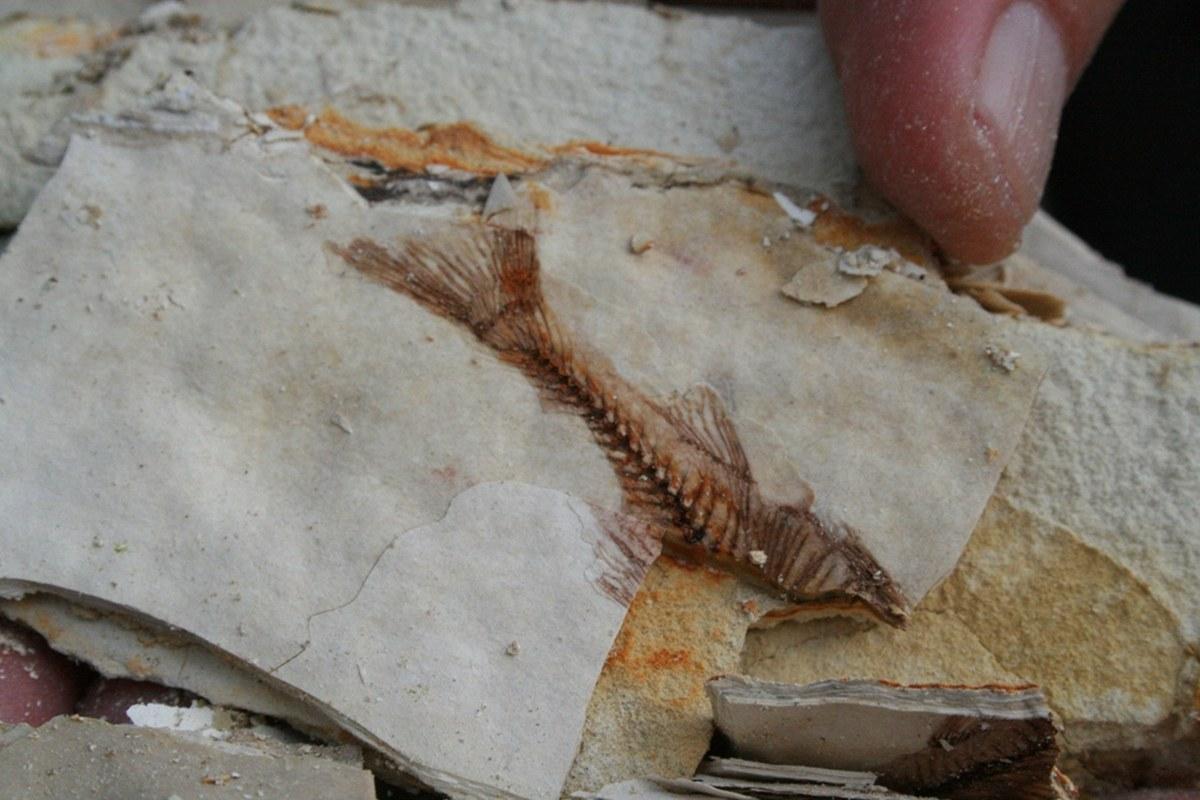
In addition to mammals, the site has yielded numerous plant and animal fossils, including fish, ants, ladybugs, leaves, and branch fragments.
The presence of coniferous and deciduous tree species indicates the existence of an ancient fossilized forest covering approximately 105 square meters.
Furthermore, silica-rich microfossils have been documented, including diatoms, pollen grains, spores of primitive vascular plants, and protozoans.

Fossil Specimen (Subgovernorship of Kızılcahamam, Republic of Türkiye)
The Beşkonak Fossil Beds have been evaluated under Law No. 2863 on the Protection of Cultural and Natural Heritage and were officially registered in 2020 as a “Strictly Protected Sensitive Area.” This registration was carried out by the General Directorate of Nature Conservation. This status entails legal regulations and monitoring measures aimed at preserving the site’s natural character.

Natural Site Map (Ministry of Environment and Urbanization of the Republic of Türkiye)
According to the official registration, construction, any activity that disrupts the natural balance, and all forms of intervention are prohibited within the Beşkonak Fossil Beds Geosite. Activities outside of scientific research are restricted to allow natural processes to continue undisturbed. Within the geosite, intra-layer structures, folds, and small-scale normal and reverse faults are also observed in stratigraphic sections. These features provide data on the area’s tectonic history.
The Beşkonak Fossil Beds Geosite offers a suitable environment for field studies conducted by fossil enthusiasts, nature explorers, and academic groups. Its registration has promoted conservation-based geotourism and scientific research activities.
The geosite has been the subject of various scientific studies by different universities and research groups. These studies form a significant foundation for understanding the typology, geological phases, and paleoecological assessments of fossil beds in Türkiye.
Anadolu Ajansı. “Kızılcahamam’da Bazı Alanlar Kesin Korunacak Hassas Alan İlan Edildi.” Accessed June 18, 2025. https://www.aa.com.tr/tr/turkiye/kizilcahamamda-bazi-alanlar-kesin-korunacak-hassas-alan-ilan-edildi/1684142.
Ministry of Environment, Urbanization and Climate Change of the Republic of Türkiye. "Ankara KızılcahamamBeşkonak Fosil Beds Registration Announcement." *tvk.csb.gov.tr*. Accessed June 18, 2025. https://tvk.csb.gov.tr/ankara-kizilcahamam-beskonak-fosil-yataklari-tescil-ilani-duyuru-405095.
T.C.Kızılcahamam Kaymakamlığı Governorship. "Beşkonak Fosil Beds Geosite." kizilcahamam.gov.tr. Accessed June 18, 2025. http://www.kizilcahamam.gov.tr/beskonak-fosil-yataklari-jeositi.
T.C.Kızılcahamam Kaymakamlığı Governorship. "Jeosit Alanları." kizilcahamam.gov.tr. Accessed June 18, 2025. http://www.kizilcahamam.gov.tr/jeosit-alanlari.

Beşkonak Fossil Beds Geosite
Location | Kızılcahamam / Ankara | ||||||||
|---|---|---|---|---|---|---|---|---|---|
Geological Period | Early–Middle Miocene (23–11 million years ago) | ||||||||
Usage | Scientific research, Conservation field studies | ||||||||
Geological Features | Volcanic rocks Lacustrine sedimentary sequence | ||||||||
Registration | Strictly Protected Sensitive Area (2020) | ||||||||
Competent Authority | General Directorate for the Protection of Natural Assets | ||||||||
No Discussion Added Yet
Start discussion for "Beşkonak Fossil Beds Geosite" article
Geological Structure and Fossil Content
Stratigraphic Features
Paleontological Findings
Legal Protection Status
Registration Process
Protection Scope
Scientific and Public Value