

This article was automatically translated from the original Turkish version.
Founding Year | 2021-04-09 | ||||||||
|---|---|---|---|---|---|---|---|---|---|
Location | Kavakdere Street 29°06′13″ E) Istanbul (41°08′18″ N Beykoz Merkez Neighborhood | ||||||||
Affiliated İnstitution | Presidency of the Republic of Türkiye, National Palaces Administration | ||||||||
Type(s) | The glass and crystal museum focuses on Turkish glass art and European-origin palace glass examples | ||||||||
Number of Collections | Approximately 1,480 to 1,500 pieces | ||||||||
The Beykoz Glass and Crystal Museum was established to meet the institutional need for exhibiting the history, aesthetic forms, and cultural applications of glass production, and it opened to the public in 2021 in the Beykoz district of Istanbul. The museum adopts a museological approach aimed at documenting the historical and technical development of glass art, preserving glass artifacts from different periods, and presenting them to the public.

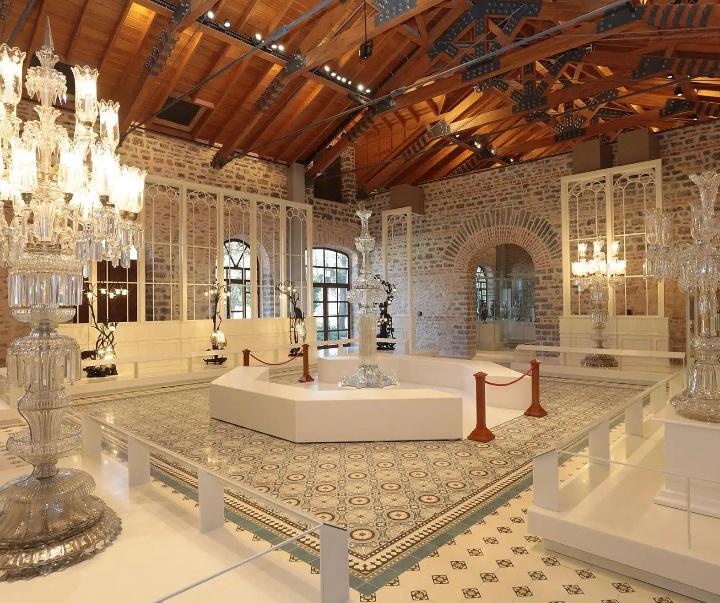
Beykoz Glass and Crystal Museum (National Palaces)
The museum was created through the restoration of a 19th-century stable building that once belonged to Abraham Pasha, an Ottoman state official. The U-shaped stone structure is situated within a spacious garden covering approximately 360 dunams, which features a variety of plant species. This landscape design considers not only spatial aesthetics but also the functional use of open areas.
The museum’s collection comprises approximately 1,500 glass artifacts spanning a broad chronological range from the Anatolian Seljuk period to the 20th century. The objects are classified according to different production techniques, formal characteristics, and functional purposes. Chronologically, early examples include glass fragments discovered during excavations at Kubadabad Palace, glass decorative items from the Mamluk period, and glass vessels used in the Ottoman imperial kitchen. Glassware produced in Beykoz during the 18th and 19th centuries, particularly those made using the “çeşm-i bülbül” technique, are especially notable. In addition, European crystal pieces from Bohemia, Moser, and Baccarat, which were used in Ottoman palace life, are also displayed in the museum.
The museum does not merely display artifacts but also provides an exhibition system that conveys technical knowledge about production processes. Thematic galleries have been organized around topics such as raw materials of glass, production techniques, and formal transformations. Multimedia narratives, interactive presentations, and demonstrations of glassworking techniques serve as supportive tools to enhance visitors’ understanding of the subject.

Glass Works (National Palaces)
The Beykoz Glass and Crystal Museum can be regarded as an institutional structure that brings together representative examples of the historical development of Ottoman and Islamic glass art and presents comparative insights into the evolving functions of glass across different periods. Through its exhibition approach that emphasizes the aesthetic, technical, and cultural dimensions of glass material, the museum offers a valuable resource for future historical and practical research on glass art.
Aydın, Ali. “Bir Müze Mekânı Olarak Beykoz Cam ve Billur Müzesi.” Artium: Sanat ve Tasarım Dergisi 7, no. 2 (2021): 554–572. https://dergipark.org.tr/en/download/article-file/1793960.
Ersoy, Mine, and Eda Elif Tibet. “Tarihî Yapıların Müze Olarak İşlevlendirilmesi: Beykoz Cam ve Billur Müzesi Örneği.” Atatürk Üniversitesi Güzel Sanatlar Enstitüsü Dergisi 27, no. 47 (2022): 468–483. https://dergipark.org.tr/en/download/article-file/2129875.
National Palaces Administration. "Beykoz Cam and Crystal Museum." Accessed July 9, 2025. https://www.millisaraylar.gov.tr/Lokasyon/12/Beykoz-Cam-ve-Billur-Muzesi.
Founding Year | 2021-04-09 | ||||||||
|---|---|---|---|---|---|---|---|---|---|
Location | Kavakdere Street 29°06′13″ E) Istanbul (41°08′18″ N Beykoz Merkez Neighborhood | ||||||||
Affiliated İnstitution | Presidency of the Republic of Türkiye, National Palaces Administration | ||||||||
Type(s) | The glass and crystal museum focuses on Turkish glass art and European-origin palace glass examples | ||||||||
Number of Collections | Approximately 1,480 to 1,500 pieces | ||||||||
No Discussion Added Yet
Start discussion for "Beykoz Glass and Crystal Museum" article
Location and Transformation of the Building
Scope and Chronological Distribution of the Collection
Exhibition Practices and Museological Approach