

This article was automatically translated from the original Turkish version.
+2 More
Construction Date(s) | 13th Century | ||||||||
|---|---|---|---|---|---|---|---|---|---|
Material(s) | Bitlis cut stone | ||||||||
Location | Bitlis Merkez Gökmeydan Neighborhood | ||||||||
Additional Structures | Four dynastic tombs | ||||||||
Architectural Plan | Two-story, open courtyard, four-iwan | ||||||||
Repair/Restoration | October 1589 (Reign of V. Şeref Han) | ||||||||
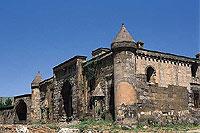
İhlasiye Medresesi, located in the Gökmeydan Neighborhood of Bitlis city center, is one of the region’s most valuable educational structures, bearing the influences of Seljuk architectural traditions and acquiring its current form following a major restoration during the Şerefhanoğlu dynasty. Regarded as one of the city’s oldest buildings, the medrese exhibits characteristics of 13th-century Seljuk style, yet no original construction inscription from that period has been found. The earliest written records concerning the structure are the restoration inscription on its portal and the work Şerefnâme, personally penned by Bitlis emir V. Şeref Han. This monumental structure, once a center of learning and culture in its time, now stands in the historical core of the city, directly opposite Bitlis Castle.
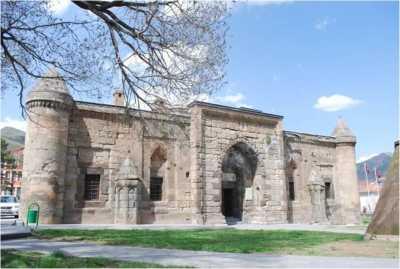
İhlasiye Medresesi (Kültür Portalı)
Although the architectural features of the medrese suggest origins in the Seljuk period (13th century), historical documents link its construction to the late 16th century. A two-line Arabic inscription on its portal reads:【1】
1- The construction of this honorable Şerefiye Medresa, named İhlasiye, was ordered with good intention before the presence of the Almighty God.
2- It was built in Dhu al-Hijjah 997 (October 1589) by the greatest, noblest, just and learned emir, the late Şemseddin Han’s son, Emir Şeref Han.
Although this inscription is written in the style of a construction plaque, the Seljuk decorative elements and spatial organization of the building indicate that this was not a new construction but a comprehensive restoration and renewal. Indeed, V. Şeref Han, in his renowned work Şerefnâme, claims to have commissioned the Hatibiye, Hacı Begiye, Şükriye, Idrisiye and İhlasiye medreses. However, it is known that other medreses such as Hacı Begiye and Idrisiye already existed prior to this period. This confirms that the activities undertaken during the Şerefhanoğlu era constituted a deep restoration aimed at reviving the Seljuk heritage.

İhlasiye Medresesi Dron Çekimi (kültür Portalı)
İhlasiye Medresesi features a two-story, open courtyard, four-iwan plan. 【2】The building exemplifies classic Seljuk medrese architecture and showcases some of the most refined examples of local Bitlis stonework. The entrance portal (taç kapı) is adorned with geometric and vegetal motifs and presents a monumental appearance.
The rooms for teachers and students, arranged around the courtyard, are connected by a covered arcade. Winter classrooms are located on the ground floor, while more spacious study areas are situated on the upper floor. The mosque section on the southern facade draws attention through its interior decorative elements. Within the garden forming a unified ensemble with the medrese building, there are four tombs belonging to II. Şerefhan, V. Şerefhan, Nuşirevan Bey and Ziyaeddin Han. 【3】

İhlasiye Medresesi’nin iki katlı, açık avlulu ve dört eyvanlı mimari yapısını gösteren kat planı.(Turizim Ansiklopedisi)
Over time, the structure has deteriorated due to exposure to natural elements, necessitating restoration efforts in various periods. Academics from Bitlis Eren University (BEÜ) provided technical and scientific support to the restoration projects conducted by the General Directorate of Foundations. The restoration aimed to preserve the building’s original stone fabric and resolve structural issues. Thanks to BEÜ’s work, projects have been developed to repurpose the medrese as a cultural center or a living museum-medrese, in alignment with its historical mission.
Today, İhlasiye Medresesi is one of the most important visitation sites listed in the inventory of the Bitlis Directorate of Culture and Tourism. Due to its proximity to the Bitlis Governorate building, it serves as a focal point for tourists visiting the city. The medrese’s garden, with its Seljuk and Ottoman-era tombstones and tombs, presents the appearance of an open-air museum. Recognized as the city’s most powerful symbol after its “five minarets,” this structure frequently appears in national and international tourism guides due to its historical integrity.
Bitlis Eren University. "Bitlis Eren Üniversitesi Tarihi İhlasiye Medresesi Restorasyon Çalışmalarına Destek Veriyor." Accessed [insert date]. https://www.beu.edu.tr/Haberler/bitlis-eren-universitesi-tarihi-ihlasiye-medresesi-restorasyon-calismalarina-destek-veriyor.
Bitlis Kalkınma Foundation (BİKAV). "İhlasiye Medresesi." Accessed [insert date]. https://bikav.org.tr/tarihimekan-detay.php?id=5.
Bitlis Kültür and Tourism Directorate. "Medreseler." Accessed [insert date]. https://bitlis.ktb.gov.tr/TR-56227/medreseler.html.
Kültür Portalı. "İhlasiye Medresesi - Bitlis." Accessed [Date]. https://www.kulturportali.gov.tr/turkiye/bitlis/gezilecekyer/ihlasiye-medresesi-.
Rûpela Nû. "Şerefhan'ın Bitlis'te Yaptırdığı İhlasiye Medresesi Korunmalı." Accessed [Date]. https://www.rupelanu.org/serefhanin-bitliste-yaptirdigi-ihlasiye-medresesi-korunmali-22855h.htm.
Türkiye Turizm Ansiklopedisi. "İhlasiye Medresesi." Accessed [Date]. http://turkiyeturizmansiklopedisi.com/ihlasiye-medresesi.
[1]
Bitlis Kültür ve Turizm Müdürlüğü, "İhlasiye Medresesi Kitabesi ve Tarihçesi," erişim 10 Şubat 2026,https://bitlis.ktb.gov.tr/TR-56227/medreseler.html.
[2]
Kültür Portalı, "İhlasiye Medresesi Kültür Envanteri,"https://www.kulturportali.gov.tr/turkiye/bitlis/kulturenvanteri/hlasye-medreses.
[3]
Bitlis Kalkınma Vakfı (BİKAV), "Tarihi Mekanlar: İhlasiye Medresesi ve Türbeler,"https://bikav.org.tr/tarihimekan-detay.php?id=5.
Construction Date(s) | 13th Century | ||||||||
|---|---|---|---|---|---|---|---|---|---|
Material(s) | Bitlis cut stone | ||||||||
Location | Bitlis Merkez Gökmeydan Neighborhood | ||||||||
Additional Structures | Four dynastic tombs | ||||||||
Architectural Plan | Two-story, open courtyard, four-iwan | ||||||||
Repair/Restoration | October 1589 (Reign of V. Şeref Han) | ||||||||
No Discussion Added Yet
Start discussion for "Bitlis İhlasiye Medresesi" article
Historical Background and Construction-Restoration Debates
Architectural Structure and Spatial Organization
Restoration Efforts and Academic Support
Current Status and Tourism Potential