

This article was automatically translated from the original Turkish version.
Height(s) | Stem that can grow up to 5 meters long and has tendrils. | ||||||||
|---|---|---|---|---|---|---|---|---|---|
Family | Cucurbitaceae | ||||||||
Pharmacological Properties | Antiviral Anticancer Antidiabetic | ||||||||
Specie(s) | Momordica charantia L. | ||||||||
Fruit | Structure 7-13 cm long, tuberculate (projecting), turning orange-yellow when mature and irregularly splitting. | ||||||||
Flowers | Unisexual (monoecious) and yellow in color. | ||||||||
Life Cycle | Annual, herbaceous, and climbing. | ||||||||
Genus | Momordica | ||||||||
World | Plantae | ||||||||
Bitter melon is a species classified within the botanical family Cucurbitaceae and scientifically named Momordica charantia L.. The genus name “Momordica” is derived from the Latin word “mordere,” meaning “to bite,” referring to the deeply toothed and serrated edges of its leaves, which resemble marks left by an animal’s bite. Known worldwide by various names such as “bitter gourd,” “bitter squash,” or “balsam pear,” this plant is commonly referred to in Türkiye as “kudret narı”.
Bitter melon is an annual, climbing herbaceous plant. It possesses a slender stem that can grow up to approximately 5 meters in length, using specialized tendrils called “sülük” to cling to surrounding supports. The leaves are arranged alternately along the stem and are palmately divided into five to seven deep lobes. Leaf width typically ranges from 4 to 12 cm, with distinctly rough and toothed margins.
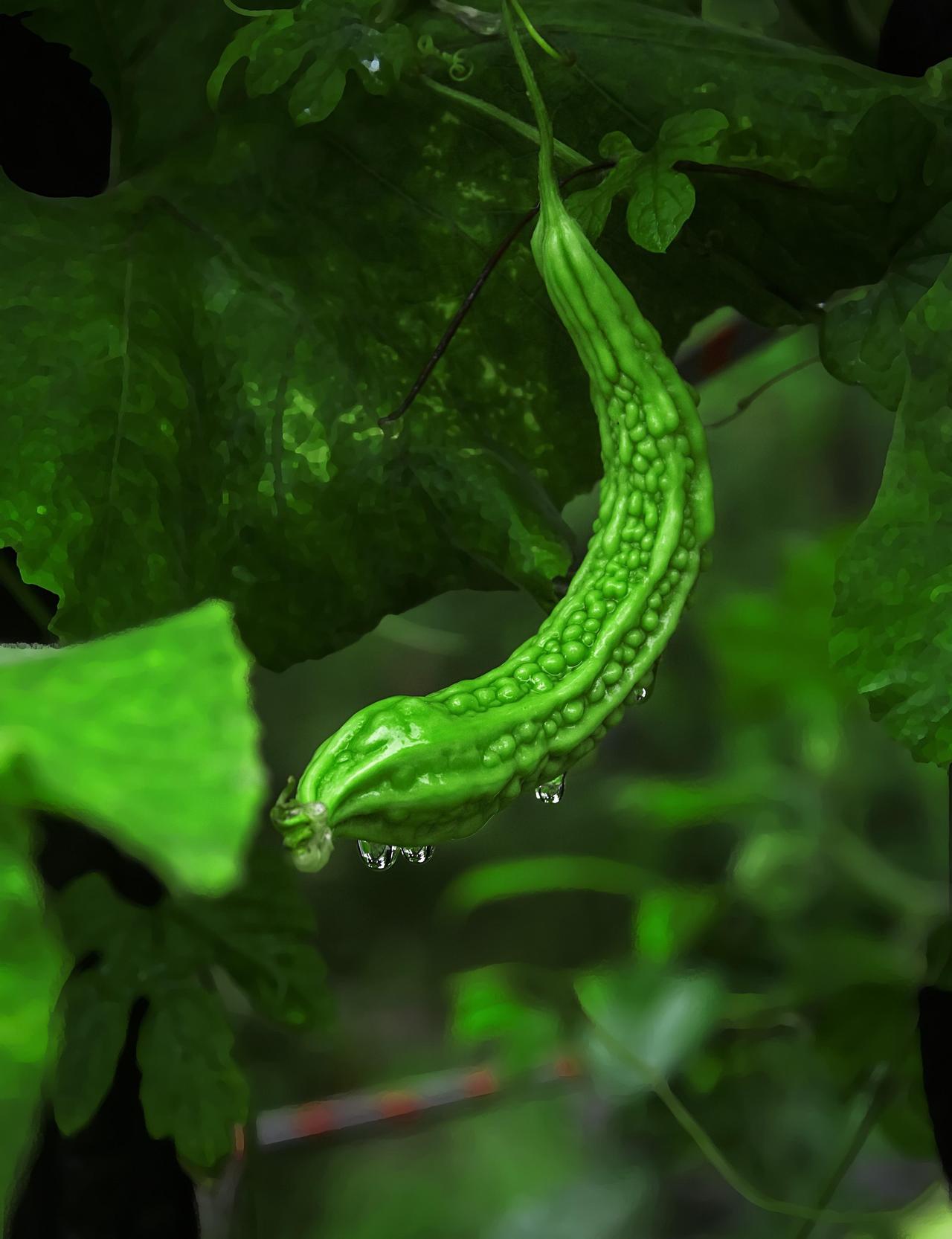
The plant bears separate male and female flowers of yellow color on the same individual. These flowers usually emerge singly from the leaf axils and each has five petals. The most characteristic feature of the plant is its fruit, which may be cylindrical, ellipsoidal, or spindle-shaped. The fruit’s outer surface is not smooth but covered with numerous small bumps, protuberances, and warty structures.
The color of the fruit undergoes a striking transformation during maturation. Immature fruits are a bright emerald green, turning orange-yellow as they ripen. Upon full maturity, the fruit splits open spontaneously into three segments by curling backward. Inside the fruit’s cavity, flat and broad seeds are found, their number varying according to fruit size. These seeds are surrounded by a fleshy, sweet, bright red aril.

Unripe Bitter Melon(Pexels)
Examination of the stem anatomy reveals a single-layered epidermis covered by a thin cuticle, with six to eight layers of collenchyma tissue prominent at the corners. Ten bicollateral vascular bundles are arranged in two rows: inner and outer, separated by parenchymatous pith rays containing prismatic crystals. Leaf anatomy is dorsiventral and amphistomatic, meaning stomata are present on both upper and lower surfaces (anomocytic type). The lower epidermis contains abundant cystoliths (calcium carbonate deposits).

Fruit and Stem Structure of Bitter Melon(Pixabay)
Momordica charantia is rich in phytochemicals; its fruit, seeds, and leaves contain proteins, polysaccharides, flavonoids, terpenoids, saponins, ascorbic acid, and steroids. The bitter taste of the plant is primarily due to triterpene glycosides known as “momordicin.” Key bioactive compounds include “charantin,” a mixture of steroidal saponins; “polypeptide-P,” an insulin-like peptide (plant insulin); alkaloids (momordicin I and II); and triterpenoids (kuguacins and momordicosides). Nutritionally, bitter melon is rich in vitamins C, A, and E, as well as folic acid, and contains high levels of calcium, potassium, sodium, magnesium, iron, and zinc【1】.
Research on the pharmacological activities of bitter melon demonstrates its broad therapeutic potential. Antidiabetic activity is the most extensively studied property; charantin, polypeptide-P, and other glycosides have been shown to lower blood glucose levels, protect or regenerate pancreatic beta cells, stimulate insulin secretion, and enhance peripheral glucose utilization. Antitumor and anticancer studies have revealed that plant extracts and the MAP30 protein induce apoptosis and inhibit proliferation in various cancer cell lines, including those of breast, prostate, liver, colon, and bladder. Antiviral effects include in vitro activity against HIV-1, HSV-1, HSV-2, and Coxsackievirus B3. Antimicrobial properties exhibit broad-spectrum efficacy against bacteria such as S. aureus, E. coli, P. aeruginosa, and Helicobacter pylori, the causative agent of gastric ulcers. Additionally, the plant’s wound-healing, anti-inflammatory, antioxidant, and hypolipidemic (cholesterol-lowering) effects are well documented in the literature.
Although generally considered safe at normal dietary doses, excessive consumption or specific routes of administration of Momordica charantia have been associated with toxic effects. In children, it may cause hypoglycemic coma and convulsions; in adults, high doses may lead to abdominal pain and diarrhea. Regarding reproductive toxicity, the plant has been found to possess antifertility effects, negatively impact spermatogenesis, and exhibit abortifacient potential due to RIP proteins present in its seeds. Furthermore, bitter melon may interact with antidiabetic and cholesterol-lowering medications, potentiating their effects. Its use is contraindicated during pregnancy and lactation.
Altmış. “Momordica charantia, Fruit, Green.” Photograph. *Pixabay*, September 8, 2015. Accessed February 11, 2026. https://pixabay.com/photos/momordica-charantia-fruit-green-924274/
Altınterim, Başar. “Bitter Melon (Momordica charantia) and the Effects of Diabetes Disease.” *U. Ü. Ziraat Fakültesi Dergisi* 26, no. 2 (2012): 65–69. Accessed February 11, 2026. https://dergipark.org.tr/en/download/article-file/154173
Anadolu Ajansı. “Kudret narının kırık tedavisinde olumlu etkileri tespit edildi.” *AA Haber*, February 26, 2021. Accessed February 11, 2026. https://www.aa.com.tr/tr/saglik/kudret-narinin-kirik-tedavisinde-olumlu-etkileri-tespit-edildi/2157888
Bakare, R. I., O. A. Magbagbeola, A. I. Akinwande, and O. W. Okunowo. “Nutritional and Chemical Evaluation of Momordica charantia.” *Journal of Medicinal Plants Research* 4, no. 21 (2010): 2189–2193. Accessed February 11, 2026. https://www.researchgate.net/profile/Wahab-Okunowo2/publication/260184234_Nutritional_and_chemical_evaluation_of_Momordica_charantia/links/00b4952feacbdb6c32000000/Nutritional-and-chemical-evaluation-of-Momordica-charantia.pdf
Eröz Poyraz, İlham, and Cülasfi Derdovski. “Morpho-Anatomical Investigations on Momordica charantia L. (Cucurbitaceae).” *Anadolu Üniversitesi Bilim ve Teknoloji Dergisi C - Yaşam Bilimleri ve Biyoteknoloji / Anadolu University Journal of Science and Technology C - Life Sciences and Biotechnology* 5, no. 1 (2016): 23–30. Accessed February 11, 2026. https://doi.org/10.18036/btdc.68664
Grover, J. K. and S. P. Yadav. “Pharmacological Actions and Potential Uses of Momordica charantia: A Review.” *Journal of Ethnopharmacology* 93, no. 1 (2004): 123–132. Accessed February 11, 2026. https://doi.org/10.1016/j.jep.2004.03.035
Jia, Shuo, Mingyue Shen, Fan Zhang, and Jianhua Xie. “Recent Advances in Momordica charantia: Functional Components and Biological Activities.” International Journal of Molecular Sciences 18, no. 12 (2017): 2555. https://doi.org/10.3390/ijms18122555
Kon072. “Momordica charantia, droop under the shed.” Photograph. *Pixabay*, March 17, 2017. Accessed February 11, 2026. https://pixabay.com/photos/momordica-charantia-droop-2139030/
Kumar, D. Sathish, K. Vamshi Sharathnath, P. Yogeswaran, A. Harani, K. Sudhakar, P. Sudha, and David Banji. “A Medicinal Potency of Momordica charantia.” *International Journal of Pharmaceutical Sciences Review and Research* 1, no. 2 (2010): 95. Accessed February 11, 2026. https://www.researchgate.net/profile/SathisDinakaran/publication/363270946_A_MEDICINAL_POTENCY_OF_MOMORDICA_CHARANTIA/links/545e218b0cf27487b44ef843/A-medicinal-potency-of-Momordica-charantia.pdf
Lum, L. “Close-up of Fresh Green Bitter Melons.” Photograph. *Pexels*, 2023. Accessed February 11, 2026. https://www.pexels.com/photo/close-up-of-fresh-green-bitter-melons-35522469/
[1]
Jia, Siwen, Mingyue Shen, Fan Zhang ve Jianhua Xie. “Recent Advances in Momordica charantia: Functional Components and Biological Activities.” International Journal of Molecular Sciences 18, no. 12 (December 2017): 2555. Accessed 11 February 2026.https://doi.org/10.3390/ijms18122555

Height(s) | Stem that can grow up to 5 meters long and has tendrils. | ||||||||
|---|---|---|---|---|---|---|---|---|---|
Family | Cucurbitaceae | ||||||||
Pharmacological Properties | Antiviral Anticancer Antidiabetic | ||||||||
Specie(s) | Momordica charantia L. | ||||||||
Fruit | Structure 7-13 cm long, tuberculate (projecting), turning orange-yellow when mature and irregularly splitting. | ||||||||
Flowers | Unisexual (monoecious) and yellow in color. | ||||||||
Life Cycle | Annual, herbaceous, and climbing. | ||||||||
Genus | Momordica | ||||||||
World | Plantae | ||||||||
No Discussion Added Yet
Start discussion for "Bitter Melon (Momordica charantia)" article
Morphological Description
Microstructural Analysis
Chemical Components and Phytochemical Properties
Biological Activities and Clinical Applications
Toxicological Evaluations and Adverse Effects