This article was automatically translated from the original Turkish version.
Scientific Name(s) | Pica hudsonia | ||||||||
|---|---|---|---|---|---|---|---|---|---|
Kingdom(s) | Animalia | ||||||||
Phylum | Chordata | ||||||||
Class | Aves | ||||||||
Order | Passeriformes | ||||||||
Family | Corvidae | ||||||||
Specie(s) | Pica hudsonia | ||||||||
Suborder | 45 – 60 cm | ||||||||
Wingspan | 56 – 61 cm | ||||||||
Weight(s) | 145 – 210 g | ||||||||
Distribution(s) | Western North America (Canada's grasslands western United States) | ||||||||
Conservation Status | Least Concern | ||||||||
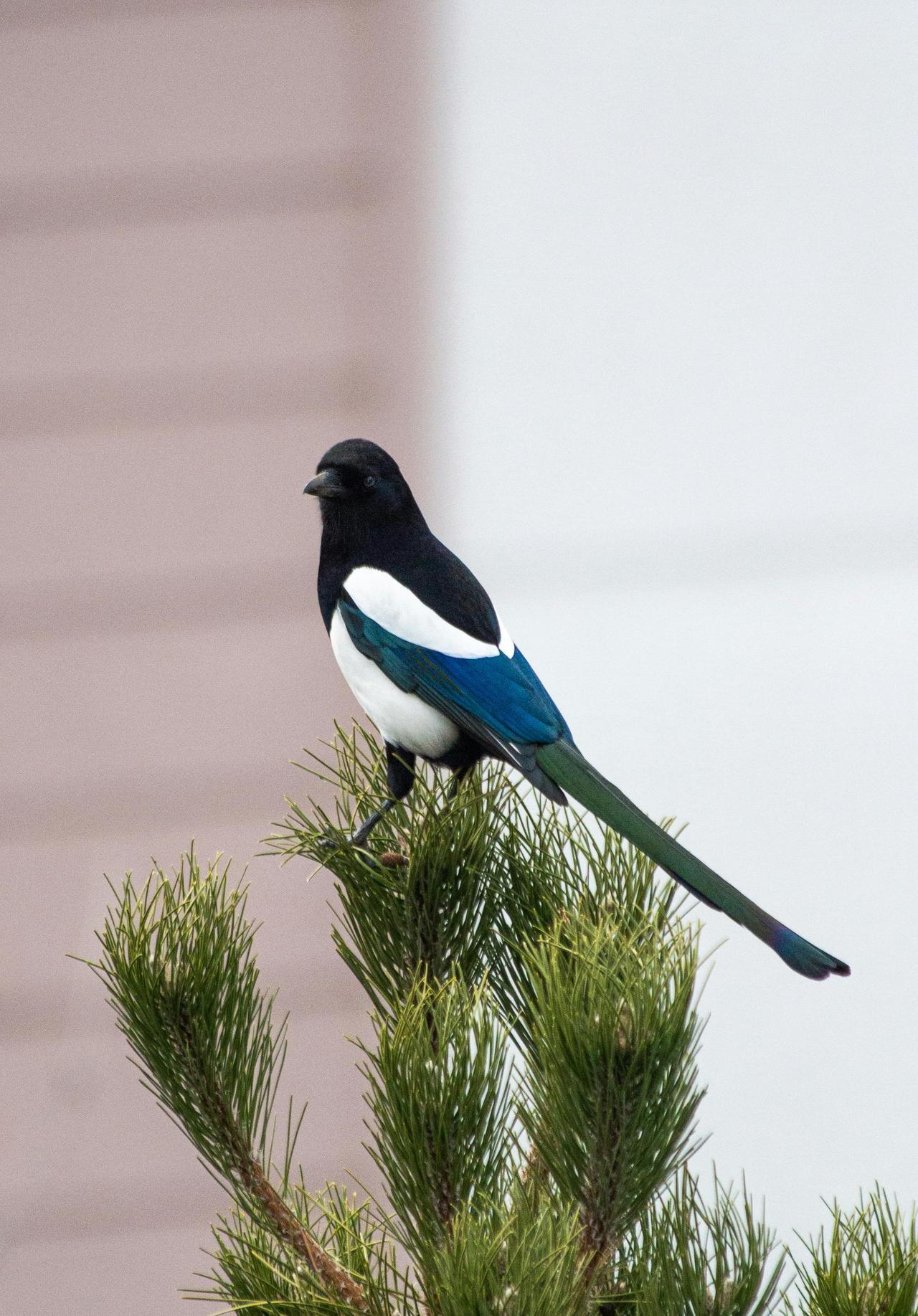
Black-billed Magpie (Pica hudsonia) is a bird species commonly found in western regions of North America, noted for its social structure and intelligence. Belonging to the Corvidae family, this bird prefers habitats such as shrublands, open areas, and rural regions. It has a distinctive appearance characterized by a long tail, white wing patches, and glossy black plumage. It communicates through loud and conspicuous calls, often producing sounds like “chak, chak, chak”.
Black-billed magpies typically measure 45 to 60 cm in length, more than half of which is accounted for by the tail. Their wingspan ranges from 56 to 61 cm, and their weight varies between 145 and 210 grams. In addition to black head, back, and tail feathers, they have prominent white areas on the shoulders and wings. The bill and legs are black. Their glossy black feathers can reflect bronze, blue, and green hues depending on the light.

Black-billed Magpie (Pexels)
Pica hudsonia inhabits a wide geographic range from the grassland provinces of Canada to the western desert regions of the United States. It can be observed at elevations up to 3000 meters. Forest edges, open areas, agricultural lands, rural settlements, and areas near water sources provide suitable habitats for this species. It can also adapt to urbanized environments.
This species is highly social and typically lives in family groups of 6 to 10 individuals. Outside the breeding season, it may form larger flocks. It exhibits behaviors such as flipping objects, caching food, and problem solving. In the presence of danger, it engages in cooperative group defense. Nest construction is complex; building a large, enclosed, dome-shaped nest can take up to 40 days.
Black-billed magpies are opportunistic omnivores. Their diet includes animal matter such as insects, small vertebrates, bird eggs, and carrion, as well as plant material like fruits, grains, and seeds. They store food supplies to prepare for periods of scarcity.
This species plays various roles within the ecosystem. By consuming parasites such as ticks, it provides symbiotic benefits to large mammals. Additionally, its sturdy nests are sometimes reused by other bird species. By preying on pest insects in agricultural areas, it indirectly contributes to human activities.
Black-billed magpies exhibit a monogamous breeding system. Pairs typically form long-term bonds and build nests together in the same area across successive breeding seasons. The breeding period generally occurs between late March and May.
Nests are constructed on shrubs, trees, or artificial structures, usually at heights of 3 to 10 meters. Nest construction is highly complex, resulting in a large, dome-shaped, roofed structure. The outer layer is built with thorny twigs and mud, while the inner lining is made of soft materials. Building a nest can take up to 40 days.
The female typically lays 6 to 9 eggs. The eggs are pale blue-green with brown speckles. Incubation lasts 16 to 18 days, during which only the female remains in the nest; the male supports her by bringing food.
Chicks are altricial and require extensive parental care. Both parents feed the young. The chicks usually fledge between 25 and 30 days after hatching. However, after fledging, they remain with their parents for some time and continue to be fed by them.
In the United States, the species is legally protected under the Migratory Bird Treaty Act. In Canada, it does not enjoy similar legal protection. The species is generally classified as “Least Concern”, but local threats exist in some areas due to habitat loss and agricultural activities. The longest recorded lifespan for an individual is 9 years and 5 months.
Cornell Lab of Ornithology. "Black-billed Magpie." *All About Birds*. Accessed June 19, 2025. https://www.allaboutbirds.org/guide/Black-billed_Magpie/
Olson, Steve. "Pica hudsonia: Black-billed Magpie." *Animal Diversity Web*. Accessed June 19, 2025. https://animaldiversity.org/accounts/Pica_hudsonia/
Pexels. "Bir Saksağanın Yakın Çekimi JPG." Pexels. Accessed June 19, 2025. https://www.pexels.com/tr-tr/fotograf/bir-saksaganin-yakin-cekimi-15701521/
Pexels. "Su üzerinde Uçan Avrasya Saksağanı JPG." Pexels. Accessed June 19, 2025. https://www.pexels.com/tr-tr/fotograf/su-uzerinde-ucan-avrasya-saksagani-29151010/

Scientific Name(s) | Pica hudsonia | ||||||||
|---|---|---|---|---|---|---|---|---|---|
Kingdom(s) | Animalia | ||||||||
Phylum | Chordata | ||||||||
Class | Aves | ||||||||
Order | Passeriformes | ||||||||
Family | Corvidae | ||||||||
Specie(s) | Pica hudsonia | ||||||||
Suborder | 45 – 60 cm | ||||||||
Wingspan | 56 – 61 cm | ||||||||
Weight(s) | 145 – 210 g | ||||||||
Distribution(s) | Western North America (Canada's grasslands western United States) | ||||||||
Conservation Status | Least Concern | ||||||||
No Discussion Added Yet
Start discussion for "Black-billed Magpie (Pica hudsonia)" article
Morphological Characteristics
Distribution and Habitat
Behavior and Ecology
Diet
Reproduction
Conservation Status