


This article was automatically translated from the original Turkish version.
+2 More
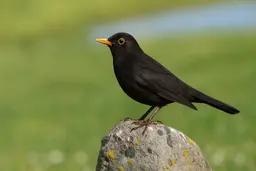
Karatavuk (generated by artificial intelligence)
Height(s) | 23–29 cm | ||||||||
|---|---|---|---|---|---|---|---|---|---|
Wingspan | 34–38 cm | ||||||||
Weight(s) | 80–120 g | ||||||||
Distribution Area | Europe, Asia, North Africa, Australia | ||||||||
Feeding Type | Omnivore | ||||||||
Breeding Season | March–July (varies by region) | ||||||||
Nesting | Shrubs, trees, wall cavities | ||||||||
IUCN Status | Least Concern (LC) | ||||||||
Blackbird (Turdus merula) is a songbird species belonging to the Turdidae family (thrushes) within the order Passeriformes. Taxonomically classified under the genus Turdus, this species is notable for its wide distribution, adaptability, and rich vocal repertoire. Individuals typically exhibit pronounced sexual dimorphism: males have entirely black plumage and a bright yellow bill, while females are colored in duller brown tones with yellowish or brownish bills.

Blackbird (generated by artificial intelligence)
Male blackbirds are distinguished by their glossy black plumage and a prominent orange-yellow eye ring. Females are uniformly dark brown in color, with paler tones and generally less distinct eye rings. Body length ranges from 23 to 29 cm on average; wingspan measures 34 to 38 cm. Adult individuals weigh between 80 and 120 grams.
The blackbird is naturally found across a broad geographic range including Europe, North Africa, the Middle East, and western Asia. It has also been introduced to regions such as Australia and New Zealand. In Türkiye it is common in both urban and rural areas. It prefers wooded and semi-open habitats such as forests, shrublands, parks, and gardens, and readily adapts to urban environments.
As an omnivorous species, the blackbird has a highly flexible diet. Its natural diet includes invertebrates such as earthworms, insects, spiders, and mollusks, as well as fruits and seeds. While foraging, it typically hops along the ground and is most active during early morning hours. During the breeding season, males exhibit intense singing activity in the early morning.
Blackbirds follow a monogamous breeding strategy. The breeding season spans from March to July. Females build nests primarily in shrubs or trees, occasionally in building cavities, using mud and dry grass. They lay three to five eggs, with an incubation period of approximately 12 to 14 days. Chicks fledge after 14 to 16 days. Two or three broods may be raised in a single season.
Male blackbirds are renowned for their melodious songs, particularly during the breeding season, heard most frequently in the early morning and evening. These songs serve functions such as territorial defense, mate attraction, and intraspecific communication. In alarm situations, short, high-pitched "chik-chik" calls are commonly emitted.
The International Union for Conservation of Nature (IUCN) classifies the species as Least Concern. Due to its wide distribution and high adaptability, populations are generally stable or increasing across most of its range. However, urbanization, agricultural pesticides, and intensive urban activities may pose threats to some local populations.
The blackbird plays a significant role in controlling above-ground invertebrate populations. It also contributes to seed dispersal by consuming various fruits. Consequently, it is regarded as a key species in maintaining the balance of forest ecosystems.
Eken Güven, Bozdoğan Murat, İsfendiyaroğlu Sureyya Cevat, Kılıç, Dicle Tuba, and Lise Yildiray. "Türkiye’nin Önemli Doğa Alanları." *Doğa Derneği*. Accessed July 18, 2025. https://www.researchgate.net/publication/348915814_Turkiye'nin_Onemli_Doga_Alanlari_-_Key_Biodiversity_Areas_of_Turkey_Cilt_2
Gyurácz, J. “Annual captures, autumn migration phenology, and morphological traits of the Common Blackbird (Turdus merula) over 24 years.” *North-Western Journal of Zoology*. Accessed July 18, 2025. https://www.researchgate.net/publication/376521576_Annual_captures_autumn_migration_phenology_and_morphological_traits_of_the_Common_Blackbird_Turdus_merula_over_24_years
Yarar, Murat and Magnin, Gernant. Türkiye’nin Önemli Kuş Alanları. Doğal Hayatı Koruma Derneği. Accessed July 18, 2025.
Özdemir, Yasemin Öztürk. “Bird diversity and conservation status in Isparta province (Turkey).” Turkish Journal of Zoology. Accessed July 18, 2025. https://www.researchgate.net/publication/320285919_Bird_diversity_and_conservation_status_in_Isparta_province_Turkey
İzmir Kuş Cenneti. "Karatavuk." *İzmir Kuş Cenneti*. Accessed July 18, 2025. https://izmirkuscenneti.gov.tr/2022/12/05/karatavuk/

Karatavuk (generated by artificial intelligence)
Height(s) | 23–29 cm | ||||||||
|---|---|---|---|---|---|---|---|---|---|
Wingspan | 34–38 cm | ||||||||
Weight(s) | 80–120 g | ||||||||
Distribution Area | Europe, Asia, North Africa, Australia | ||||||||
Feeding Type | Omnivore | ||||||||
Breeding Season | March–July (varies by region) | ||||||||
Nesting | Shrubs, trees, wall cavities | ||||||||
IUCN Status | Least Concern (LC) | ||||||||
No Discussion Added Yet
Start discussion for "Blackbird (Turdus merula)" article
Morphological Characteristics
Distribution and Habitat
Behavior and Diet
Reproductive Biology
Vocalizations and Communication
Conservation Status and Threats
Ecological Role