


This article was automatically translated from the original Turkish version.
+1 More
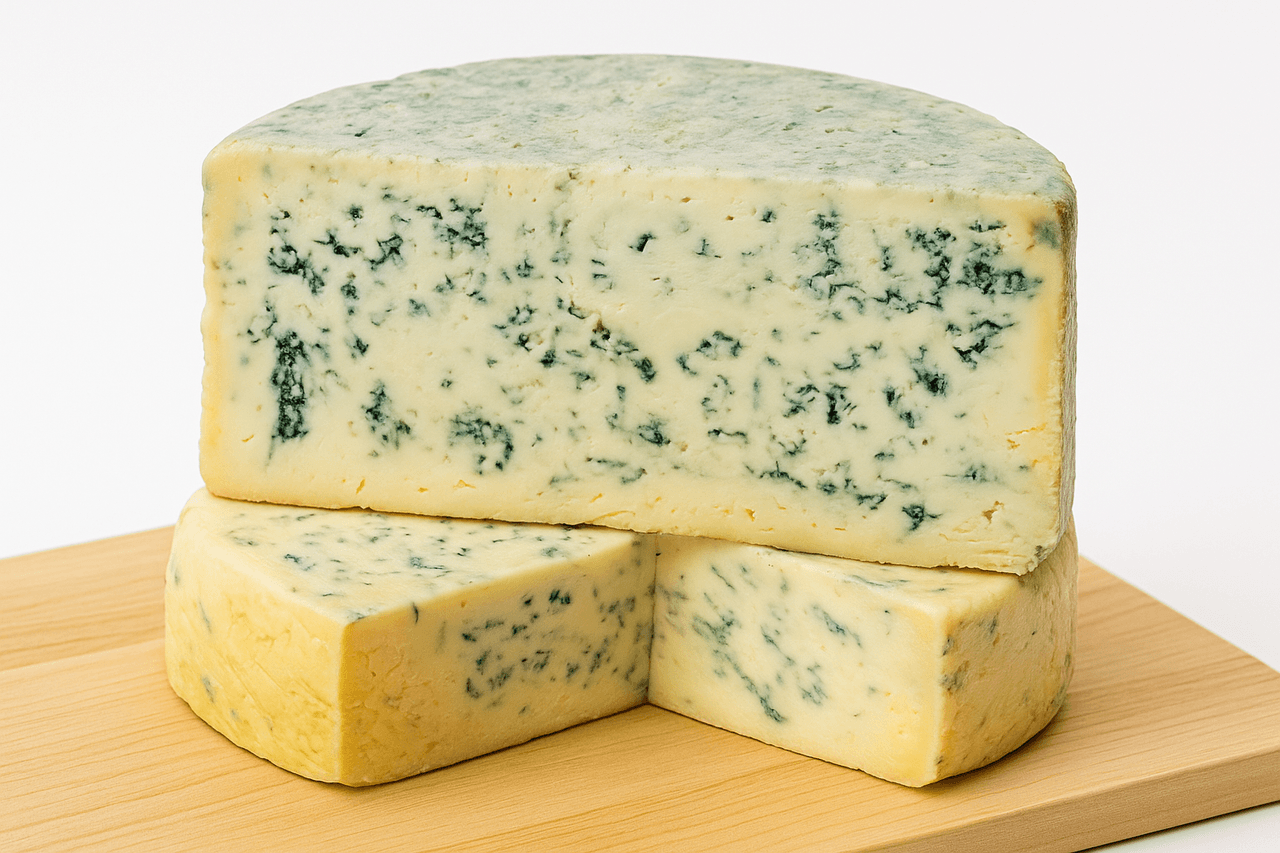
Bleu d'Auvergne (generated with YZ)
Country | France | ||||||||
|---|---|---|---|---|---|---|---|---|---|
Type of Geographical Indication | Origin Name (PDO) | ||||||||
File Number | PDO-FR-0107 | ||||||||
Product Type | Food | ||||||||
Date(s) | 21.06.1996 | ||||||||
Product Category | Cheeses | ||||||||
Status | Registered | ||||||||
Protector | EU | ||||||||
Bleu d’Auvergne AOP is a veined cheese made from cow’s milk, featuring a marbled interior and a bloomy rind (croûte fleurie). It derives its name from the blue-veined streaks within its flesh. The cheese has a cylindrical shape with a veined interior and is distinguished from other blue cheeses by its extremely fine veins evenly distributed throughout the paste. A typical Bleu d’Auvergne AOP weighs between 2 and 3 kilograms and has a cylindrical form measuring 20 centimetres in diameter and 10 centimetres in height. Larger sizes of 2 to 3 kilograms are available alongside smaller sizes weighing 1 kilogram, 500 grams or 350 grams.
Bleu d’Auvergne is protected by geographical indications: AOC: The cheese obtained the Appellation d'Origine Contrôlée (AOC) status in March 1975 after applying in 1972. It later acquired the Appellation d’Origine Protégée (AOP) status in 1996. Control is carried out by I.N.A.O. (Institut National des Appellations d'Origine).
Bleu d’Auvergne originated in the volcanic Massif Central region of France. It is produced at elevations between 600 and 1,200 metres in the area where the Auvergne Rhône-Alpes Nouvelle-Aquitaine and Occitanie regions converge. The geographical heart of the production area lies within the Massif Central, encompassing the Puy-de-Dôme and Cantal départements and certain neighbouring communes.
The cheese’s origins date back to the early 19th century, when it was produced on the high volcanic plateaus of the Massif Central. Bleu d’Auvergne emerged through the efforts of local farmer Antoine Roussel in the 19th century. Roussel, a native of Auvergne, travelled to Rouen to complete an apprenticeship in a pharmacy. Through various experiments, he injected spores derived from rye bread into the cheese curd using a needle, achieving a uniform blue veining. He conducted further trials on the cheese in 1854.
The production area is a natural geographical unit characterised by volcanic and granitic soils rich in trace elements and a harsh climate. These conditions foster a unique local flora essential to the cheese’s distinctive character. A total of 630 communes are authorised for Bleu d’Auvergne AOP production, with concentration concentrated in the volcanic massifs. High-altitude pastoralism and abundant rainfall support the growth of grasses suitable for feeding dairy cattle. The AOP specification requires that cows graze for a minimum of 150 days per year and that each animal has access to at least 0.3 hectares of pasture.
The production process follows the same traditional steps as in the past.
Production Volume: Each year, more than 43 million litres of milk are produced by approximately 1,100 Auvergne farmers and transformed into 5,250 tonnes of cheese.
Milk Requirement: Approximately 20 to 25 litres of milk are needed to produce one 2 to 3 kg Bleu d’Auvergne AOP. Around 1,100 tonnes of Bleu d’Auvergne are exported annually to international markets.
Centre national interprofessionnel de l’économie laitière (CNIEL). "Bleu d’Auvergne AOP." *Produits Laitiers AOP.* Accessed October 21, 2025. https://www.produits-laitiers-aop.fr/produits/bleu-dauvergne/
European Commission. “Bleu d’Auvergne.” Accessed October 21, 2025. https://webgate.ec.europa.eu/eambrosia-api/api/v1/attachments/72111
Ministère de l’Agriculture et de la Souveraineté alimentaire. “Le Bleu d’Auvergne AOP, une montagne de saveurs.” Accessed October 21, 2025. https://agriculture.gouv.fr/le-bleu-dauvergne-aop-une-montagne-de-saveurs

Bleu d'Auvergne (generated with YZ)
Country | France | ||||||||
|---|---|---|---|---|---|---|---|---|---|
Type of Geographical Indication | Origin Name (PDO) | ||||||||
File Number | PDO-FR-0107 | ||||||||
Product Type | Food | ||||||||
Date(s) | 21.06.1996 | ||||||||
Product Category | Cheeses | ||||||||
Status | Registered | ||||||||
Protector | EU | ||||||||
Geographical Origin and History
Production Geography and Conditions
Production Process