


This article was automatically translated from the original Turkish version.
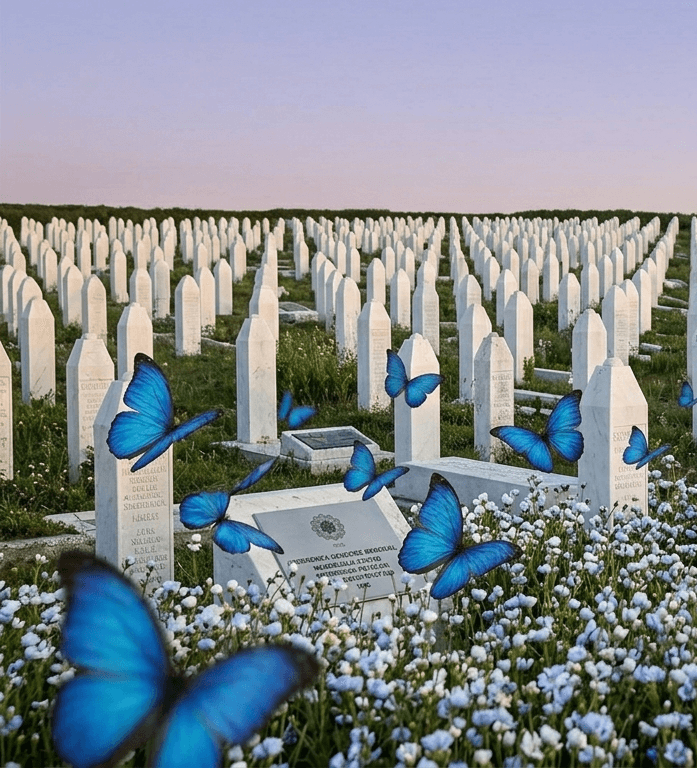
Blue Butterflies (Generated with Artificial Intelligence.)
Scientific Name(s) | Blue Butterfly (Maculinea rebeli) | ||||||||
|---|---|---|---|---|---|---|---|---|---|
Symbolic Meaning | Justice, Social Memory | ||||||||
Discovery Count | Nearly 300 hidden mass graves | ||||||||
Triggering Factor | Excessive growth of the Artemisia (Yavşan Otu) plant over mass graves | ||||||||
Blue Butterflies are an ecological phenomenon that played a role in locating hidden mass graves following the Bosnian War of the 1990s and especially the Srebrenitsa Genocide of 1995, becoming a global symbol of that event.
Yugoslavia's dissolution process saw the territory of Bosnia-Herzegovina subjected between 1992 and 1995 to aggressive attacks by Serbian forces, followed by Croatian forces. During this 43-month war, between 200,000 and 250,000 Bosniaks were systematically killed and hundreds of thousands were displaced.【1】 The tragic climax of the war occurred in Srebrenica, one of six areas declared a “Safe Area” by the United Nations (UN) and placed under the protection of the UN Protection Force (UNPROFOR).
Srebrenica, which had been placed under UN protection by a Security Council resolution in 1993 and was supposed to be demilitarized, was attacked by Serbian forces in July 1995. Dutch UN peacekeepers, who failed to defend the area, abandoned it, allowing Serbian units under the command of Ratko Mladić to seize control. During this period, more than 8,372 Bosniak men and boys were systematically murdered.【2】 This event constitutes the largest mass killing in Europe since World War II and the first officially recognized genocide of modern history.
In an effort to erase evidence of the genocide and prevent international judicial mechanisms from uncovering proof, Serbian forces dismembered the victims’ bodies and concealed them in multiple remote locations.
Following the Srebrenitsa Genocide, a systematic strategy was employed to obscure evidence of war crimes. Serbian forces initially used heavy machinery to exhume corpses buried in primary mass graves and transported them to distant and scattered locations to evade satellite surveillance and international scrutiny.
However, this concealment plan was inadvertently exposed by a natural anomaly occurring in the region’s local ecosystem, known as the “blue butterfly effect.” The decomposition of buried bodies altered the mineral and chemical composition of the soil, triggering unusually dense and distinct growth of native plant species such as Artemisia (wormwood), which thrive exclusively in such nutrient-rich soil conditions.
Populations of the Blue Butterfly (Maculinea rebeli), which feed exclusively on the pollen and scents of these specific plants, congregated abnormally in these locations, drawing the attention of researchers. By following these scientifically recognized ecological indicators, investigators were able to locate nearly 300 hidden mass graves buried several meters beneath the surface.【3】
For the people of Bosnia, blue butterflies initially symbolized grief and loss, but over time they came to represent hope through the discovery of the missing. These creatures have become the visual emblem of the Srebrenitsa Genocide in international public opinion and media, while also embodying the struggle for justice. Today, these butterflies appear metaphorically in monuments, artworks, and commemorative ceremonies erected in places such as Ahmići and Srebrenica to ensure that the massacres are never forgotten.
Alp, İlker. "Srebrenitsa Soykırımı (Temmuz 1995)." Avrasya Etüdleri, 52/2017-2 (153-197). Accessed March 3, 2026. https://dergipark.org.tr/tr/download/article-file/422209
Kamit, Maşide. "Balkan Ülkeleri Araştırma ve İnceleme Gezisi." *Necmettin Erbakan Üniversitesi İlahiyat Fakültesi, İstem*, no. 2, pp. 277–303. Accessed March 3, 2026. https://dergipark.org.tr/tr/download/article-file/260926
Lelo, Suvad. “Revised Inventory of the Butterflies of Bosnia and Herzegovina (Insecta: Lepidoptera: Hesperioidea, Papilionoidea).” Sarajevo: Department of Biology, Faculty of Science and Mathematics, pp. 139-156. Accessed March 3, 2026. https://www.researchgate.net/publication/200804034_Revised_inventory_of_the_butterflies_of_Bosnia_and_Herzegovina_Insecta_Lepidoptera_Hesperioidea_Papilionidea/link/0912f50c978a9411c6000000/download?_tp=eyJjb250ZXh0Ijp7ImZpcnN0UGFnZSI6InB1YmxpY2F0aW9uIiwicGFnZSI6InB1YmxpY2F0aW9uIn19
Orbay, Nigar Oturakçı. "Türkiye Türkçesinde Kelebek Adları." Çukurova Üniversitesi Türkoloji Araştırmaları Merkezi Kültür Evi Konuşmaları (ÇÜTAM-KEK), pp. 14-39. Accessed March 3, 2026. https://turkoloji.cu.edu.tr/pdf/cutam_kek_haziran_2022.pdf
Özdemir, Mehmet Nadir. "Balkan Gezisinden Notlar." *Bülent Ecevit Üniversitesi İlahiyat Fakültesi Dergisi*, Volume 1, Issue 1, 2014, pp. 157-168. Accessed March 3, 2026. https://www.academia.edu/34193073/BALKAN_GEZ%C4%B0S%C4%B0NDEN_NOTLAR
[1]
İlker Alp, "Srebrenitsa Genocide (July 1995)" Eurasian Studies, 52/2017-2, 153. Access 3 March 2026. https://dergipark.org.tr/tr/download/article-file/422209.
[2]
İlker Alp, "Srebrenitsa Genocide (July 1995)" Eurasian Studies, 52/2017-2, 182. Access 3 March 2026. https://dergipark.org.tr/tr/download/article-file/422209.
[3]
Maşide Kamit,"Balkan Countries Research and Study Trip." Necmettin Erbakan University Faculty of Theology, İstem, Issue: 2, pp. 278. Access 3 March 2026. https://dergipark.org.tr/tr/download/article-file/260926.


Blue Butterflies (Generated with Artificial Intelligence.)
Scientific Name(s) | Blue Butterfly (Maculinea rebeli) | ||||||||
|---|---|---|---|---|---|---|---|---|---|
Symbolic Meaning | Justice, Social Memory | ||||||||
Discovery Count | Nearly 300 hidden mass graves | ||||||||
Triggering Factor | Excessive growth of the Artemisia (Yavşan Otu) plant over mass graves | ||||||||
Historical and Systematic Background
Discovery of Mass Graves and the Ecological Process
Symbolic Value and Collective Memory