

This article was automatically translated from the original Turkish version.
+1 More
Blue crab (Callinectes sapidus) is a crustacean species native to the coastal waters of the Americas extending from Nova Scotia to Uruguay in the Atlantic Ocean. Over time, through ship ballast water or natural dispersal, it has also been observed along European coasts, in Danish, French, and Japanese waters, as well as in the Mediterranean Sea, the Black Sea, the Aegean Sea, and the Sea of Marmara. Populations have also been reported in the Nile River delta of Israel and Egypt. Its presence in the Black Sea basin has been known since 1968. In Türkiye’s central Black Sea coast (Ordu-Fatsa), individuals were first recorded after examination of specimens captured using trawl nets at depths of 2 to 10 meters.

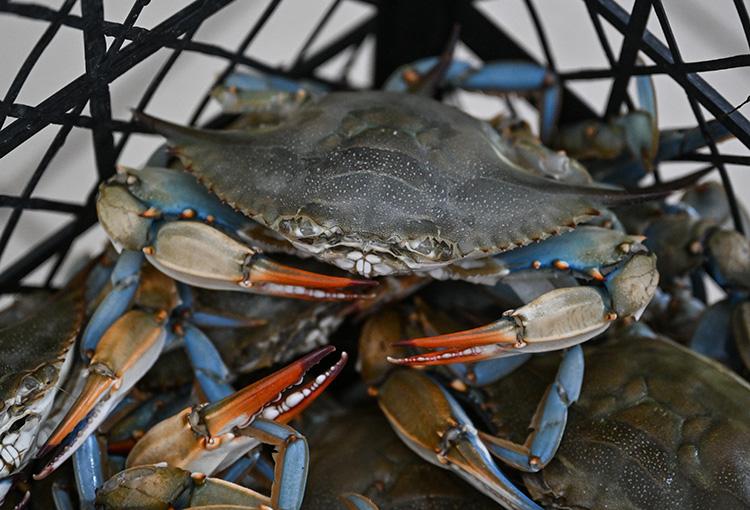
Blue Crabs (AA)
The species has a carapace with blue-green tones and blue legs; the tips of the claws of females are typically red or orange. The animal has five pairs of legs: the first pair are clawed legs used for feeding and defense, the next three pairs are walking legs, and the final pair are paddle-like swimming legs. The species can regenerate lost limbs or claws.
The carapace width generally reaches up to 23 centimeters. The maximum reported carapace width is 20.9 cm in males and 20.4 cm in females. In the central Black Sea, a male specimen measured 19.4 cm in carapace width, 8.40 cm in length, and weighed 449.19 g; a female specimen measured 19.6 cm in carapace width, 7.83 cm in length, and weighed 269.39 g.
In the Gulf of İskenderun, the largest female measured 194.4 mm in carapace length and the largest male measured 169.1 mm. During molting, the animal is vulnerable until its new shell hardens and buries itself in the sediment for protection.【1】
Blue crabs are distributed in depths ranging from 0 to 90 meters in their preferred habitats of sandy and muddy substrates. Estuaries and brackish water channels are of great importance for this species’ populations. Environmental factors such as depth and salinity directly influence population structure. Adult individuals typically mate in these areas, after which females migrate to river mouths or open sea waters with higher salinity to lay and brood their eggs.
The blue crab’s diet includes a wide variety of organisms such as fish, crustaceans, mollusks, arthropods, polychaetes, animal remains, and aquatic plants; however, algae are rarely consumed. As a species that competes with other economically important organisms and exerts predatory pressure, it can cause changes in native ecosystems.
The transition from egg to adult stage typically lasts several weeks depending on environmental conditions. Although a female blue crab can produce one or two million eggs, only one or two of the resulting larvae survive to adulthood. Rising sea surface temperatures are expected to facilitate larval growth, suggesting that the species may benefit from climate change.
Genetic analyses using mitochondrial cytochrome c oxidase I (COI) gene sequences on eight distinct blue crab populations along Türkiye’s Mediterranean coast (Akyatan, Fethiye, Beymelek, Güllük, İskenderun, Köyceğiz, Mersin, and Taşucu) revealed 42 variable sites (6.41%) among 143 samples across a 655 base-pair region, with an average variation of 1.9%. The highest genetic difference, at 2.5%, was found between the Akyatan and Güllük populations. When the phylogenetic tree constructed using the Tamura 3-parameter and UPGMA methods (total branch length = 0.07232) was evaluated, a genetic clustering correlated with geographic distance among populations was reported.
In the İskenderun Gulf population, females dominate at approximately 69%, with the highest abundance observed in June. The average carapace width of females was 148.9±2.5 mm, while that of males, which constitute 31% of the population, was 123.3±3.4 mm.
In the İskenderun Gulf, the population of the blue swimming crab (Portunus segnis) consists of 53.26% males, 36.85% females, and 9.89% juveniles. In this species, males are dominant, with a sex ratio (male:female) of 1:0.69. Analysis of the length-weight relationship (W=0.000068CL2.971) indicated isometric growth for all individuals; the average fecundity of ovigerous individuals collected between April and November was calculated at 805,851 eggs.
In the Indo-Pacific-origin sand crab (Portunus pelagicus), which shares the same habitat, males dominate at 58%, with peak abundance occurring in April. The sand crab, known to have established itself in the Mediterranean via the Suez Canal, exhibits a denser population in the İskenderun Gulf compared to the blue crab. The average carapace width of female sand crabs is 119.9±2.8 mm, while that of males is 104.9±2.1 mm.
Considered a luxury food item with high commercial value in international markets, the blue crab is primarily exploited for economic purposes in Türkiye through fishing. Studies on specimens from Beymelek Lagoon (Antalya) determined an average live weight of 128.044±10.71 g, total meat yield of 24.365±2.25 g, and total meat recovery rate of 23.136%.
Nutritional analysis of the crab’s meat revealed dry matter content of 22.20%, high protein (17.50–17.60%), low crude fat (0.22–2.40%), crude ash (0.37–3.20%), calcium (0.09–0.20%), and phosphorus (0.04–0.18%). Due to its low fat content and rich supply of protein and minerals, blue crab meat constitutes a good and balanced food source for human nutrition.
Anadolu Ajansı. “Dalyan Kanalı’nın Mavi Yengeçleri Alternatif Lezzet Oluşturuyor.” Accessed February 22, 2026. https://www.aa.com.tr/tr/kultur/dalyan-kanalinin-mavi-yengecleri-alternatif-lezzet-olusturuyor/2944833
Atar, Hasan H., Murtaza Ölmez, Süleyman Bekcan, and Selçuk Seçer. “Mavi Yengecin (Callinectes sapidus Rathbun 1896) Et Verimi ve Besin Madde İçeriği Üzerine Bir Araştırma.” Gıda 26, no. 3 (2001): 195–201. Accessed February 22, 2026. https://dergipark.org.tr/en/download/article-file/78794
Aydın, Mehmet. “First Record of Blue Crab Callinectes sapidus (Rathbun 1896) from the Middle Black Sea Coast.” Turkish Journal of Maritime and Marine Sciences 3, no. 2 (2017): 121–124. Accessed February 22, 2026. https://www.researchgate.net/profile/Mehmet-Aydin-12/publication/321723031_First_Record_of_Blue_Crab_Callinectes_sapidus_Rathbun_1896_from_the_Middle_Black_Sea_Coast/links/5a2e3f3ba6fdccfbbf89b435/First-Record-of-Blue-Crab-Callinectes-sapidus-Rathbun-1896-from-the-Middle-Black-Sea-Coast.pdf
Başar, Enes Emre, and Aysu Kes-Erkul. “Advantages and Challenges of Biobased Plastics: A Qualitative Analysis of Stakeholders’ Perceptions.” FSM İlmi Araştırmalar İnsan ve Toplum Bilimleri Dergisi 23 (2024): 1–29. Accessed February 22, 2026. https://dergipark.org.tr/en/download/article-file/3365086
Ministry of Agriculture and Forestry of the Republic of Turkey. "Türkiye Ulusal İstilacı Yabancı Türler Veri ve Bilgi Sistemi (TurIST)." Accessed February 22, 2026. https://turist.tarimorman.gov.tr/Search/Detail/
TÜBİTAK Bilim Çocuk. *Mavi Yengeci Tanımak.* 2025. Accessed February 22, 2026. https://bilimcocuk.tubitak.gov.tr/wp-content/uploads/sites/157/2025/09/639a0fad-5fb8-49e8-bc1a-856cfcd8bd85-2.pdf
Özcan, Tahir, and İhsan Akyurt. “İskenderun Körfezi’nde Dağılım Gösteren Kum Yengeci (Portunus pelagicus Linnaeus, 1758) ve Mavi Yengeç (Callinectes sapidus Rathbun, 1896) Populasyonları ve Morfometrisi Üzerinde Araştırmalar.” Ege University Journal of Fisheries and Aquatic Sciences 23, no. 3–4 (2006): 407–411. Accessed February 22, 2026. https://dergipark.org.tr/en/download/article-file/57650
[1]
Tahir Özcan and İhsan Akyurt, “İskenderun Körfezi’nde Dağılım Gösteren Kum Yengeci (Portunus pelagicus Linnaeus, 1758) ve Mavi Yengeç (Callinectes sapidus Rathbun, 1896) Populasyonları ve Morfometrisi Üzerinde Araştırmalar,” Ege University Journal of Fisheries and Aquatic Sciences 23, no. 3–4 (2006): 407–411, accessed February 22, 2026, https://dergipark.org.tr/en/download/article-file/57650

No Discussion Added Yet
Start discussion for "Blue Crab (Callinectes sapidus)" article
Morphology and Physical Characteristics
Habitat and Ecology
Reproduction and Life Cycle
Population Genetics and Demography on Turkish Coasts
Related Species (Blue Swimming Crab and Sand Crab)
Nutritional Value and Economic Importance