

This article was automatically translated from the original Turkish version.
Team(s) | Coraciiformes | ||||||||
|---|---|---|---|---|---|---|---|---|---|
Family(ies) | Momotidae | ||||||||
Conservation Status(es) | IUCN: Least Concern | ||||||||
Specie(s) | Momotus momota | ||||||||
Habitat | Plantations Gardens Secondary forests Tropical forests | ||||||||
Average Weight | 102–122 g | ||||||||
Average Length | 39–41 cm | ||||||||
Genus | Momotus | ||||||||
Class | Aves | ||||||||
Blue-crowned Motmot (Momotus momota); a member of the Momotidae family within the class Aves, phylum Chordata, and order Coraciiformes of the kingdom Animalia. The species is recognized as one of the characteristic birds of the Neotropical region, and recent taxonomic studies indicate that this species may in fact represent a species complex divisible into multiple subspecies or distinct species. In scientific literature, this bird is known as the Blue-crowned Motmot and is distinguished by its distinctive coloration on the head and unique tail structure.
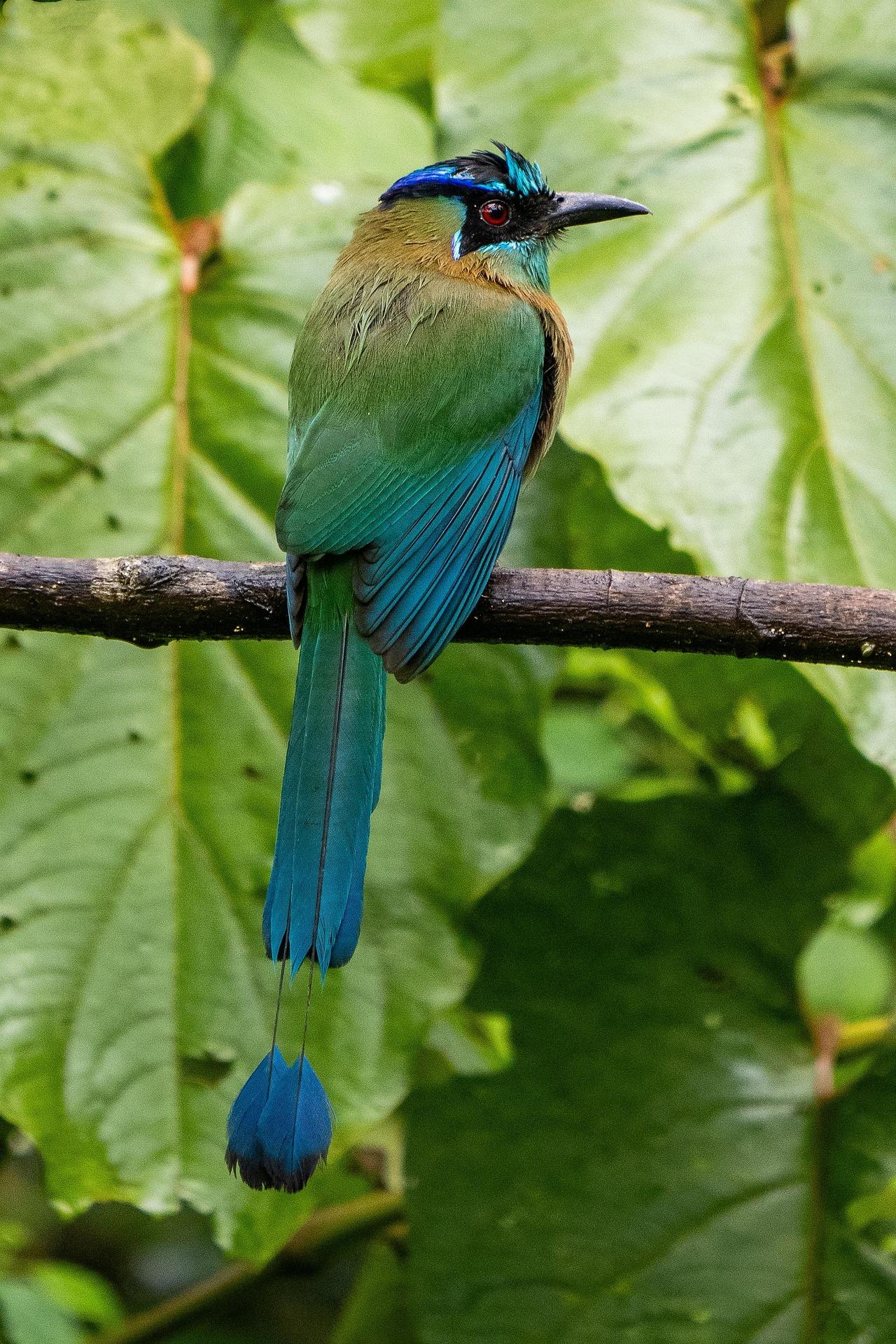
An adult Blue-crowned Motmot measures approximately 39 to 41 centimeters in length and weighs on average between 102 and 122 grams. Sexual dimorphism in this species is minimal; although males are slightly larger in mass and size than females, their plumage coloration is indistinguishable. 【1】The upperparts and back feathers vary in tone between olive green and parrot green. The most striking feature of the head is a diadem composed of a broad, bright blue band that covers much of the forehead and encircles a black crown.
The most distinctive morphological feature of the bird is its racket-shaped central tail feathers. These two long central feathers have blue and black tips; part of the feather shaft lacks barbs, creating a spatula-like appearance at the end. The bill is broad and heavy, with rough serrations along the edges of the upper mandible. The eyes are dull red, and the legs and feet are gray.

Blue-crowned Motmot (Pixabay)
The Blue-crowned Motmot has a wide distribution across Central and South America, ranging from northeastern Mexico to northwestern Peru, Paraguay, Bolivia, Trinidad, and northern Argentina. It is a highly adaptable species, inhabiting diverse environments including areas with intense dry seasons in Pacific lowlands, coffee plantations, secondary forest edges, shaded gardens, forested valleys, and humid rainforests. It is also frequently observed foraging near buildings and in areas with human activity.

Geographic Distribution of the Blue-crowned Motmot (Image Generated by Artificial Intelligence)
Momotus momota is omnivorous but predominantly insectivorous. Its primary food sources include Coleoptera, especially dung beetles, August beetles, June beetles, and various larvae. It also supplements its diet with fruits. The species is known to prey on small vertebrates such as lizards, small snakes, frogs, birds, bats, and small rodents like mice.
During hunting, it typically employs a sit-and-wait strategy, perching on a branch and then making a sudden dive to capture prey once detected. Prey is often stunned by striking it against a perch or the ground before consumption. In rare cases, it has been observed hunting insects around artificial light sources during nighttime activity.

Feeding Behavior of the Blue-crowned Motmot (Pixabay)
The species has a socially monogamous breeding system, with pairs typically remaining together throughout the year. The breeding season generally coincides with the rainy season; in Central America this occurs between March and April, while in regions such as Brazil it occurs around October to November. Motmots nest in self-excavated tunnels, approximately 2.5 meters long, dug into earthen banks or cavities.
A clutch typically consists of two to four white eggs. Incubation lasts approximately three weeks and is shared by both parents; the female usually incubates at night while the male takes over during the day. Chicks hatch completely naked and with closed eyes. Parents brood the young continuously for the first few days, then visit the nest only during daylight hours to feed them. The chicks leave the nest after approximately 24 to 38 days.【2】
Blue-crowned Motmots are territorial birds that defend their nesting areas. The most characteristic behavior of the species is the wag-display, in which it swings its tail like a pendulum from side to side. Scientific evidence supports that this motion functions as a pursuit-deterrent signal, alerting predators—particularly ambush predators—to the bird’s awareness and readiness to flee, thereby discouraging attack and preventing unnecessary energy expenditure by both parties. Additionally, in captive individuals, a different display has been observed, in which the tail is raised and fanned outward, associated with aggressive behavior.
According to the IUCN Red List, the Blue-crowned Motmot is classified as Least Concern due to its wide distribution and adaptability. Its ability to survive in human-modified habitats such as gardens and plantations is an advantage for the species’ persistence. However, at local levels, it may face pressure from invasive predators such as domestic cats. Motmots are important figures in ecotourism and birdwatching due to their exotic appearance and are known as the only motmot species successfully bred in captivity.
Dickerson, A. "Momotus momota." *Animal Diversity Web*. 2001. Accessed March 28, 2026. https://animaldiversity.org/accounts/Momotus_momota/.
Nishikawa, Elise. "The Wag-Display of the Blue-Crowned Motmot (*Momotus momota*) As a Predator-Directed Signal." Bachelor's thesis, University of Colorado, 2013. Accessed March 28, 2026. https://scholar.colorado.edu/concern/undergraduate_honors_theses/cn69m458w
Pesquero, Marcos Antônio, A. G. Corrêa, M. F. Pesquero, et al. "Feeding of nestlings of the Amazonian Motmot (Momotus momota) in southern Goiás, Brazil." Rev. Bras. Ornitol. 22 (2014): 288–91. Accessed March 28, 2026. https://doi.org/10.1007/BF03544262
Pesquero, Marcos Antônio, Sinara Luísa Veloso, Crizanto Brito de Carvalho, Flávio Camarota, and Filipe Viegas de Arruda. "Reproductive Strategies of the Widely Distributed Neotropical Burrow-Nesting Bird *Momotus momota* (Aves: Momotidae) in Tropical Forest Remnants." *Biota Neotropica* 25, no. 2 (2025). Accessed March 28, 2026. https://www.biotaneotropica.org.br/BN/article/view/2113
Pixabay. "ekvadordan motmot kelime momotidae." Pixabay. Accessed March 28, 2026. https://pixabay.com/tr/photos/ekvadordan-motmot-kelime-momotidae-9097159/
Pixabay. "kosta rika motmot kuş hayvan doğa." Accessed March 28, 2026. https://pixabay.com/tr/photos/kosta-rika-motmot-ku%c5%9f-hayvan-do%c4%9fa-9301365/
Pixabay. "kuş motmot ornitoloji türler fauna." Accessed March 28, 2026. https://pixabay.com/tr/photos/ku%c5%9f-motmot-ornitoloji-t%c3%bcrler-fauna-7148525/
Pixabay. "kuş motmot ornitoloji türler fauna." Pixabay. Accessed March 28, 2026. https://pixabay.com/tr/photos/ku%c5%9f-motmot-ornitoloji-t%c3%bcrler-fauna-7833890/
Solano-Ugalde, Alejandro, and Agustina Arcos-Torres. "Nocturnal Foraging Observations of the Blue-Crowned Motmot (*Momotus momota*) in San José, Costa Rica." *The Wilson Journal of Ornithology* 120, no. 3 (2008): 653–54. Accessed March 28, 2026. http://www.jstor.org/stable/20456214
[1]
A. Dickerson, "Momotus momota," Animal Diversity Web, 2001, access date: 28 March 2026, https://animaldiversity.org/accounts/Momotus_momota/
[2]
A. Dickerson, "Momotus momota," Animal Diversity Web, 2001, access date: 28 March 2026, https://animaldiversity.org/accounts/Momotus_momota/


Team(s) | Coraciiformes | ||||||||
|---|---|---|---|---|---|---|---|---|---|
Family(ies) | Momotidae | ||||||||
Conservation Status(es) | IUCN: Least Concern | ||||||||
Specie(s) | Momotus momota | ||||||||
Habitat | Plantations Gardens Secondary forests Tropical forests | ||||||||
Average Weight | 102–122 g | ||||||||
Average Length | 39–41 cm | ||||||||
Genus | Momotus | ||||||||
Class | Aves | ||||||||
No Discussion Added Yet
Start discussion for "Blue-crowned Motmot (Momotus momota)" article
Morphological Features and Physical Structure
Geographic Distribution and Habitat Preferences
Feeding Ecology and Hunting Strategies
Reproductive Biology and Parental Care
Behavioral Patterns and Defense Mechanisms
Conservation Status and Human Interactions