


This article was automatically translated from the original Turkish version.
Blue-footed Booby (Sula nebouxii) is a species of seabird that inhabits the eastern tropical Pacific coastlines, particularly on rocky islands and coastal areas. Its distinctive blue feet play a significant role in intraspecific communication and reproductive behavior. This species, which has dense populations especially in the Galápagos Islands, has been the subject of scientific research due to its morphological and behavioral characteristics.
Blue-footed boobies are medium-sized seabirds. Adult individuals measure on average 81–90 cm in length and weigh approximately 1.5 kg. Their wingspan reaches about 1.5 meters. Their most prominent feature, the blue feet, provide information about health and mating suitability. The more vivid and bright the foot color, the healthier the booby is considered to be.
Their plumage ranges from white to brown tones. Their faces exhibit faint grayish-blue hues. Their beaks are sharp and elongated, adapted for fishing.
Blue-footed boobies live along the eastern tropical Pacific Ocean, including the coasts of Colombia, Ecuador (especially the Galápagos Islands), Peru, and Mexico. They form colonies on rocky islands and coastal areas near open seas.
This species is particularly famous for its courtship rituals. Male blue-footed boobies attract females by raising and displaying their feet while performing a special dance. This behavior is known as the "foot display." Females prefer males with more vivid and darker blue feet.
Their diet consists primarily of fish and squid. They hunt by diving from great heights into the water to catch their prey.
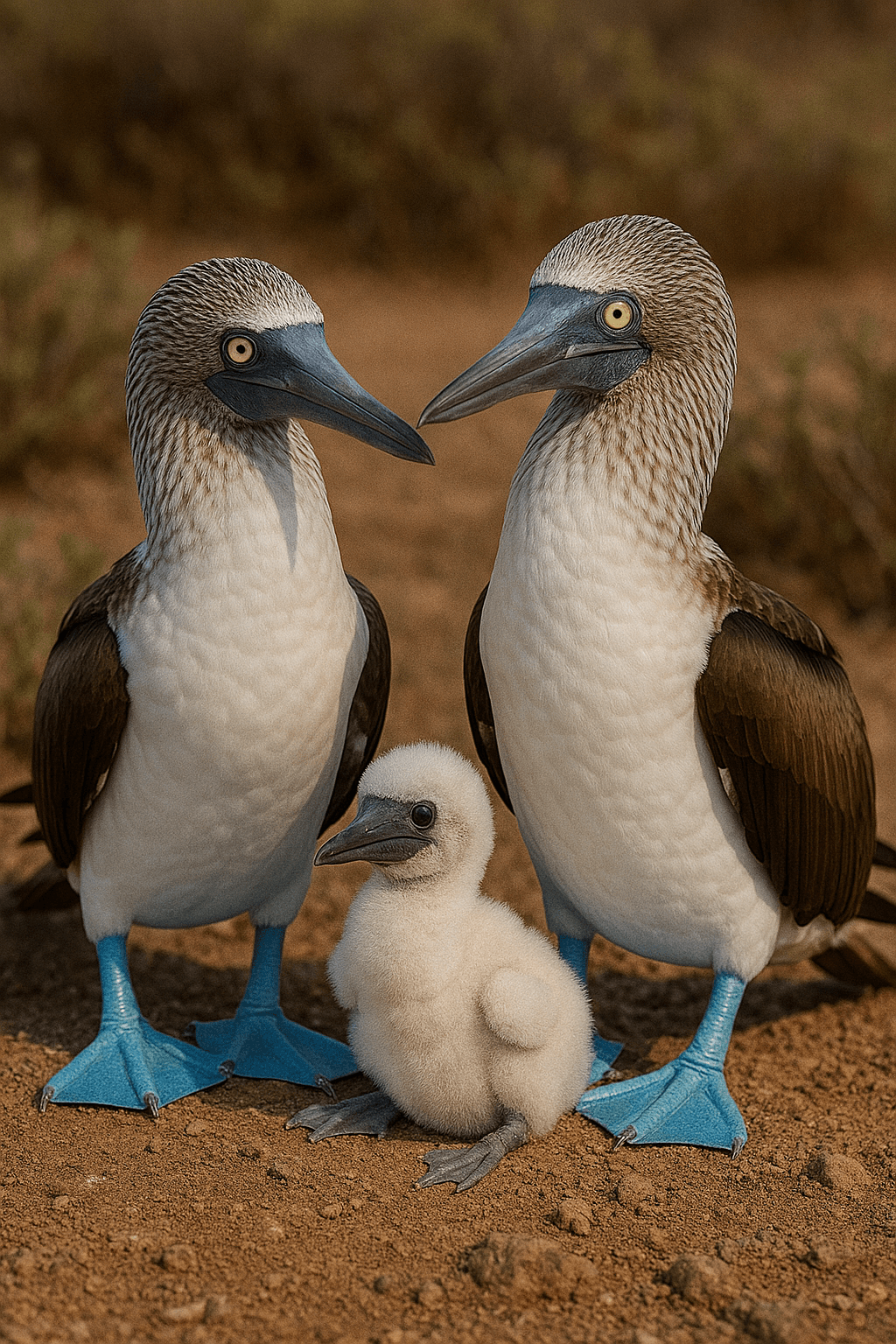
Blue-footed Booby Family (This image was generated by artificial intelligence.)
Blue-footed boobies build nests on the ground, typically on bare surfaces. The female lays one to three eggs. The incubation period lasts approximately 41 to 45 days. Both parents actively participate in raising the chicks.
Blue-footed boobies are currently classified as "Least Concern" by the IUCN. However, threats such as habitat loss, climate change, and marine pollution may endanger this species in the long term.
National Geographic. "Blue-footed Booby." Accessed May 8, 2025.
World Wildlife Fund. "Mavi Ayaklı Sümsük Kuşlarının Neden Mavi Ayakları Var ve Diğer 8 Gerçek." World Wildlife Fund. Accessed May 8, 2025. https://www.worldwildlife.org/stories/why-do-blue-footed-boobies-have-blue-feet-and-8-other-blue-footed-booby-facts.

Definition and Characteristics
Habitat and Distribution
Behavior
Reproduction
Conservation Status