


This article was automatically translated from the original Turkish version.
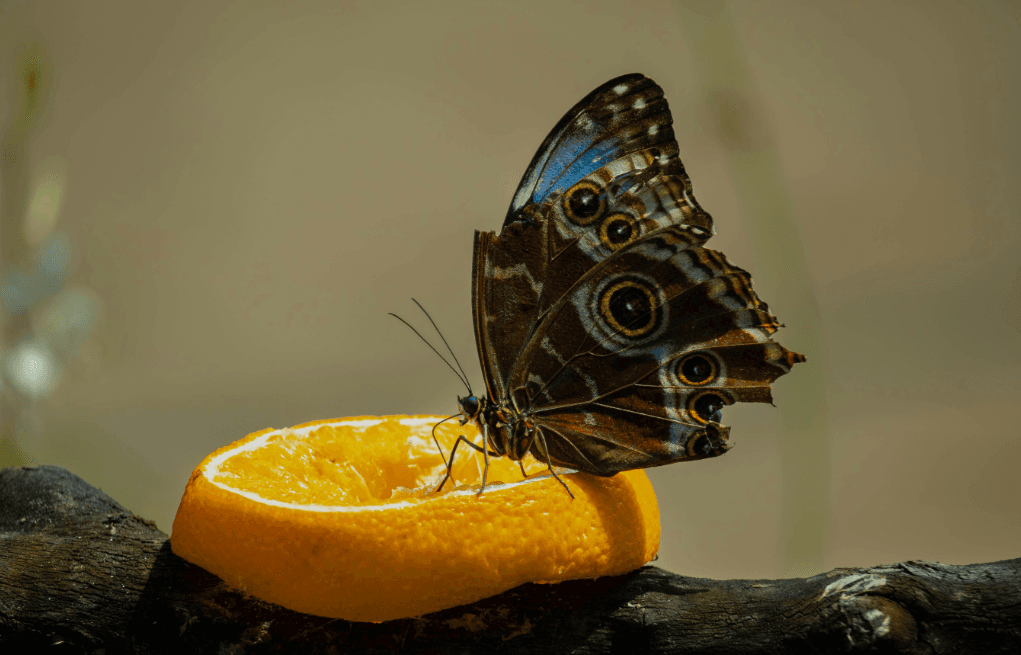
Blue Morpho Butterfly (Morpho Menelaus)
Type Name | Morpho menelaus | ||||||||
|---|---|---|---|---|---|---|---|---|---|
Common Name | Blue Morpho Butterfly | ||||||||
Family | Nymphalidae | ||||||||
Subfamily | Morphinae | ||||||||
Order | Lepidoptera | ||||||||
Habitat | Tropical rainforests of Central and South America | ||||||||
Lifespan | Approximately 115–137 days (from egg to death) | ||||||||
Adult Lifespan | Average 2 weeks | ||||||||
The Blue Morpho butterfly (Morpho menelaus) is a large species of butterfly found in the tropical rainforests of Central and South America, distinguished by its brilliant blue upper wing surface. Its coloration arises not from pigment but from microscopic wing structures that reflect light. The underside of the wings is brown and serves a camouflage function. These butterflies typically feed on ripe fruit juices and fly at low altitudes.
The most distinctive morphological feature of the Blue Morpho butterfly is the brilliant blue coloration seen on the wings of males. This color is not pigment-based but results from the refraction of light by diamond-shaped microscopic scales on the wing surface. The wings change color between brilliant blue and dull brown depending on the angle of incoming light, creating a visual effect that alters the butterfly’s visibility during flight and provides protection against predators.
These butterflies can have a wingspan of up to approximately 20 cm. The undersides of their wings feature patterns and eye-like spots that serve a camouflage function. These spots are especially effective at misleading predators when the butterfly is at rest. Females typically have wings colored in shades of brown, yellow, and black rather than blue. This sexual dimorphism (gender-based color difference) is a key characteristic for identifying the species.

Blue Morpho Butterfly (Pexels)
Blue Morpho butterflies are naturally distributed across the rainforests of Central and South America. They are particularly abundant in the forests of Brazil, Costa Rica, and Venezuela. However, some species can be observed across a broader geographic range extending as far north as North America.
These butterflies are characteristic inhabitants of regions with high biodiversity, such as the Amazon rainforest. They typically inhabit dense forested areas, especially in moist and shaded environments. These habitats provide suitable conditions for both feeding and camouflage, which are essential for the species’ survival.
Blue Morpho butterflies are known for their striking color changes during flight. The diamond-shaped microscopic scales on the upper wing surface refract light at different angles, causing the butterfly’s color to shift from brilliant blue to dull brown. This visual effect is perceived by predators as the butterfly suddenly disappearing and reappearing, serving as a defensive mechanism.
When at rest, the butterfly closes its wings, revealing the eye-like spots along the wing edges. These structures have evolved to confuse and misdirect predators attempting to feed on the butterfly. Such behaviors form an essential part of the visual defense strategies that Blue Morphos have developed within their ecological system to evade predators.
The life cycle of Morpho butterflies, from egg to death, lasts approximately 115 to 137 days. During this short period, adverse weather conditions—particularly heavy rainfall or prolonged droughts—can reduce the survival chances of caterpillars. However, when caterpillars detect environmental threats, they enter a state called diapause to protect themselves. In this state, metabolic activity slows dramatically and energy consumption drops to a minimum. Diapause is analogous to hibernation in warm-blooded animals and enables caterpillars to survive without food until the danger has passed.

Blue Morpho Caterpillar (Pexels)
Morpho butterflies live for about two weeks on average, typically without reproducing before dying. Instead of feeding on nectar or pollen, they are attracted to water sources. Their diet includes various substances such as tree sap, juices from ripe or decaying fruit, and other liquids. Although their feeding habits differ from those of many other butterflies, they still play a role in pollination.
In rainforests, Morpho caterpillars serve as a primary food source for predators such as birds and lizards. As a result, Blue Morpho caterpillars have developed defensive mechanisms to enhance their chances of survival. These caterpillars, which look very different from the adult butterflies, are reddish-brown in color with lemon-green markings. They are well adapted to feeding on leaves. Their most important defense is their toxicity. These brightly colored larvae are covered in fine hairs that can cause irritation upon contact. While their toxins pose only a mild threat to humans with allergies, they can be lethal to small animals. These features protect them from predators.
BioExplorer. "Top 21 Facts About Blue Morpho Butterfly." Bio Explorer. Accessed May 31, 2025. https://www.bioexplorer.net/blue-morpho-butterfly-facts.html/
Gözcelioğlu, Bülent. "Mavi Morfo Kelebeği." *TÜBİTAK Popüler Bilim Dergisi* 54, no. 1095 (May 2021): 82. Accessed May 31, 2025. Accessed adresi.
Pexels. "Doğada Portakal Diliminde Mavi Morfo Kelebeği." Pexels. Accessed May 31, 2025. https://www.pexels.com/tr-tr/fotograf/dogada-portakal-diliminde-mavi-morfo-kelebegi-29311737/
Pexels. "Doğada Portakal Diliminde Mavi Morfo Kelebeği." Pexels. Accessed May 31, 2025. https://www.pexels.com/tr-tr/fotograf/dogada-portakal-diliminde-mavi-morfo-kelebegi-29311737/
Pixabay. "Tırtıl Larva Doğa Orman Fauna." Accessed May 31, 2025. https://pixabay.com/tr/photos/t%C4%B1rt%C4%B1l-larva-do%C4%9Fa-orman-fauna-7546984/

Blue Morpho Butterfly (Morpho Menelaus)
Type Name | Morpho menelaus | ||||||||
|---|---|---|---|---|---|---|---|---|---|
Common Name | Blue Morpho Butterfly | ||||||||
Family | Nymphalidae | ||||||||
Subfamily | Morphinae | ||||||||
Order | Lepidoptera | ||||||||
Habitat | Tropical rainforests of Central and South America | ||||||||
Lifespan | Approximately 115–137 days (from egg to death) | ||||||||
Adult Lifespan | Average 2 weeks | ||||||||
No Discussion Added Yet
Start discussion for "Blue Morpho Butterfly (Morpho menelaus)" article
Morphological Characteristics
Distribution and Habitat
Behavior and Ecology
Reproduction
Diet
Conservation Status