

This article was automatically translated from the original Turkish version.
Dimension(s) | 132 × 283 cm | ||||||||
|---|---|---|---|---|---|---|---|---|---|
Location Museum | Russian State Museum - Русский Музей | ||||||||
Original Name(s) | Burlaks on the Volga | ||||||||
Technique | Oil on canvas | ||||||||
Artist | Ilya Efimovich Repin (1844–1930) | ||||||||
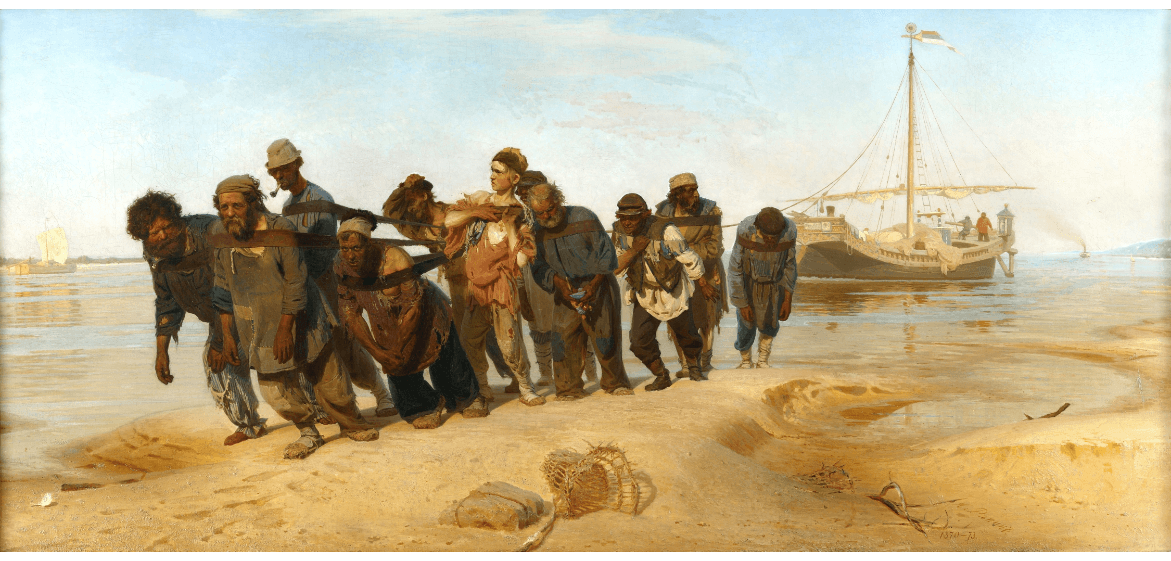
Barge Haulers on the Volga is an oil on canvas painting by Ilya Efimovich Repin, created between 1870 and 1873, depicting a group of eleven laborers pulling a barge along the banks of the Volga River. This work, which focuses on the daily toil of ordinary people, was directly associated with contemporary social reality debates in Russia upon its completion and has occupied a central position within the artist’s early output.
Ilya Efimovich Repin was born in 1844 in the town of Chuguyev, part of the Kharkov Governorate of the Russian Empire, located near the Donets River, within one of its military colonies. Due to the hereditary status of these colonies, Repin grew up in an environment with limited rights and freedoms. Similarly, his family’s position differed only marginally from that of state peasants. Although he is commonly regarded in art historical literature as a “Russian” artist, Repin was born and raised in the geographical region of Ukraine and maintained lifelong connections to this area.

Painter Ilya Efimovich Repin (Picryl)
During the second half of the 19th century, particularly under the reign of Alexander II, political and social reforms in Russia directly influenced artistic production. Some artists of this period focused their works on the lower classes and everyday life. Within this context, Repin established ties with the Artel and the Society for Travelling Art Exhibitions (Peredvizhniki), who argued that art should reflect social reality, and adopted a critical stance toward the idealizing tendencies of academic tradition.
Barge Haulers on the Volga was Repin’s first major work following his graduation from the Imperial Academy of Arts. In 1868, he was inspired by barge haulers he observed on the Neva River and later developed preliminary sketches after closely observing these laborers during his trips to the Volga River.
In 1870, Repin began working on the painting with the financial support and patronage of Grand Duke Vladimir Alexandrovich, who also granted him a scholarship. The painting was exhibited in March 1873 at the annual exhibition of the Imperial Academy of Arts in Saint Petersburg and later that same year represented Russian art at the Vienna World Exhibition. Following the exhibition, the work was acquired for the imperial collection through the initiative of Grand Duke Vladimir Alexandrovich.
The painting depicts eleven male figures, one of whom is a child, hauling a barge along a sandy riverbank using wide straps fastened across their chests. Their worn clothing, weary postures, and varied facial expressions reveal individual differences within the collective labor.
The composition consists of figures advancing horizontally against the expansive vista of the Volga. The open sky, water, and sandy ground form the background, while landscape details are deliberately restrained so as not to overshadow the figures. The child figure at the center, depicted standing more upright and attempting to remove his harness, is visually distinguished from the other figures.
Upon its first exhibition, the work was extensively analyzed by the art critic Vladimir Stasov, who regarded it as a concrete embodiment of expectations for Russian national art. Stasov emphasized elements such as the narrow landscape framing, the powerful depiction of a collective group, the sense of shared movement, and the realistic portrayal of the figures.
Some art historians have viewed Barge Haulers on the Volga as an early example of the multi-figure, socially themed compositions that Repin would continue to produce in later years. The painting is regarded both as a defining milestone in the artist’s career and as one of the foundational works of 19th-century Russian realism.
Barge Haulers on the Volga is currently held in the collection of the State Russian Museum in Saint Petersburg. Executed in oil on canvas, the painting measures 132 × 283 cm and is registered in the museum’s inventory under the number Ж-4056.
Güler, Ercan. "İlia Efimoviç Repin’in Volga Kayıkçıları Eserinin 3D Modeli ile Karşılaştırılması." Artfactor 2. Uluslararası Sanat ve Tasarım Sempozyumu Bildirileri, (February 2025): 43–58. Accessed January 14, 2026. https://www.academia.edu/129228504/IL%C4%B0A_EF%C4%B0MOV%C4%B0CH_REP%C4%B0N_%C4%B0N_VOLGA_KAYIK%C3%87ILARI_ESER%C4%B0N%C4%B0N_3D_MODEL%C4%B0_%C4%B0LE_KAR%C5%9EILA%C5%9ETIRILMASI
Kurt, Eymen. "Çarlığın Son Büyük Ressamı: İlya Repin." *Gazete Bilkent*, 2022. Accessed January 10, 2026. https://gazetebilkent.com/genel/eymenkurt/carligin-son-buyuk-ressami-ilya-repin/
Shimshon, Ariela. "The Recipe for Success: Repin’s Painting Barge-Haulers on the Volga and Stasov’s Conception of Russian Art." *Arts* 10, no. 85 (2021): 1–13. Accessed January 14, 2026. https://www.researchgate.net/publication/357043432_The_Recipe_for_Success_Repin's_Painting_Barge-Haulers_on_the_Volga_and_Stasov's_Conception_of_Russian_Art
State Russian Museum (Русский музей). "Volga'da Kayık Çekenler - Burlaki na Volge." Russian Museum: Virtual Branch. 2015. Accessed January 14, 2026. https://rusmuseumvrm.ru/data/collections/painting/19_20/zh_4056/

Dimension(s) | 132 × 283 cm | ||||||||
|---|---|---|---|---|---|---|---|---|---|
Location Museum | Russian State Museum - Русский Музей | ||||||||
Original Name(s) | Burlaks on the Volga | ||||||||
Technique | Oil on canvas | ||||||||
Artist | Ilya Efimovich Repin (1844–1930) | ||||||||
No Discussion Added Yet
Start discussion for "Boat Pullers on the Volga (Painting)" article
Ilya Efimovich Repin and the Social Context of His Time
Origin and Exhibition of the Work
Composition and Depiction
Critical Reception and Place in Art History
Current Status of the Work