
This article was automatically translated from the original Turkish version.
+2 More
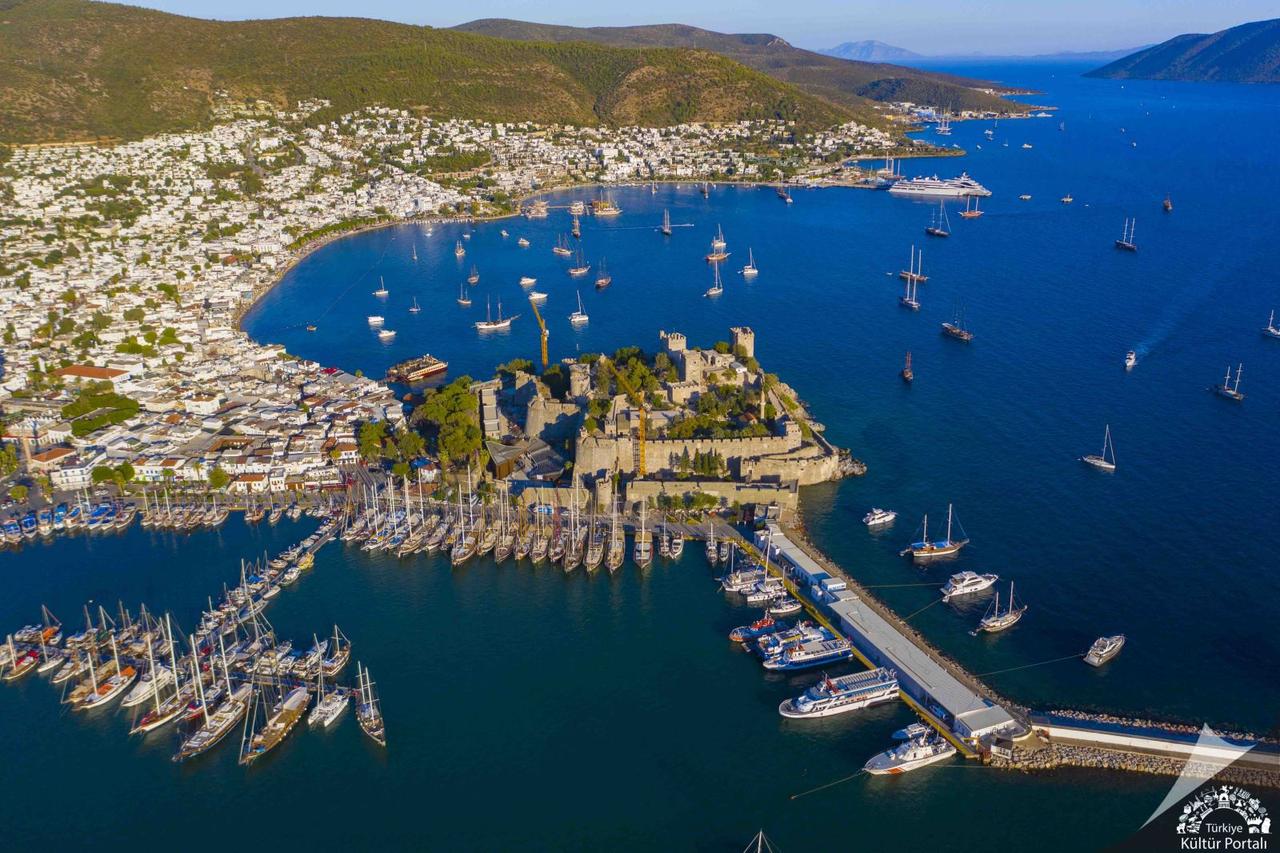
Bodrum Castle
Location | Bodrum district center 5 km from the center. Castle It is located on a peninsula surrounded by sea on three sides. On the shore of Bodrum Harbor | ||||||||
|---|---|---|---|---|---|---|---|---|---|
Geographical Features | Length: 1800 meters, Width: 20-120 meters, Height: 100 meters | ||||||||
Establishment | Bodrum Castle was begun to be built by the Knights of Rhodes in 1406 and its construction lasted approximately a century. | ||||||||
Former Name | Castle of Saint Peter | ||||||||
Bodrum Castle is a medieval fortress built in 1406 by the Knights of Saint John on a strategic peninsula in the Bodrum district of Muğla. Located between Bodrum Harbor and İçkale Harbor and surrounded on three sides by the Aegean Sea the castle has served various military religious and cultural functions throughout history. Originally known as Sanctus Petrus the castle incorporates stones sourced from the ancient Mausoleum of Halicarnassus leaving traces of different historical periods. Today the castle houses the Bodrum Underwater Archaeology Museum and continues to exist as an important cultural and historical heritage site under the protection of the Republic of Türkiye Ministry of Culture and Tourism.
Bodrum Castle (Turkish Museums)
Bodrum Castle is located in the Bodrum district of Muğla province on the southwestern coast of Türkiye along the Aegean Sea. The castle is situated between Bodrum Harbor and İçkale Harbor and built on a peninsula surrounded by sea on three sides. Its strategic location has enabled its use for various purposes throughout history and today it functions as both a historical and tourist site.
Construction of the castle began in 1406 by the Knights of Saint John also known as the Knights of Rhodes who sought to establish a defensive base in the region. The construction process spanned many years with various works carried out throughout the 15th century. Over time new sections were added to the castle and existing structures were reinforced. During this period the architectural styles of different eras were reflected in the castle’s structure.
The castle’s original name was recorded as Sanctus Petrus Saint Peter a Latin term used during its construction period. Over time this name evolved into Petronium in local vernacular and eventually gave way to the modern name Bodrum.
The castle consists of five main towers each named after the national groups responsible for their construction:
Each tower features distinct architectural details while serving defensive and observational purposes. Inside the castle there are large courtyards water cisterns religious structures dungeons storerooms and military buildings. Various types of stone and materials were used in its construction. In particular some wall sections incorporate remnants from ancient periods.

Bodrum Kalesi (Turkish Museums)
Stones from the Mausoleum of Halicarnassus one of the Seven Wonders of the Ancient World were used in the construction of certain parts of the castle. The ruins of the mausoleum were treated as a source of building material during the castle’s construction. This practice holds both architectural and archaeological significance.
In 1522 the castle came under Ottoman Empire control and continued to serve as a military base. It was also intermittently used as a prison. The chapel within the castle was converted into a mosque during the Ottoman period. Throughout this era the castle retained its existing architecture while undergoing certain modifications.
After the founding of the Republic of Türkiye the castle remained unused for a period. Restoration efforts initiated in the 1960s led to its reorganization. In 1964 the Bodrum Underwater Archaeology Museum was established within the castle. This museum is among the first in Türkiye dedicated to underwater archaeology. Today restoration works on the castle and its surroundings are still ongoing.
Bodrum Kalesi Restorasyonu (TRT2)
The museum is located within the castle’s interior spaces and displays various archaeological artifacts recovered from shipwrecks in the Mediterranean. The collection includes amphorae glassware everyday objects from sunken vessels and other ancient finds. The museum serves as a source of information for both researchers and visitors.
Bodrum Castle is under the jurisdiction of the Republic of Türkiye Ministry of Culture and Tourism. The structure is listed on UNESCO’s Tentative List of World Heritage Sites and is protected accordingly. Ongoing archaeological excavations and restoration activities aim to preserve the castle’s historical integrity.
The castle is open to visitors during specific periods of the year. Tourists can explore the towers courtyards and museum within. Various exhibitions cultural events and scholarly activities are also held at the castle. It continues to function both as a historical monument and as a cultural center.
Anadolu Ajansı. “Bodrum Kalesi'ni 2022'de 324 Bin Kişi Ziyaret Etti.” Anadolu Ajansı, January 9, 2023. Accessed April 13, 2025.https://www.aa.com.tr/tr/yasam/bodrum-kalesini-2022de-324-bin-kisi-ziyaret-etti/2796983
Bodrum Belediyesi. "Bodrum Kalesi." Bodrum Belediyesi Resmi Web Sitesi. Accessed April 13, 2025.https://www.bodrum.bel.tr/page.php?id=20/bodrum_kalesi.
Hürriyet. "Bodrum Kalesi Nerede? Bodrum Kalesi Tarihi Özellikleri ve Hakkında Bilgi." *Hürriyet Seyahat*, May 7, 2020.https://www.hurriyet.com.tr/seyahat/bodrum-kalesi-nerede-bodrum-kalesi-tarihi-ozellikleri-ve-hakkinda-bilgi-41513512.
T.C. Bodrum Kaymakamlığı. "Bodrum Kalesi." Bodrum Kaymakamlığı Resmi Web Sitesi. Accessed April 13, 2025.http://www.bodrum.gov.tr/bodrum-kalesi.
T.C. Kültür ve Turizm Bakanlığı. "Bodrum Kalesi." Kültür Portalı. Accessed April 13, 2025.https://www.kulturportali.gov.tr/turkiye/mugla/gezilecekyer/bodrum-kalesi.
T.C. Muğla Valiliği. “Bodrum Kalesi.” Muğla Valiliği Resmi Web Sitesi. Accessed April 13, 2025.http://www.mugla.gov.tr/bodrum-kalesi.
T.C.Muğla İl Directorate of Culture and Tourism. "Bodrum Kalesi." Muğla Provincial Directorate of Culture and Tourism Official Website. Accessed April 13, 2025.https://mugla.ktb.gov.tr/TR-296867/bodrum-kalesi.html.
“Bodrum Kalesi.” Bodrum Cruise Port. Accessed April 13, 2025.https://www.bodrumcruiseport.com/tr/gorulmesi-gerekenler/bodrum-kalesi
“More Than 50,000 Visitors Attended the Renovated Bodrum Castle in the First Five Months of the Year.” Anadolu Ajansı, June 28, 2022. Accessed April 13, 2025.https://www.aa.com.tr/tr/kultur-sanat/yenilenen-bodrum-kalesini-yilin-ilk-5-ayinda-50-binden-fazla-kisi-ziyaret-etti/2594460
“Muğla Bodrum Castle Celebration of the 179th Year of the Police Organization.” Demirören Haber Ajansı (DHA). Accessed April 13, 2025.https://www.dha.com.tr/amp/yerel-haberler/mugla/bodrum/mugla-bodrum-kalesine-polis-teskilatinin-1-2617520

Bodrum Castle
Location | Bodrum district center 5 km from the center. Castle It is located on a peninsula surrounded by sea on three sides. On the shore of Bodrum Harbor | ||||||||
|---|---|---|---|---|---|---|---|---|---|
Geographical Features | Length: 1800 meters, Width: 20-120 meters, Height: 100 meters | ||||||||
Establishment | Bodrum Castle was begun to be built by the Knights of Rhodes in 1406 and its construction lasted approximately a century. | ||||||||
Former Name | Castle of Saint Peter | ||||||||
Location and General Information
Construction Process and Historical Background
Origin and Evolution of the Name
Architectural Features and Structural Elements
Relationship with the Mausoleum of Halicarnassus
Use During the Ottoman Period
Republican Era and Restoration Process
Bodrum Underwater Archaeology Museum
Management and Status
Visit Information and Usage Purposes