


This article was automatically translated from the original Turkish version.
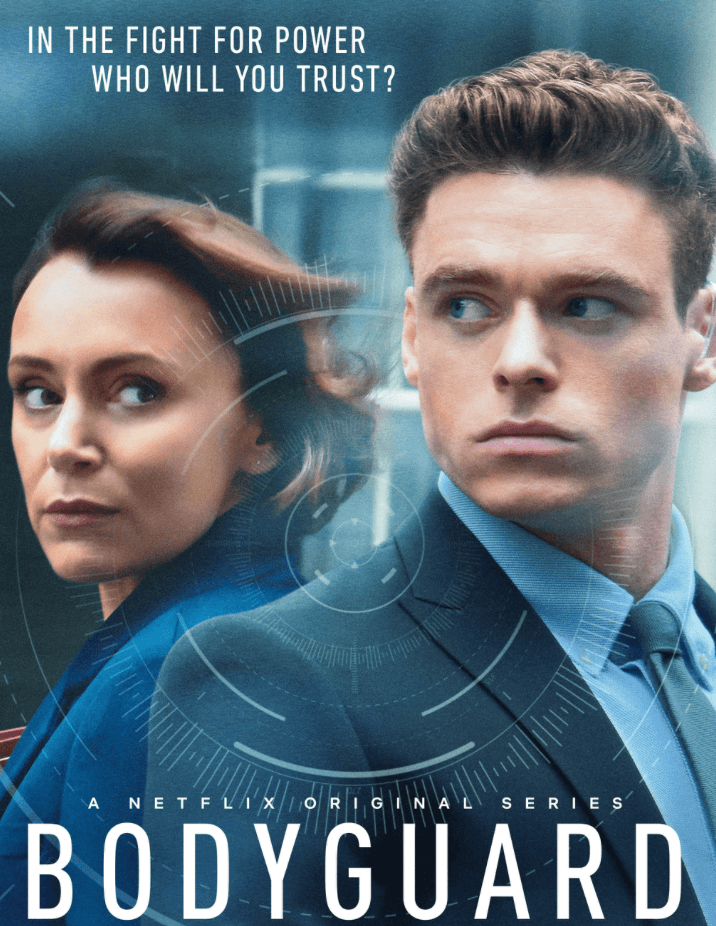
Bodyguard
Type(s) | Political Tension Police Drama Crime Drama | ||||||||
|---|---|---|---|---|---|---|---|---|---|
Creator | Jed Mercurio | ||||||||
Producer(s) | Simon Heath, Jed Mercurio, Elizabeth Kilgarriff | ||||||||
Actors | Richard Madden, Keeley Hawes, Sophie Rundle | ||||||||
Platform | Netflix BBC One | ||||||||
Number of Episodes | 6 | ||||||||
Duration | Each episode is approximately 60 minutes | ||||||||
Directed by Thomas Vincent and John Strickland and written by Jed Mercurio, Bodyguard succeeded in captivating its audience with a gripping political tension narrative despite consisting of only six episodes. The series presents a high-paced story that unfolds at the intersection of Britain’s internal political security mechanisms and individual trauma.
Bodyguard begins with former Afghan War veteran David Budd being assigned to protect Home Secretary Julia Montague. Budd’s struggle with post-service trauma (PTSD) and the ideological contrasts embodied by Montague’s policies add depth to the narrative. The series fictionalizes the United Kingdom’s Royalty and Specialist Protection (RaSP) unit, and many details featured in the show — such as single-person protective duties or emotional attachments — do not reflect reality according to experts.
While the political atmosphere draws on concepts like the “snoopers’ charter” and evokes debates from an earlier era, particularly those surrounding surveillance laws in the early 2000s, its references are grounded more in the complex security-politics dynamics of today than in the simpler order of the past.
David Budd, portrayed by Richard Madden, stands at the center of the series as a man torn between his sense of duty and his personal beliefs, haunted by wartime psychological collapse. The theme of PTSD became controversial, with some critics arguing that it was handled superficially and that its inconsistent spirit fabric realism was questionable.
Julia Montague, played by Keeley Hawes, is a complex character shaped by ambition and security policy. One of the series’ most compelling aspects is the tense dynamic between these two characters. However, the relationship between Montague’s political building and Budd’s past is explored not merely on a personal level but as an ideological conflict.
The high blood pressure established in the first episode remains unbroken until the sixth. However, this pace has been criticized by some viewers as artificial, even strained by plot devices that stretch logical event boundaries. The BBC-produced series became the most-watched program in the UK after the 2018 World Cup, with a single final episode drawing 12.6 million views.
In terms of representations of security and terrorism, Bodyguard repeats certain clichés. Narrative elements centered around the “Muslim terrorist” stereotype were criticized by reviewers as responsibility lacking in nuance.
The episodes directed by Thomas Vincent and John Strickland take viewers not only into the political fiction but also into the psychological depth of personal conflicts. Richard Madden’s performance earned him the 2019 Golden Globe Award for Best Actor in a Television Series Drama. Madden powerfully conveys the character’s physical and mental struggles.
The camera’s perspective, focusing closely on Madden’s body and reactions, subverts the “male protector” archetype. Julia Montague’s position of control further supports this dynamic; gender roles and representations of power in the series challenge classical norms.
Bodyguard is regarded as one of the rare recent examples of “watercooler TV” — series that audiences watch simultaneously and discuss the next day. It particularly attracted attention for drawing in viewers aged 16 to 34 age. In an era where Digital platforms have fragmented viewing habits, the show’s instant viewership figures were striking.
Although producer Jed Mercurio has made encouraging statements about a second season, no official production process has been announced. It is clear that BBC and Netflix wish to sustain this success, but the timing of a potential follow-up season remains uncertain.
IMDb. *Bodyguard (TV Series 2018)*. Accessed March 27, 2025. https://www.imdb.com/title/tt7493974/
The BBC Series. Accessed March 27, 2025. https://www.intelligent-protection.com/bbc-series-bodyguard.html
The Guardian. “To die for: how Bodyguard became the biggest new TV drama of the decade”. Accessed March 27, 2025. https://www.theguardian.com/tv-and-radio/2018/sep/06/bodyguard-the-return-of-watercooler-tv
World Productions. *Bodyguard*. Accessed March 27, 2025. https://www.world-productions.com/productions/bodyguard

Bodyguard
Type(s) | Political Tension Police Drama Crime Drama | ||||||||
|---|---|---|---|---|---|---|---|---|---|
Creator | Jed Mercurio | ||||||||
Producer(s) | Simon Heath, Jed Mercurio, Elizabeth Kilgarriff | ||||||||
Actors | Richard Madden, Keeley Hawes, Sophie Rundle | ||||||||
Platform | Netflix BBC One | ||||||||
Number of Episodes | 6 | ||||||||
Duration | Each episode is approximately 60 minutes | ||||||||
No Discussion Added Yet
Start discussion for "Bodyguard (TV Series)" article
In the Shadow of Security Policies: Theme and Context
Internal Tensions of the Characters: David Budd and Julia Montague
Boundaries Between Tension, Representation, and Reality
Production Quality, Direction, and Acting Performances
Impact on the Television Culture of the Era and Ongoing Discussions