

This article was automatically translated from the original Turkish version.
+2 More
Category | Strategic Bomber | ||||||||
|---|---|---|---|---|---|---|---|---|---|
Origin(s) | USA (Boeing) | ||||||||
Engine(s) | 8 x Pratt & Whitney TF33-P-3/103 turbofan engines | ||||||||
First Flight(s) | 1952 | ||||||||
Entry into Service | 1955 | ||||||||
Crew | 5 people | ||||||||
Maximum Takeoff Weight | 220.00 kg | ||||||||
Maximum Speed | 1.047 km/s | ||||||||
Range(s) | 14.162 km | ||||||||
Boeing B-52 Stratofortress is a long-range, heavy bomber aircraft developed by Boeing for the United States Air Force. Designed for strategic bombing missions during the Cold War, the B-52 has been in continuous service since the 1950s and has played a central role in both nuclear deterrence and conventional combat operations.

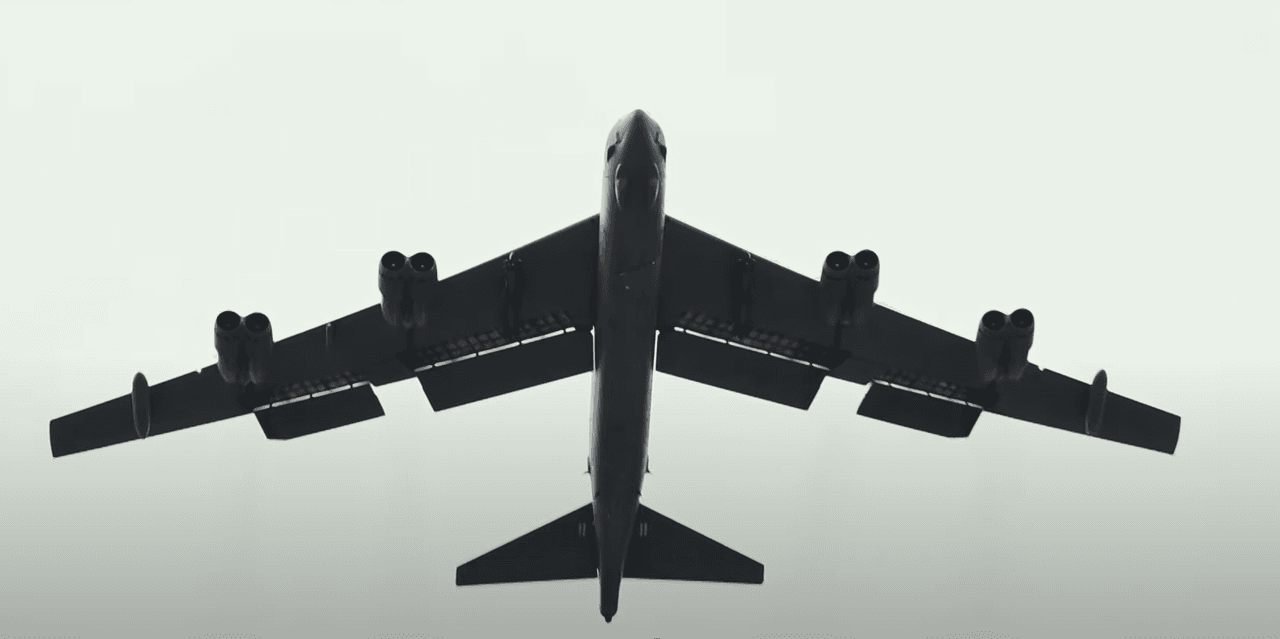
Boeing B-52 Stratofortress (Wilson Hui)
The development of the B-52 began in the late 1940s as a strategic deterrent against the Soviet Union. Over the decades, it underwent continuous modernization, resulting in the production of eight main variants (B-52A, B, C, D, E, F, G, H). Today, the only model still in active service is the B-52H.
The aircraft’s design was aerodynamically shaped to meet the jet bomber requirements of its era. Thanks to rapid advancements during its development, the B-52 made its first flight in 1952 and became operational in 1955. The nickname “Stratofortress” emphasizes its capability to operate at high altitudes.
Boeing B-52 Stratofortress (Haci Productions)
One of the B-52’s distinguishing features is its eight turbofan engines, arranged in four underwing pods with two engines per pod. The Pratt & Whitney TF33-P-3/103 engines used in the B-52H model provide the aircraft with high speed and extended range. The main landing gear features a unique “bicycle” configuration, with two main gear units mounted in tandem to support the aircraft’s weight. This design allows the B-52 to operate from rough or uneven terrain, while small outrigger wheels on the wingtips provide lateral stability.

Boeing B-52 Stratofortress (Haci Productions)
The B-52 holds a unique place in aviation history due to its size and performance.
The aircraft is a “dual-capable” platform, able to carry both nuclear and conventional munitions. It can carry more than 31,500 kg of ordnance in its internal bomb bay and on external underwing hardpoints. This includes:
Over its decades of operational service, the B-52 has participated in numerous conflicts. During the Vietnam War, it conducted extensive “carpet bombing” missions against large areas. In the 1991 Gulf War, it launched attacks against ground targets and has since been employed in operations in Afghanistan and Iraq.
Boeing B-52s Vietnam War Carpet Bomb (Buyout Footage Historic Film Archive)
Air Force Global Strike Command. "B-52 Stratofortress." Air Force Global Strike Command. Accessed August 16, 2025. https://www.afgsc.af.mil/About/Fact-Sheets/Article/630716/b-52-stratofortress
Boeing. "B-52 Stratofortress." *Boeing.* Accessed August 16, 2025. https://www.boeing.com/defense/b-52
Buyout Footage Historic Film Archive. "Vietnam War B-52s Carpet Bomb." YouTube. Accessed August 16, 2025. https://www.youtube.com/watch?v=9XktwcMsij4
Haci Productions. "B-52 Stratofortress Strategic Bomber." YouTube. Accessed August 16, 2025. https://www.youtube.com/watch?v=xDt5SY7UDS4
Hui, Wilson. "USAF B-52 Bomber." Flickr. Accessed August 16, 2025. https://www.flickr.com/photos/wilsonhui/35414198423/in/photolist-VXr2nZ-aaid9m-2oQ7Utx-aahJ95-PNDUP-J3s7Z1-qE4bJL-V92xoj-5QzZWR-aaeVTH-4N6WqT-ca2vyu-bFBuvM-fToeDV-pKz1gM-2icukw6-2gfQhxJ-2gfQhA9-2gfQhz7-4RfFZX-bXnQpV-qE4hib-qpM1Z3-2kLVsmD-PfxFAh-33cFF2-2gJArmj-2i1gyeL-4TJPBt-2kLRMmw-bDEE4H-5PZ4H2-2oQnPUT-7S4Ldk-2kfvE4K-24op83o-4Nb8By-2h14HMG-2hFVsPm-2pbDJY5-2kQLaC6-21Gvntj-JMuTyH-2hf3asE-2iJ7FcS-2hFRMSR-2h14J5a-2tD6iS-PNDSZ-2hFRMvi
Pima Air & Space Museum. "Boeing B-52A." Pima Air & Space Museum. Accessed August 16, 2025. https://pimaair.org/museum-aircraft/boeing-b-52a
Simple Flying. "Odd Facts About The Boeing B-52 Stratofortress." Simple Flying. Accessed August 16, 2025. https://simpleflying.com/odd-facts-boeing-b-52-stratofortress
The Museum of Flight. "Boeing B-52G Stratofortress." The Museum of Flight. Accessed August 16, 2025. https://www.museumofflight.org/exhibits-and-events/aircraft/boeing-b-52g-stratofortress
U.S. Air Force. "B-52H Stratofortress Fact Sheet." U.S. Air Force. Accessed August 16, 2025. https://www.af.mil/About-Us/Fact-Sheets/Display/Article/104465/b-52h-stratofortress

Category | Strategic Bomber | ||||||||
|---|---|---|---|---|---|---|---|---|---|
Origin(s) | USA (Boeing) | ||||||||
Engine(s) | 8 x Pratt & Whitney TF33-P-3/103 turbofan engines | ||||||||
First Flight(s) | 1952 | ||||||||
Entry into Service | 1955 | ||||||||
Crew | 5 people | ||||||||
Maximum Takeoff Weight | 220.00 kg | ||||||||
Maximum Speed | 1.047 km/s | ||||||||
Range(s) | 14.162 km | ||||||||
No Discussion Added Yet
Start discussion for "Boeing B-52 Stratofortress" article
Design and Development
Engine and Structural Features
Technical Specifications
Weapons Systems and Payload Capacity
Combat History