This article was automatically translated from the original Turkish version.
+1 More
Origin(s) | Bolu | ||||||||
|---|---|---|---|---|---|---|---|---|---|
Type of Geographical İndication | Warning Sign | ||||||||
Registration Number | 683 | ||||||||
Registration Date | 23.02.2021 | ||||||||
Product / Product Group(s) | Processed and unprocessed fruits vegetables and mushrooms | ||||||||
Applicant/Registrant(s) | Bolu Chamber of Commerce and Industry | ||||||||
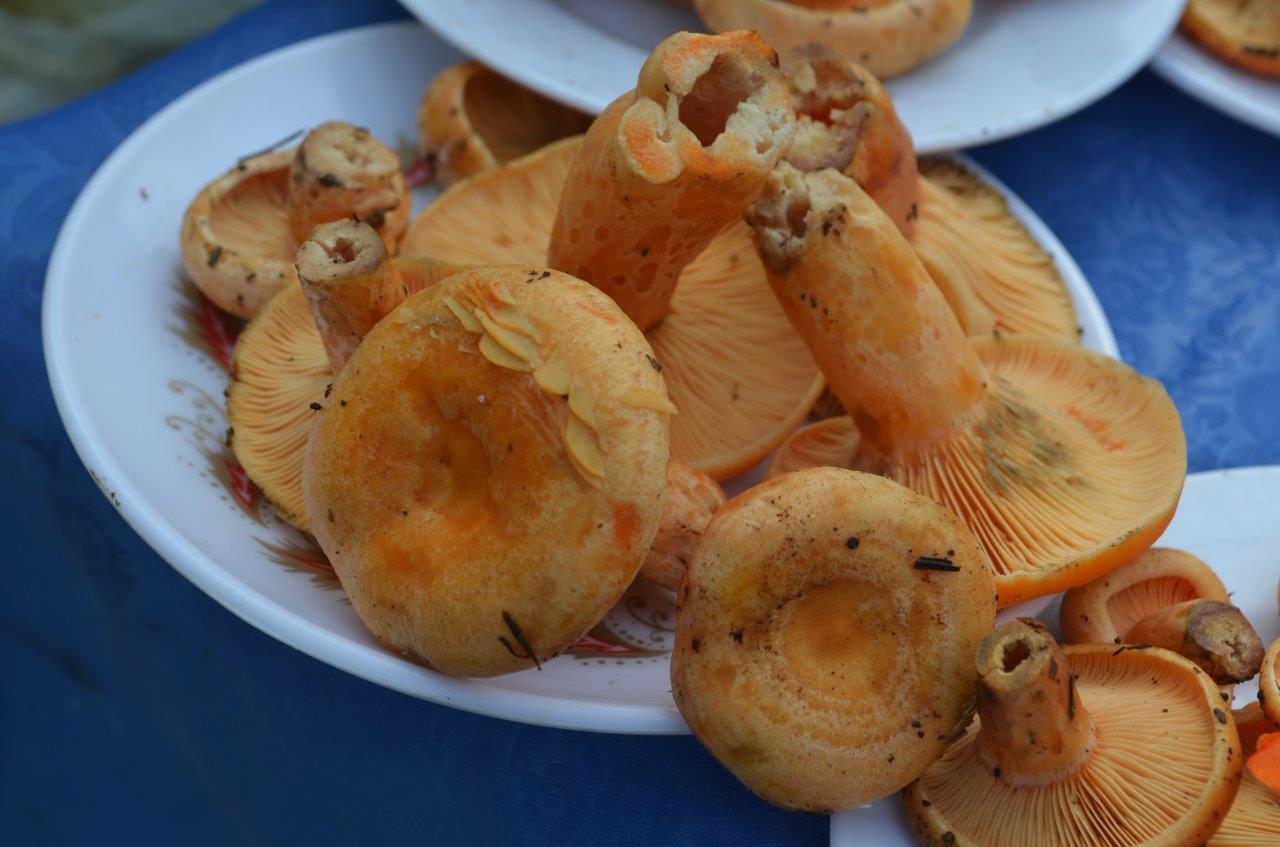
Bolu Kanlıca Mushroom is an edible fungus belonging to the species Lactarius salmonicolor of the family Russulaceae. This product was registered as a geographical indication by the Turkish Patent and Trademark Office (TPTO) on 23 February 2021, with the application submitted on 23 January 2020 by the Bolu Chamber of Commerce and Industry. The geographical indication covers the province of Bolu.

Kanlıca Mushroom (Bolu Municipality)
The people of Bolu also refer to this mushroom by local names such as "Melki," "Ebişek," and "Elicek." Prominent for its orange color, this mushroom has a cap and a brittle structure that easily breaks into small pieces. The key physical features distinguishing it from other mushrooms are as follows:
The cap displays narrow, concentric rings in light or dark orange. The upper portion of the cap above the stem is concave. Although typically found dry, it may exhibit stickiness when moist. The cap margins are initially turned inward but gradually flatten and assume a funnel shape over time.
The cap measures 3 to 11 cm in diameter, while the stem is cylindrical, 3 to 6.5 cm in length and 0.8 to 1.5 cm in thickness.
The flesh of the mushroom is white. When cut or damaged, it exudes a milky, orange-colored liquid. This liquid is bitter and stains the mushroom flesh orange initially, then wine-red after some time, and finally green. The cross-section of the stem is porous or hollow. The lamellae beneath the cap are the same orange color as the stem.
By weight, the mushroom consists largely of moisture (89–93%). It also contains 9–13% protein, 5–5.5% ash, and 0.5–0.8% lipids.
The Bolu Kanlıca mushroom is a purely natural product that grows under wild conditions and is not commercially cultivated.
The mushroom is found in forested areas of Bolu province, particularly on calcareous soils covered with needle litter, often near fir trees.
It is harvested in autumn (late August, September, and October), when rainfall and humidity increase, average temperatures drop to around 11–12°C, and monthly precipitation reaches 35–45 mm. Shaded, dark, or sunless secluded areas with 60–70% air humidity provide suitable conditions for its growth.
Harvesting occurs when the cap has reached a size of 3–11 cm and exhibits a slight concavity with inward-curled margins. At the time of collection, the milky and fleshy parts must show an orange color that gradually turns reddish-brown and eventually matte green over time.
The mushroom is collected by digging or cutting at its base and placed in baskets or containers to prevent damage. No additional cleaning is required beyond trimming the stem. Methods for storage include freezing, drying, frying in oil, and canning. Drying is carried out using warm air flow below 50°C; after cleaning, the mushrooms are sliced into pieces 2 to 5 mm thick.
Even in regions with a strong culinary tradition such as Mengen, the Kanlıca mushroom does not appear as a standard dish on commercial restaurant menus; it is primarily consumed in home kitchens through individual recipes. The importance of fresh consumption, its short shelf life, and the absence of a standardized recipe limit the mushroom’s contribution to Mengen’s gastronomic tourism. On the other hand, mushroom foraging serves as an economic activity providing supplementary income for the local population, especially women in rural areas.

Kanlıca Mushroom (Bolu Municipality)
The authority responsible for monitoring the production and market release of the Bolu Kanlıca mushroom in accordance with its registered characteristics consists of experts convened under the coordination of the Bolu Chamber of Commerce and Industry. This monitoring body includes experts from the Bolu Provincial Directorate of Agriculture and Forestry, the Department of Food Engineering at Abant İzzet Baysal University, and the Bolu Regional Forest Directorate. Inspections are conducted annually to verify proper harvesting in natural habitats, appropriate preservation methods, and correct use of the geographical indication label and emblem, and may be carried out at any time in response to complaints.
Bolu Municipality. "Kanlıca Mantarı." Bolu Municipality. Accessed October 24, 2025. https://www.bolu.bel.tr/gastronomi/kanlica-mantari/
Turk Patent and Trademark Office. "Bolu Kanlıca Mantarı." Accessed October 24, 2025. https://ci.turkpatent.gov.tr/cografi-isaretler/detay/1583
Turk Patent and Trademark Office. "Bolu Kanlıca Mantarı." Turk Patent and Trademark Office. Accessed October 24, 2025. https://ci.turkpatent.gov.tr/Files/GeographicalSigns/37926ed5-2001-43d0-b5ba-08418a3d08b0.pdf
Çavuş, Osman, and Şenay Eker. 2022. “Coğrafi İşaretli Ürünlerin Sürdürülebilir Gastronomi Turizmi Bağlamında Değerlendirilmesi: Bolu Kanlıca Mantarı, Mengen Örneği”. *Türk Turizm Araştırmaları Dergisi* 6 (1): 303–20. Accessed October 24, 2025. https://doi.org/10.26677/TR1010.2022.953
Origin(s) | Bolu | ||||||||
|---|---|---|---|---|---|---|---|---|---|
Type of Geographical İndication | Warning Sign | ||||||||
Registration Number | 683 | ||||||||
Registration Date | 23.02.2021 | ||||||||
Product / Product Group(s) | Processed and unprocessed fruits vegetables and mushrooms | ||||||||
Applicant/Registrant(s) | Bolu Chamber of Commerce and Industry | ||||||||
No Discussion Added Yet
Start discussion for "Bolu Kanlıca Mushroom" article
Definition and Distinguishing Characteristics
Appearance
Dimensions
Internal Structure
Chemical Composition
Growth Conditions and Harvesting
Natural Habitat
Seasonal Distribution
Harvesting Criteria
Cleaning and Storage
Regional Gastronomy and Economic Impact
Monitoring