

This article was automatically translated from the original Turkish version.
Registration Number | 1266 | ||||||||
|---|---|---|---|---|---|---|---|---|---|
Registration Date | 01.12.2022 | ||||||||
Application Number | C2021/000308 | ||||||||
Application Date | 09.08.2021 | ||||||||
Name of the Geographical Indication | Bolvadin Mantısı | ||||||||
Product / Product Group(s) | Mantı / Foods and Soups | ||||||||
Type of Geographical Indication | Mahreç mark | ||||||||
Applicant/Registrant(s) | Bolvadin Chamber of Commerce and Industry | ||||||||
Address of the Registrant | Şazi Mah. Eski Demirciler İçi Sok. Bolvadin AFYONKARAHİSAR | ||||||||
Geographical Boundary | Bolvadin district Afyonkarahisar province | ||||||||
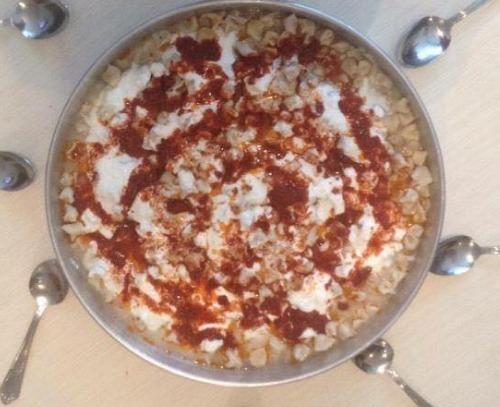
Bolvadin mantı is a traditional variety of mantı unique to the Bolvadin district of Afyonkarahisar province, prepared without filling and distinguished by its unique cooking method. The dough, made from bread wheat flour, water, salt, and egg, is rolled into thin sheets and cut into 2.5–3 cm squares, then sealed without filling and baked. The prepared mantı are cooked in a sauce made from tomato paste, water, and meat stew derived from beef fillet or lamb shank. When served, garlic-infused yogurt is poured over the top, and optionally sprinkled with red pepper flakes and black pepper, and served hot.
Bolvadin mantı is a traditional dish specific to the Bolvadin district of Afyonkarahisar province. It is fundamentally prepared as hollow dumplings that are baked and then cooked in a sauce of tomato paste and meat, served hot with garlic-infused yogurt. Unlike classical mantı varieties found elsewhere in Türkiye, Bolvadin mantı is made without any filling; its production method and presentation give it a unique gastronomic identity.
The dough consists of bread wheat flour, water, salt, and egg. The rolled sheets are cut into squares measuring 2.5–3 cm on each side and sealed so that the interior remains hollow. After baking, these pieces are cooked in a liquid containing tomato paste and meat. At serving, they are accompanied by a mixture of yogurt and garlic. This method differentiates Bolvadin mantı both in preparation and cooking from other mantı types.
The main ingredients used in the production of Bolvadin mantı can be grouped into three stages:
The production process occurs in three stages:
After kneading, the dough is rested for 25–30 minutes, then rolled out into sheets measuring 75–80 cm in diameter and 3–3.5 mm in thickness. These sheets are cut into square pieces, each sealed by bringing the edges together so that the interior remains hollow.
Fillet or shank meat is cut into cubes measuring 1.5–2 cm on each side. It is cooked at 180°C for 18–20 minutes, then stewed for an additional 20–25 minutes. The prepared meat stew can be stored for 3 days at 4–6°C in a refrigerator or for 3–4 months at –18°C.
The baked mantı are heated at 180°C for 18–20 minutes on the same tray, then mixed with tomato paste. Water and meat stew are added, and the mixture is cooked at 100–115°C for 15 minutes. Immediately before serving, the prepared garlic-infused yogurt is added. Approximately 40–60 g of yogurt sauce is served per portion. Cooked Bolvadin mantı should be consumed fresh; however, the baked mantı dough can be stored in the refrigerator for up to one month.
Bolvadin mantı can only be produced within the administrative boundaries of the Bolvadin district of Afyonkarahisar province. This restriction is linked to the product’s development based on traditional knowledge and local production methods. As an inseparable part of the regional culinary culture, this variety of mantı carries a geographical indication due to its exclusive association with this area. The entire production process must take place within these defined boundaries.
The production and marketing of Bolvadin mantı are controlled under a monitoring system coordinated by the Bolvadin Chamber of Commerce and Industry, the registered owner. The monitoring board consists of a three-member team representing the Chamber of Commerce and Industry, the Bolvadin Commercial Exchange, and the District Directorate of Agriculture and Forestry. Inspections are conducted at least once per year and may be carried out at any time upon request or complaint. The criteria monitored include the suitability of ingredients, adherence to the production method, and the correct use of the geographical indication and product name.
Turkish Patent and Trademark Office. "Bolvadin Mantısı." Turkish Patent and Trademark Office. Accessed August 16, 2025. https://ci.turkpatent.gov.tr/Files/GeographicalSigns/42691d4d-5e5f-492d-ba76-0f35a9478356.pdf
Türk Patent ve Marka Kurumu. "Bolvadin Mantısı." Accessed August 16, 2025. https://ci.turkpatent.gov.tr/cografi-isaretler/detay/4766

Registration Number | 1266 | ||||||||
|---|---|---|---|---|---|---|---|---|---|
Registration Date | 01.12.2022 | ||||||||
Application Number | C2021/000308 | ||||||||
Application Date | 09.08.2021 | ||||||||
Name of the Geographical Indication | Bolvadin Mantısı | ||||||||
Product / Product Group(s) | Mantı / Foods and Soups | ||||||||
Type of Geographical Indication | Mahreç mark | ||||||||
Applicant/Registrant(s) | Bolvadin Chamber of Commerce and Industry | ||||||||
Address of the Registrant | Şazi Mah. Eski Demirciler İçi Sok. Bolvadin AFYONKARAHİSAR | ||||||||
Geographical Boundary | Bolvadin district Afyonkarahisar province | ||||||||
Distinctive Features
Ingredients and Recipe/Production Process
Dough Ingredients (for 6 portions)
Meat Stew (Beef Fillet or Lamb Shank)
For Cooking the Mantı
For the Topping:
Production Steps
Dough Preparation and Shaping
Meat Preparation (Stewing)
Cooking and Serving the Mantı
Geographical Boundary and Production Area
Monitoring and Protection Mechanism