


This article was automatically translated from the original Turkish version.
+2 More
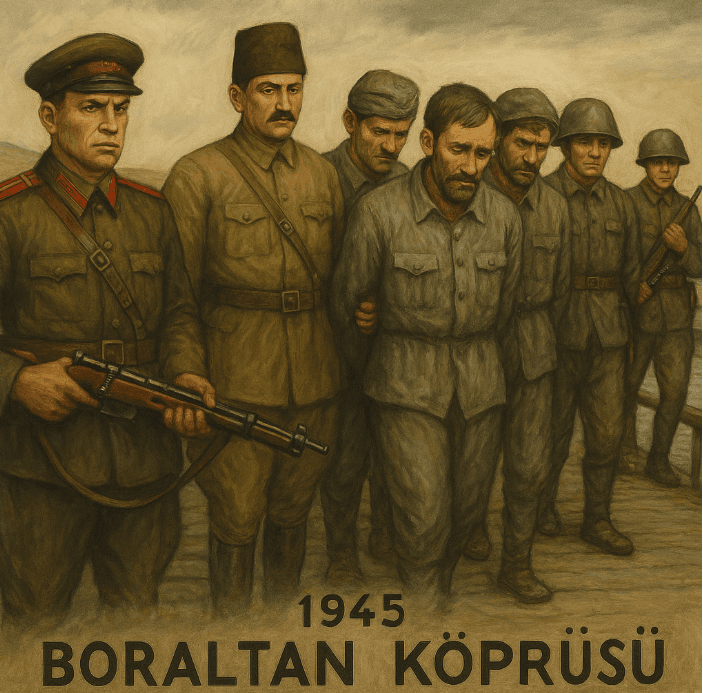
The Boraltan Bridge Incident was a border incident that occurred in 1945 between Türkiye and the Soviet Union, resulting in the repatriation of Azerbaijani-origin Soviet soldiers who had sought asylum in Türkiye. Information indicating that those repatriated were executed on Soviet territory has rendered the incident a controversial issue within the context of human rights. The event derives its name from the bridge over the Boraltan Creek, located between Türkiye and the Nakhchivan Autonomous Republic.
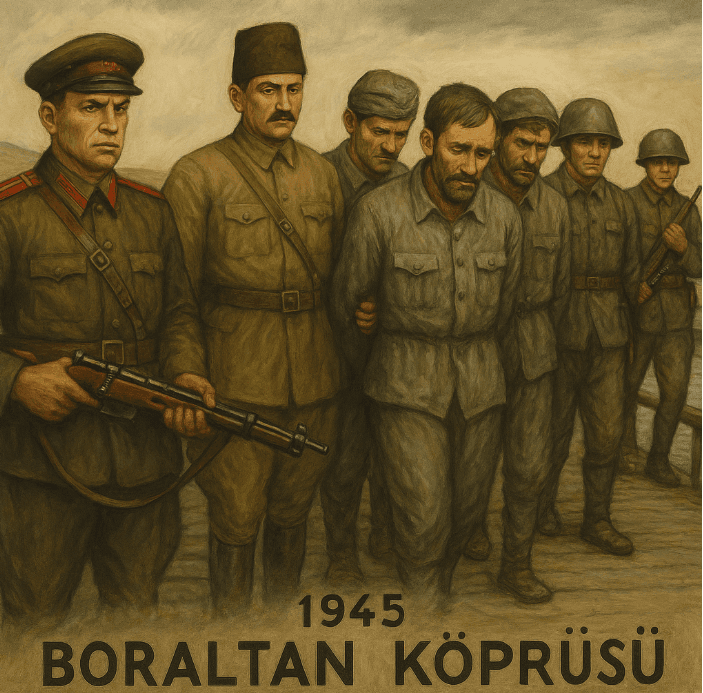
A Visual Depicting the Boraltan Bridge Incident (Generated by Artificial Intelligence)
Throughout the Second World War, Türkiye pursued a policy of neutrality but began to reorient its foreign policy as the war neared its conclusion. By 1945, Türkiye had aligned itself with the Allied Powers, the victorious side in the conflict. Soviet demands regarding Eastern Anatolia and pressure over the Turkish Straits significantly influenced Turkish foreign policy.
In the final stages of the war, certain Azerbaijani-origin soldiers serving in the Soviet army defected from Soviet authority and sought asylum in Türkiye for various reasons. Among the asylum seekers were individuals who had escaped from prisoner-of-war camps as well as those who crossed the border directly. It is estimated that their number exceeded 150, and they were housed in a camp established in Yozgat, Türkiye.
Following Türkiye’s declaration of war against Germany and Japan in May 1945, thereby joining the Allies, the Soviet Union demanded the repatriation of these individuals. The Turkish government decided that repatriation would be limited to military personnel and based on the principle of reciprocity. However, in practice, the Soviet side was assessed as failing to uphold the same conditions.
On 6 August 1945, approximately 195 individuals were handed over to Soviet authorities across the Boraltan Bridge. Information indicating that a significant portion of these individuals were executed after repatriation has rendered the incident controversial within the framework of human rights and the principle of non-refoulement. A planned second transfer was never carried out.
The Boraltan Bridge Incident occurred during a sensitive period when Türkiye was striving to define its position within the postwar international system and its foreign policy orientation. Amid tangible perceptions of Soviet threat, Türkiye sought to align itself with the West and was compelled to make such decisions to avoid diplomatic confrontation with the Soviet Union. Nevertheless, the fact that the repatriated individuals faced an evident threat to their right to life, yet were still handed over, has prompted scrutiny of Türkiye’s approach to human rights.
From the perspective of international law, the incident can be interpreted in multiple ways due to the fact that the principle of non-refoulement had not yet become a universal norm at the time. Nevertheless, it is known that the asylum seekers clearly expressed their unwillingness to return and stated that their lives were in danger. This situation raises ethical and legal questions regarding the state’s obligation to provide protection.

No Discussion Added Yet
Start discussion for "Boraltan Bridge Disaster" article
Historical Background
Course of Events
Political and Legal Assessment