


This article was automatically translated from the original Turkish version.
+2 More
Bornova Kınalı Bamyası
Product / Product Group(s) | Processed and unprocessed fruits and vegetables and mushrooms | ||||||||
|---|---|---|---|---|---|---|---|---|---|
Applicant/Registrant(s) | Bornova Municipality | ||||||||
Registration Date | 27.10.2020 | ||||||||
File Number | C2019/017 | ||||||||
Registration Number | 581 | ||||||||
Bornova Kınalı Bamyası is a delicate, fiber-free variety of okra cultivated primarily in the Bornova district of İzmir Province and surrounding areas, characterized by reddish blotches on its fruit. The product has been officially registered with the Turkish Patent and Trademark Office under the designation “Origin Name” and is protected under Registry No. 581 dated 27 October 2020.

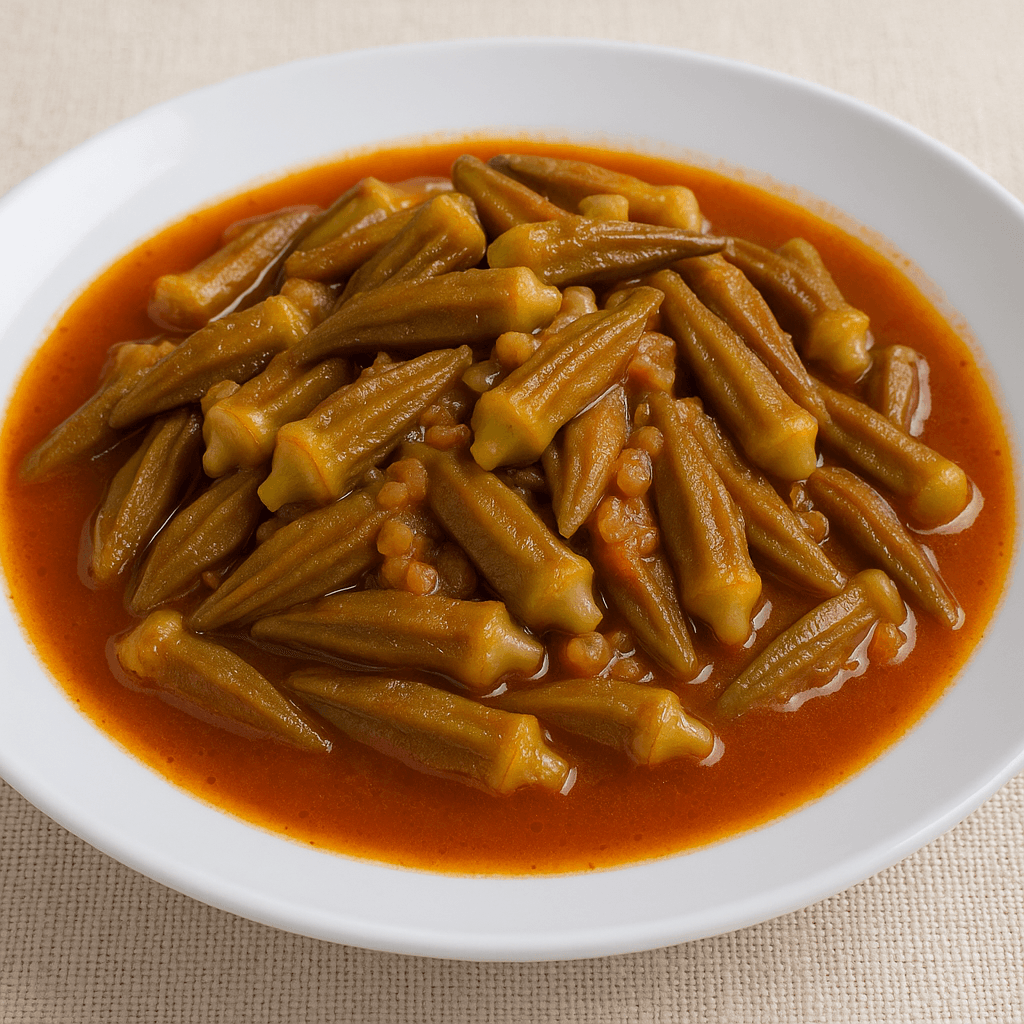
Bornova Kınalı Bamyası (Generated by Artificial Intelligence)
Bornova Kınalı Bamyası, botanically classified as Abelmoschus esculentus (L.) Moench, is a local variety identified by irregular red pigmentation on the fruit and fruit stalks. This red coloring varies depending on exposure to sunlight and is caused by anthocyanin pigments.
Fresh fruits are 3.5–4.0 cm in length, approximately 2.5–3.0 grams in weight, and about 1 cm in diameter. The fruits are typically five-loculed, though six- to seven-loculed forms are occasionally observed. Its fiber-free, tender, and slightly hairy structure makes it suitable for canning. Unlike other varieties, it does not cloud the canning liquid.
The plant has a robust structure and, under proper cultivation conditions, can develop five to six lateral branches and reach a height of approximately three meters. Reddish pigmentation may also appear on the roots, leaves, and stems. Harvesting can begin from the second half of June. This early harvest period enhances the product’s economic value.

Bornova Kınalı Bamyası (Turkish Patent)
Bornova Kınalı Bamyası is sown in mid-April when soil temperature reaches 15 °C. Seeds are obtained from previous seasons. Light, well-drained soils are preferred, and furrow irrigation is applied instead of drip irrigation to support root development. Nitrogen fertilizer application is planned based on soil analysis. It is recommended to apply 3–4 kg of nitrogen, 8–10 kg of phosphorus, and 10–12 kg of potassium per decare. Excessive fertilization can damage plant structure and inhibit the development of red blotches.
Under optimal cultivation conditions, plants grow 1.0–1.5 cm per day. Harvested fruits measure 3.5–4.0 cm in length and weigh 2.5–3.0 grams. Harvesting is conducted daily to include any overlooked overripe fruits. On average, 10,000–12,000 plants are cultivated per decare, with yields ranging from 500 to 750 kg.
Bornova Kınalı Bamyası is produced in the districts of Bornova, Urla, Çeşme, Karaburun, Balçova, Narlıdere, Güzelbahçe, Torbalı, Menderes and Seferihisar in İzmir Province. Monitoring is carried out by a commission composed of representatives from the Department of Horticultural Crops at Ege University Faculty of Agriculture, the Ege Agricultural Research Institute, and the Bornova Municipality Directorate of Agricultural Services, under the coordination of Bornova Municipality.
Ministry of Culture and Tourism of the Republic of Türkiye. "Bornova Kınalı Bamyası." *Kültür Portalı.* Accessed May 27, 2025. https://www.kulturportali.gov.tr/portal/bornova-kinali-bamyasi
Turk Patent and Trademark Office. "Bornova Kınalı Bamyası." Turk Patent and Trademark Office. Accessed May 27, 2025. https://ci.turkpatent.gov.tr/cografi-isaretler/detay/122
İzmir İl Directorate of Culture and Tourism. "Bornova Kınalı Bamyası." Accessed May 27, 2025. https://izmir.ktb.gov.tr/TR-294189/bornova-kinali-bamyasi.html

Bornova Kınalı Bamyası
Product / Product Group(s) | Processed and unprocessed fruits and vegetables and mushrooms | ||||||||
|---|---|---|---|---|---|---|---|---|---|
Applicant/Registrant(s) | Bornova Municipality | ||||||||
Registration Date | 27.10.2020 | ||||||||
File Number | C2019/017 | ||||||||
Registration Number | 581 | ||||||||
No Discussion Added Yet
Start discussion for "Bornova Kınalı Bamyası" article
Product Definition and Distinguishing Characteristics
Production Method
Geographical Boundary and Monitoring