

badge icon

This article was automatically translated from the original Turkish version.

Article

Breadboard (Circuit Board)

The platform that allows connections between electronic circuit components without the use of solder or a soldering iron is called a "Breadboard". In Turkish it is commonly referred to as "devre tahtası" or "prototip tahtası".


Breadboards are used to connect electronic components in a temporary and reversible manner. The board contains conductive holes where electronic components are inserted. Some of these holes are connected internally as rows while others are connected as columns from the underside.


Representative image of "Breadboard usage" generated by artificial intelligence.

Structure of a Breadboard

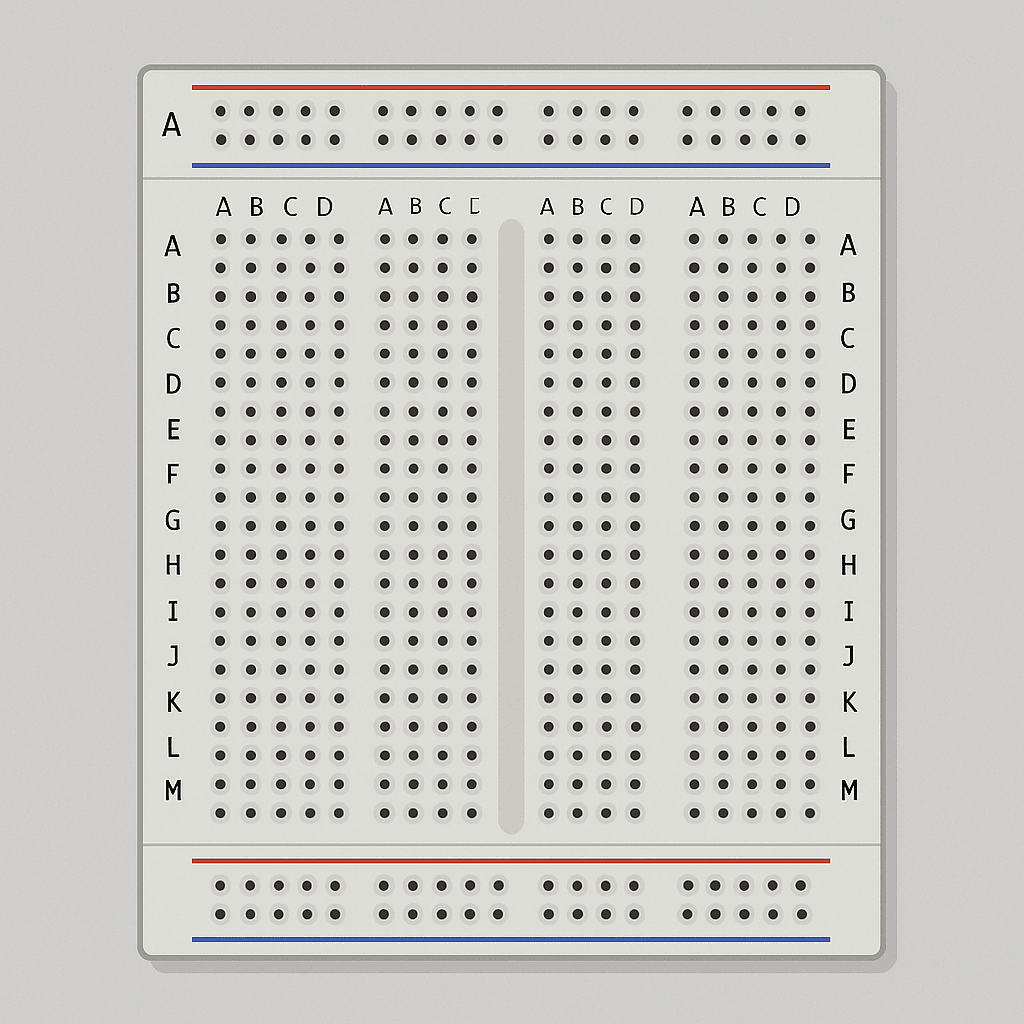
Breadboards are used to quickly connect and test electronic circuits without soldering. Their structure consists of metal conductive strips that link components together to form circuits. The basic structure of a breadboard comprises the following sections:


  • Power Rails: Located at the top and bottom of the breadboard. They are marked with red lines for positive (+) and blue lines for negative (–). They are used to supply power and connect voltage references across the circuit.
  • Connection Holes: Located in the central area. These are used to place electronic components. This section contains columns of five holes each. Since these holes are connected to the same metal strip, they are electrically connected to each other.
  • Central Divide: The central section of the breadboard is designed for integrated circuits. It prevents short circuits by separating the two rows of pins on each side of the integrated circuit.


Known Advantages and Disadvantages

Advantages

  • Components can be easily inserted and removed since no soldering is required.
  • It allows testing during circuit construction, enabling error correction and further development of the circuit.
  • It offers widespread ease of use in analog and digital circuit designs, sensor testing, IoT projects, and many other applications.

Disadvantages

  • Circuits built on breadboards are typically intended for testing and may not be suitable for long-term projects.
  • They can be inefficient in high-frequency circuits.
  • The internal metal connections in breadboards cannot carry high currents.
  • They have low mechanical durability.

Applications

Breadboards are practical and reusable platforms that greatly facilitate the design, testing, and development of electronic circuits. They are especially preferred by students, hobbyists, and engineers involved in prototyping. Thanks to their solder-free design, they enable testing of different components, rapid assembly and modification of circuits, and easy troubleshooting. In this regard, they have a broad range of applications from education to industrial development. Some of these applications are summarized in the following like:
  • Electronic Circuit Design and Testing: Used to connect and test circuits without solder or a soldering iron.
  • Electronic Projects: Used for prototyping and building projects with development boards such as Deneyap Kart and Arduino.
  • Robotics and IoT Projects: Used to test sensors, motors, and communication modules in intelligent systems and Internet of Things (IoT) projects.


Representative image of a "Breadboard" generated by artificial intelligence.

Author Information

Avatar
AuthorGonca Sude ŞahbazDecember 12, 2025 at 8:11 AM

Tags

Discussions

No Discussion Added Yet

Start discussion for "Breadboard (Circuit Board)" article

View Discussions

Contents

  • Structure of a Breadboard

  • Known Advantages and Disadvantages

    • Advantages

    • Disadvantages

  • Applications

Ask to Küre