


This article was automatically translated from the original Turkish version.
Long before the sky turned cloudy and the earth was stained with blood and suffering, in an age when stars shone brightly and spirits were pure, there stood a city at the foot of the highest mountain. The city was called Havsala. During the day, its inhabitants were bathed in sunlight; at night, they found their way by moonlight. The people of Havsala survived by cultivating crops and using meat, milk, and hides from their animals. Nearly all homes were simple, single-story structures built of wood or adobe. Only the palace in the city center was constructed from marble and waterfall stone. The waterfall immediately south of the mountain was the city’s only source of water, and thus everything drawn from it was considered precious.
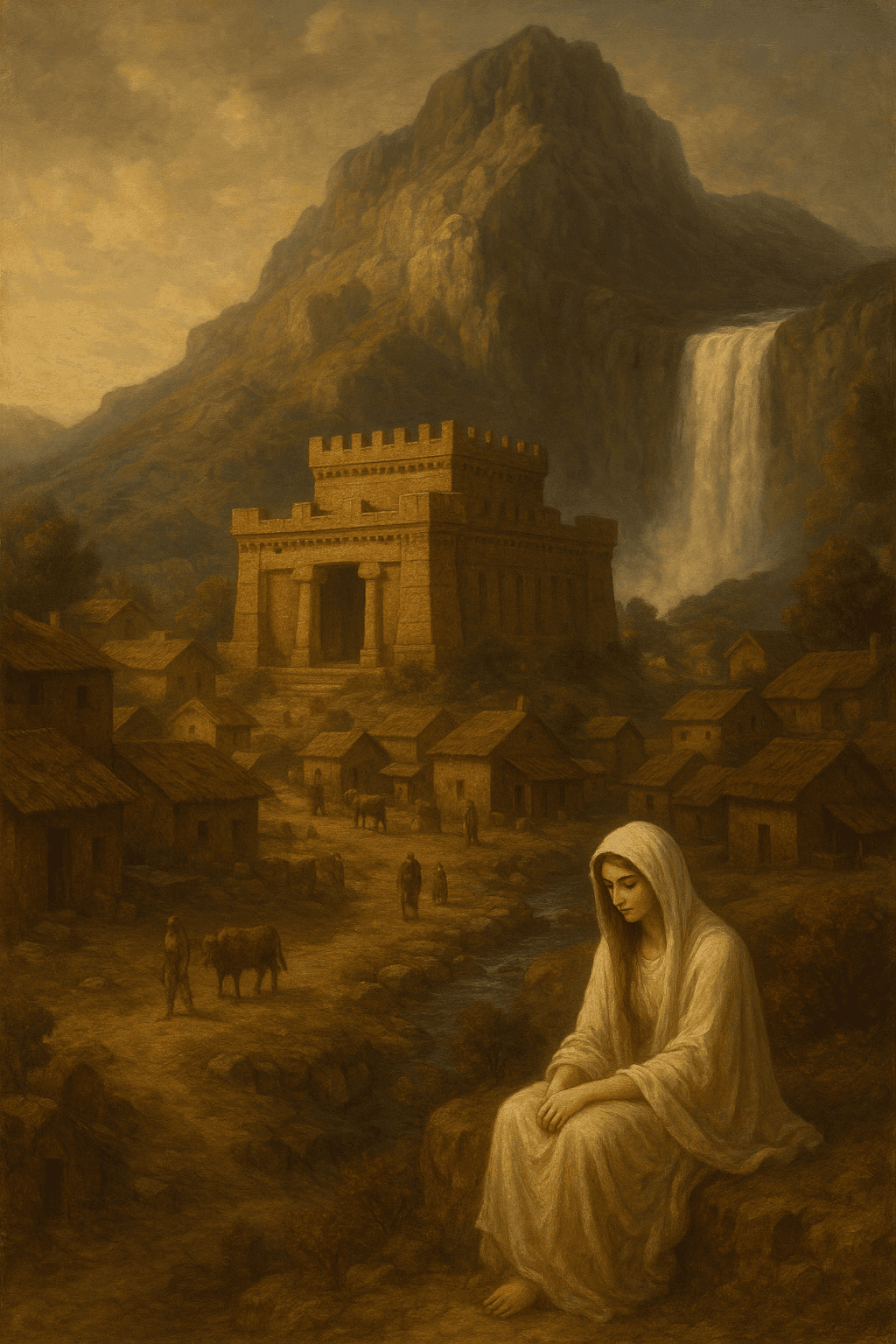
A Depiction of Havsala (Generated by Artificial Intelligence)
Lately, a quiet whisper had been circulating through the city. According to rumor, the wise man’s daughter, Aybike, had stopped eating and drinking after her brother’s sudden death and had fallen into bed. Aybike was beloved throughout the city—a kind, gentle, and compassionate soul. Her only flaw was her constant sadness. Those who had seen her laugh considered themselves blessed. Though she wandered often through the city, only two people had ever heard her laugh with joy: one beside the waterfall, and the other atop a hill at midnight, while she spoke with her brother, Gündoğdu.
Aybike’s mother had died giving birth to her and her brother. Their father raised them both, striving never to let them feel the absence of a mother. He tried every means to lift Aybike’s sadness—even taking her to doctors in distant cities. But neither medicine nor his own wisdom could ease her sorrow. Only when playing with her brother Gündoğdu did she find happiness. To see her laugh, even for a moment, made her father the happiest man in the world.
When they both turned sixteen, their interests had become clear. Gündoğdu had fallen in love with travel, writing, and storytelling—he was destined to become a wanderer like his mother. Aybike, meanwhile, spent her days wandering the forest, chasing animals, and when she found an injured one, she would race back to her father to have him treat it. One night, when Aybike did not return from the forest, her father, frantic with fear, searched the woods and found her curled up asleep beside a deer. The deer had been clawed by a bear. Realizing she had no time to return to the city and alert her father, Aybike wrapped the wound with healing herbs as her father had taught her, and waited beside the deer until it stood again—then fell asleep from exhaustion.
On one of those days when she returned to the forest, Aybike saw a wounded Kızılgerdan beneath a poplar tree. She picked up the small bird and, using materials from the bag she always carried, bandaged its wound. She fed it food and water and kept it as a guest in her home for several days. When it had fully recovered, she carried it to the forest’s edge and released it toward the sky. The bird circled overhead several times, then returned and landed gently on Aybike’s shoulder. Aybike smiled at it and asked, “Do you want to stay?” The little bird answered by gently tugging at her hair with its beak.
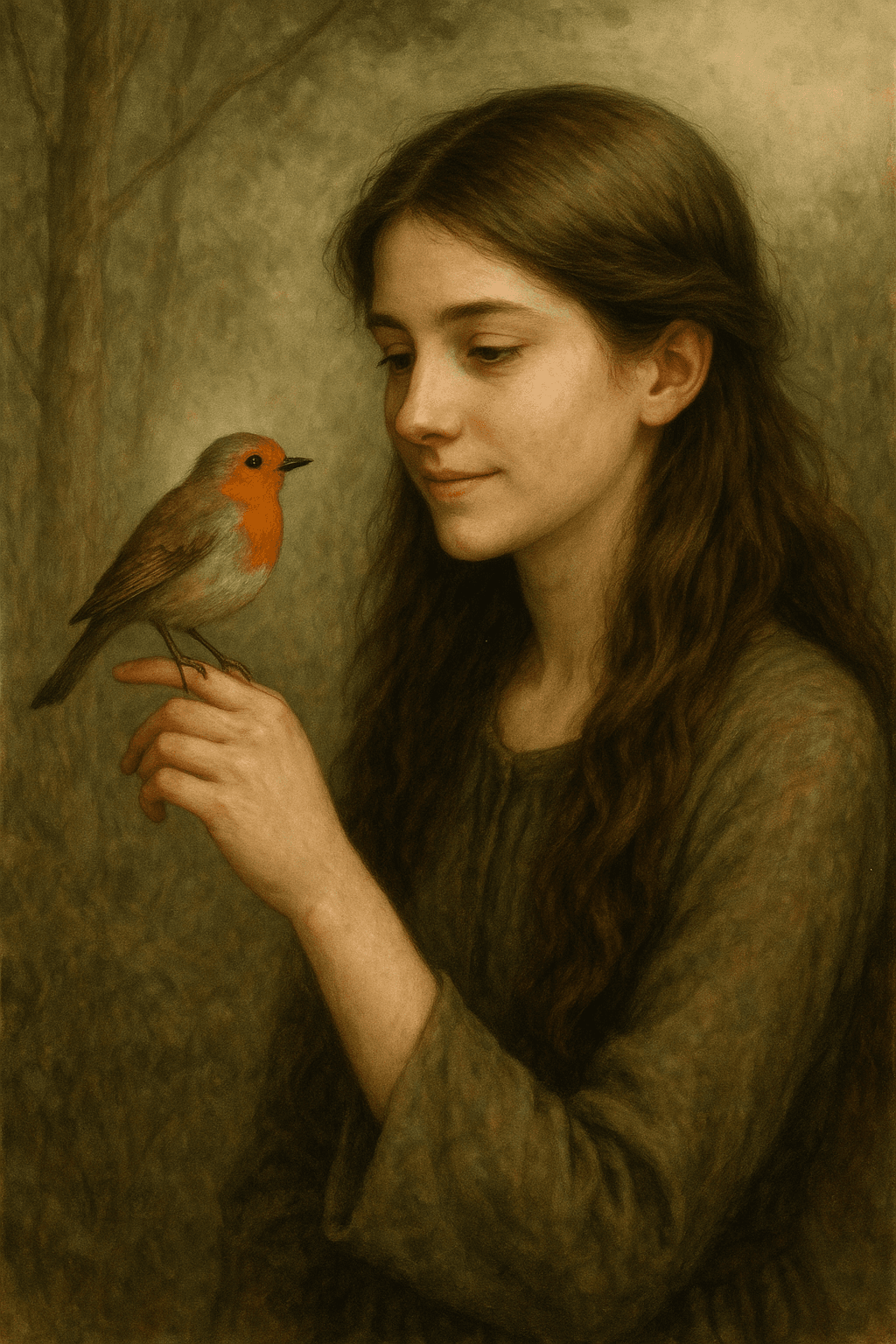
Aybike and Kiraz (Generated by Artificial Intelligence)
Since Gündoğdu began traveling frequently, Aybike fell ill more often and recovered more slowly. Some nights she ran a fever that refused to break for days. Ever since the small bird, whom she named Kiraz, came to live with her, Aybike had not once fallen ill. Though her father was puzzled by this, he was overjoyed to see his daughter’s condition improve—especially on the days when both Gündoğdu and Kiraz were home together, when she truly seemed happy.
Yes, Kiraz was not always at home. Aybike opposed keeping animals confined indoors. Kiraz had learned the path to and from the house and came and went as it pleased.
In the winter of Aybike’s seventeenth year, Kiraz returned home for the final time. After playing with her and being fed, Kiraz tugged at her hair and flew out the window. For a week afterward, Kiraz did not return, and Aybike grew anxious. Together with her father, they searched the forest desperately but found no trace of the bird. Three or four days after this, Aybike fell violently ill, stopped eating and drinking. This was the first time in her life she had come close to death. When Gündoğdu learned of her condition, he rushed home. Upon seeing him, Aybike began to eat again. When she finally regained consciousness, there stood before them a girl even more sorrowful than before.
When Aybike and Gündoğdu turned nineteen, Gündoğdu announced his intention to embark on a long journey. He had already walked nearly every street of every town and village nearby, recording his observations in a notebook. Now he wished to travel farther, to see new lands. Though their father understood his desire, Aybike did not want him to leave. Aside from Gündoğdu, she had only two people she could call friends: the veterinarian’s daughter and the architect’s son, who had lost his mind to plants. Knowing her distress, Gündoğdu pulled a book from his pack and handed it to her. “Take this. These are my notes from all the places I’ve visited. By the time you finish reading it, I will have returned.” Though reluctant, Aybike did not wish to stand in the way of someone’s dream. She took the book and embraced her brother. The next day, she walked with him to the harbor and saw him off.
Approximately two weeks later, Gündoğdu sent a letter confirming his safe arrival at the harbor. Letters continued to arrive in the following days and months. Each month, he traveled to a new country, documenting his experiences both in his journal and in letters to Aybike and their father. He wrote of six-legged elephants in Nanna and the colossal Ay Festival in Sin. What fascinated Aybike most was the vast animal market in Anu, where creatures ranged from birdlike dragons to hounds and tigers she had never seen before. Though she disliked the idea of animals being kept captive, her curiosity outweighed her distaste. In one letter, she even asked Gündoğdu to bring her a tiger. In his reply, he drew a sketch comparing the tiger’s size to that of a human, explaining why such a thing was impossible.
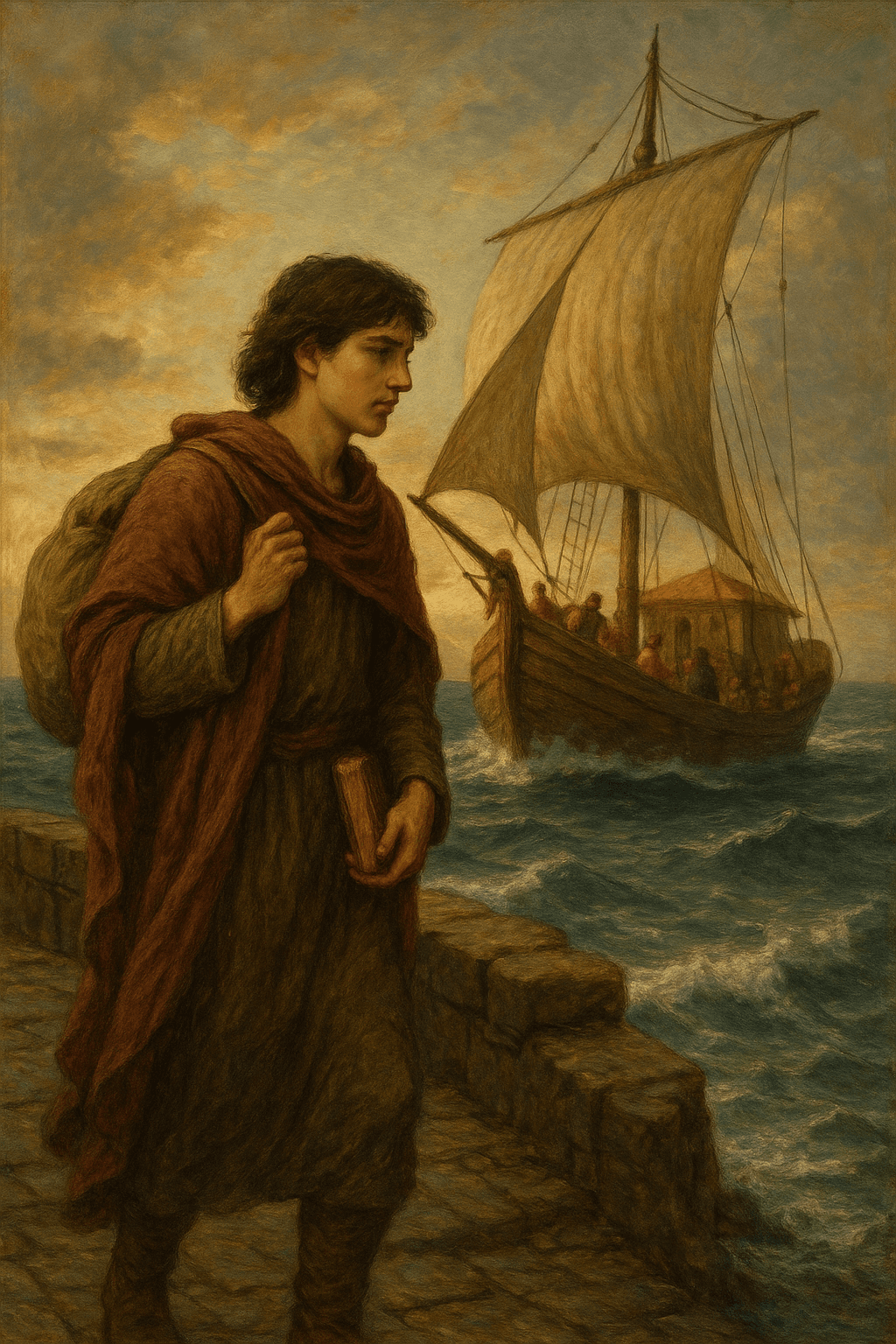
Gündoğdu Setting Out on His Journey (Generated by Artificial Intelligence)
On the day Aybike and Gündoğdu turned twenty, a letter arrived at home. It was from Gündoğdu. He was celebrating their birthday and announcing his return. He estimated he would reach Havsala’s harbor in two weeks. Aybike and her father were overjoyed and began preparing the house for his arrival. Aybike bought a new notebook to give him, and she took the feather she had preserved from her dead bird and brought it to an artisan to make into a pen. When all preparations were complete, only four days remained until Gündoğdu’s expected arrival.
On the morning of the day they awaited his return, Aybike’s father was urgently summoned to the palace. Though irritated, Aybike resolved to wait at home for her brother. As evening approached, she began to sense something was wrong. It was normal for ships to be delayed by one or two days, but her father had not returned even as night fell. Looking out the window, she saw the cobbler’s daughter collapsed by the door, weeping in the middle of the night. Seeing this, Aybike stepped outside and sat beside her, asking if she was well. The girl turned to her in shock and asked:
-Don’t you know?
Aybike stared at the girl’s face, bewildered. The girl answered her own question and continued crying:
-The ship expected to arrive today was caught in a storm and sank. No one survived.
Aybike froze upon hearing these words. Then, leaving the girl where she was, she ran swiftly toward the palace. At the gate, she found her father crouched ten or fifteen meters from the palace wall, beside a well. She approached slowly, but he did not notice her. When she drew close, she saw the notebook he held. Its pages, dried and wrinkled from exposure to saltwater, were unmistakable. At the sight, Aybike’s vision darkened and her consciousness slipped instantly into nothingness. This was the beginning of her second encounter with death.
Aksungur and İlbilge were Havsala’s most renowned sages. Though they had grown up together, they were utterly unlike one another. İlbilge was regarded as a genius in mathematics, astronomy, physics, chemistry, medicine, and biology. Aksungur, by contrast, had no rival in philosophy, literature, history, and geography. Though Aksungur always supported İlbilge’s teachings, İlbilge viewed much of Aksungur’s knowledge as useless and unreliable. Upon hearing rumors that Aksungur healed people merely through speech, he stormed into Aksungur’s school near the harbor, shouted accusations of fraud, and ended their friendship.
İlbilge believed every illness had a physical cause and could be cured only by medicinal herbs. He therefore opposed Aksungur’s verbal therapies entirely—even writing a book refuting them. Aksungur held the opposite view. To him, illness affected not only the body but also the soul. He believed some ailments were entirely spiritual and could be healed only through words, for only words could reach the soul.
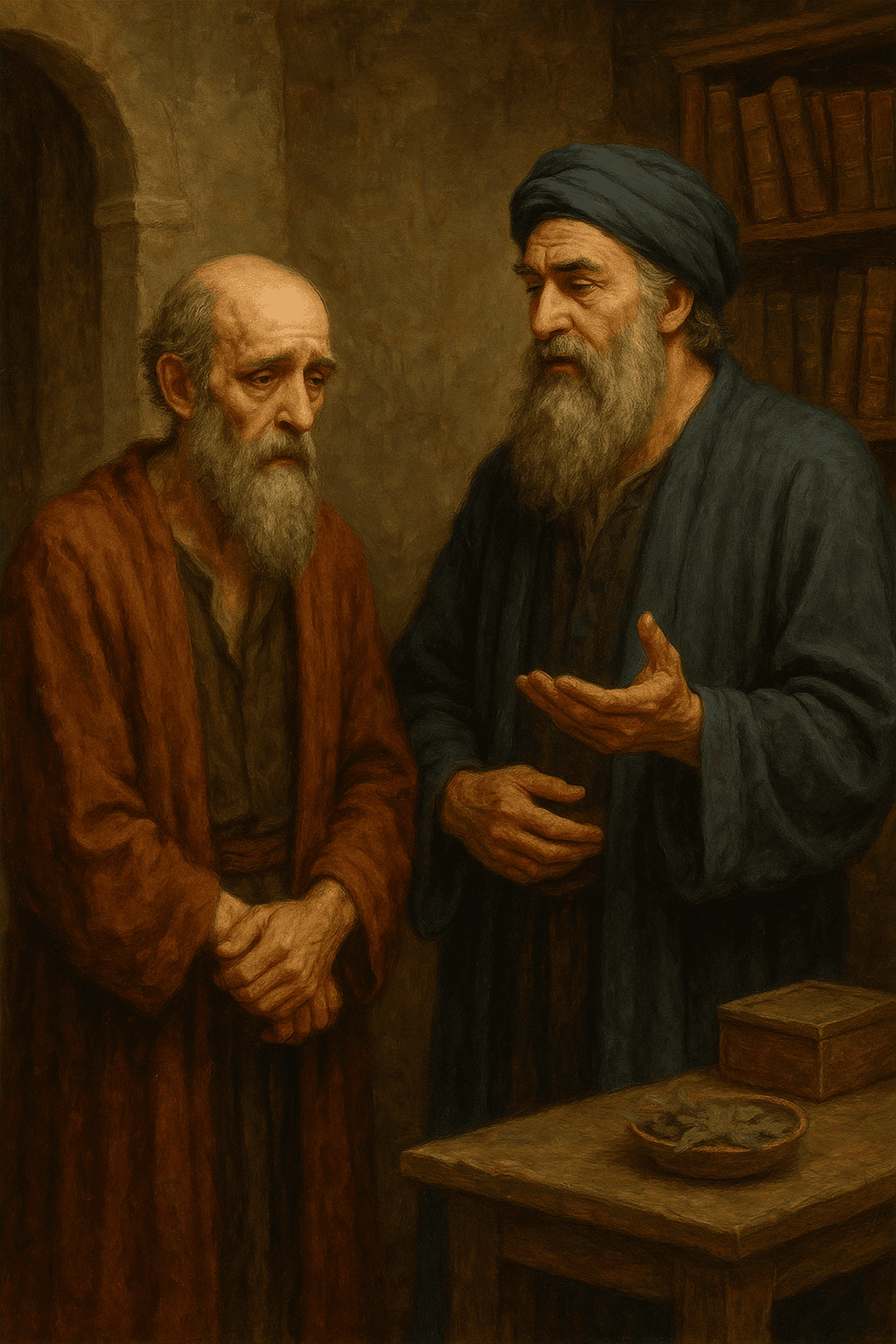
İlbilge Asking Aksungur for Help (Generated by Artificial Intelligence)
One day, while teaching his students, Aksungur noticed a stranger approaching the school. Upon closer inspection, he recognized with a mixture of surprise and joy that it was İlbilge. He had not seen him since the day he had shouted at him. He dismissed his students and hurried toward İlbilge, catching him before he entered the schoolyard. But something was wrong: İlbilge’s eyes were darkened, his skin pale, his body thin, streaks of gray in his beard, and he struggled to stand. Just as Aksungur was about to ask what had happened, İlbilge looked at him with tear-filled eyes and said, I need your help.
Aksungur immediately took his arm and said, Welcome. Come inside. He led him into the classroom and closed the door. Then he asked what was troubling him. İlbilge recounted everything: his daughter Aybike’s lifelong sadness and recurring illnesses since birth, the death of his son Gündoğdu, and how Aybike had not eaten for a month and had stopped drinking water since yesterday. When he finished, he turned to Aksungur and said:
-I have tried every healing herb known to me for twenty years, and now I watch my daughter die before my eyes. You are the only person I can entrust her to. Can you heal her?
Aksungur smiled at his friend, opened the cabinet beside him, took out a small bundle of lemon balm, and stood up.
-Let us first drink some tea, then take me to your daughter.
İlbilge stared in astonishment at the small box from which Aksungur had taken the lemon balm.
-Is this the lemon balm I gave you as a child? Have you kept it all these years?
Aksungur smiled and replied:
-Did you think a friendship could be severed only by shouting? You truly know nothing of the human soul.
After their brief conversation at the school, İlbilge led Aksungur to his home. After crossing the garden, they entered through the front door. İlbilge then led Aksungur into Aybike’s room, located in the right corner of the house. As Aksungur entered, he first looked at the frail, emaciated girl lying on the bed beside the window. Then he glanced around the room. It was beautifully arranged: drawings of animals covered the walls, books lined the shelves, and medicinal herbs hung from the rafters. Aybike barely turned her head to look at him, then turned back to the window without interest. Aksungur nodded to İlbilge to leave. When he was alone, Aksungur took a stool and sat beside the bed.
-Would you like to tell me?
Aybike remained turned away. She gave no response. Aksungur smiled at her.
-Then let me tell you a story.
Once upon a time, in an ancient land, a king wished to make his capital on a large island impregnable. He ordered massive walls to be built around the entire island. But there was a problem: if the island were fully enclosed, no food, water, or supplies could enter. The king summoned his chief architect and commanded him to build a bridge strong enough to connect the island to the mainland. The architect built a bridge of steel so sturdy that destroying it would require demolishing part of the island itself.
Years passed. The kingdom went to war with another state and suffered a crushing defeat. The only way the enemy could enter the capital was through the bridge built decades earlier. They resolved to destroy it. But the bridge was so strong that no matter how hard they tried, they could not damage its structure. Finally, they concluded the only solution was to destroy its four massive steel supports. When they detonated tons of gunpowder beneath the supports, the bridge collapsed—but so did a portion of the island, which sank into the sea. Thus they learned: just as important as building a bridge strong enough to last is building it so it can be destroyed when necessary.
When Aksungur finished speaking, he rose to leave. Just as he turned to go, a faint voice called out:
-Is that all? What happened next?
Aksungur looked at her with quiet triumph and replied:
-I will continue tomorrow. If you wish to hear the rest, do not leave.
And he stepped out.
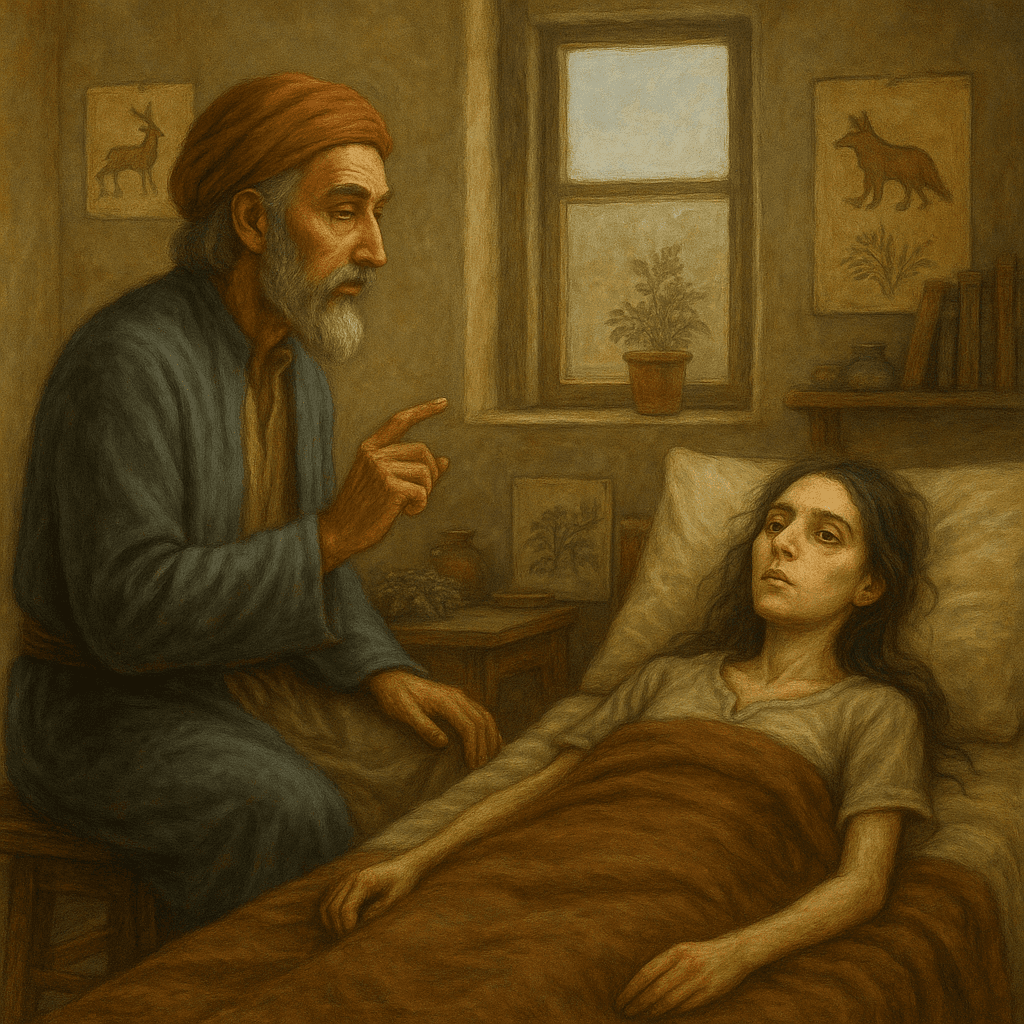
Aksungur Speaking with Aybike (Generated by Artificial Intelligence)
On the second morning, as Aksungur prepared to visit İlbilge’s home, he saw him waiting at his own door. İlbilge embraced him joyfully:
-I don’t know what you did, but my daughter has started drinking water again.
He thanked him repeatedly. But Aksungur had not yet finished his work. Aybike was not yet healed—she was merely alive because she wanted to hear the end of the story.
When Aksungur returned and sat on the stool, he noticed Aybike was no longer facing the window but looking upward, her half-open eyes waiting for the tale to continue. Without delay, he began:
Yes… We return to the story… Years later, the occupation ended and the kingdom regained its independence. This time, the king gathered his architects and ordered them to build a bridge that could be easily destroyed when needed. The architects debated materials—stone, iron, copper—until they agreed on wood. A wooden bridge could be burned and easily destroyed. The king approved, and a massive wooden bridge was built. But new problems arose.
Because it was made of wood, the bridge was highly vulnerable to rain and bad weather. It required constant maintenance. It was also not as strong as the steel bridge and could not bear heavy loads. Caravans, animals, and people could not cross it safely. One day, as the bridge became crowded with people and goods, it collapsed under the weight. Thousands of people and animals died. The people revolted and deposed the king. This event became a great day of mourning in the kingdom’s history, proving that bridges must be both durable and destroyable.
As Aksungur finished and turned to leave, he heard another voice behind him:
-Where does this story lead? Why are you telling me this?
Aksungur smiled at Aybike.
-Be patient. We are nearing the end.
And he left quickly.
On the third morning, as the two men walked to the house, İlbilge seemed somewhat recovered. Though Aybike still did not eat, she was drinking water and answering simple questions from her father. When Aksungur entered the room, he saw that Aybike was now fully facing him. After a brief greeting, he began the final part of his story:
The new king ascended the throne, dismissed the old architects, and appointed new ones. He gave them forty days to decide on the material for the bridge. At the end of forty days, the chief architect stood before the king and announced:
-Have you reached a decision?
-Yes, Your Majesty.
-What material will you use?
-Spiderweb.
At these words, the hall fell silent. High officials believed this was an insult to the king and that the architect would be severely punished. But the king calmly asked the architect to explain. The architect began:
-Spiderweb is the strongest material found in nature. Though it appears fragile at microscopic scale, it is resistant to rain and harsh weather. It can also be easily destroyed by fire. If we can produce enough of it, we will build a bridge unlike any other.
Despite the opposition of all high officials, the king granted permission. Within five years, the world’s largest bridge was built from spiderweb. At first, the people doubted its strength, but as days passed, its durability became known even beyond the kingdom’s borders. Spies were sent to steal its plans. In the end, after great effort, they had found the perfect material: spiderweb.
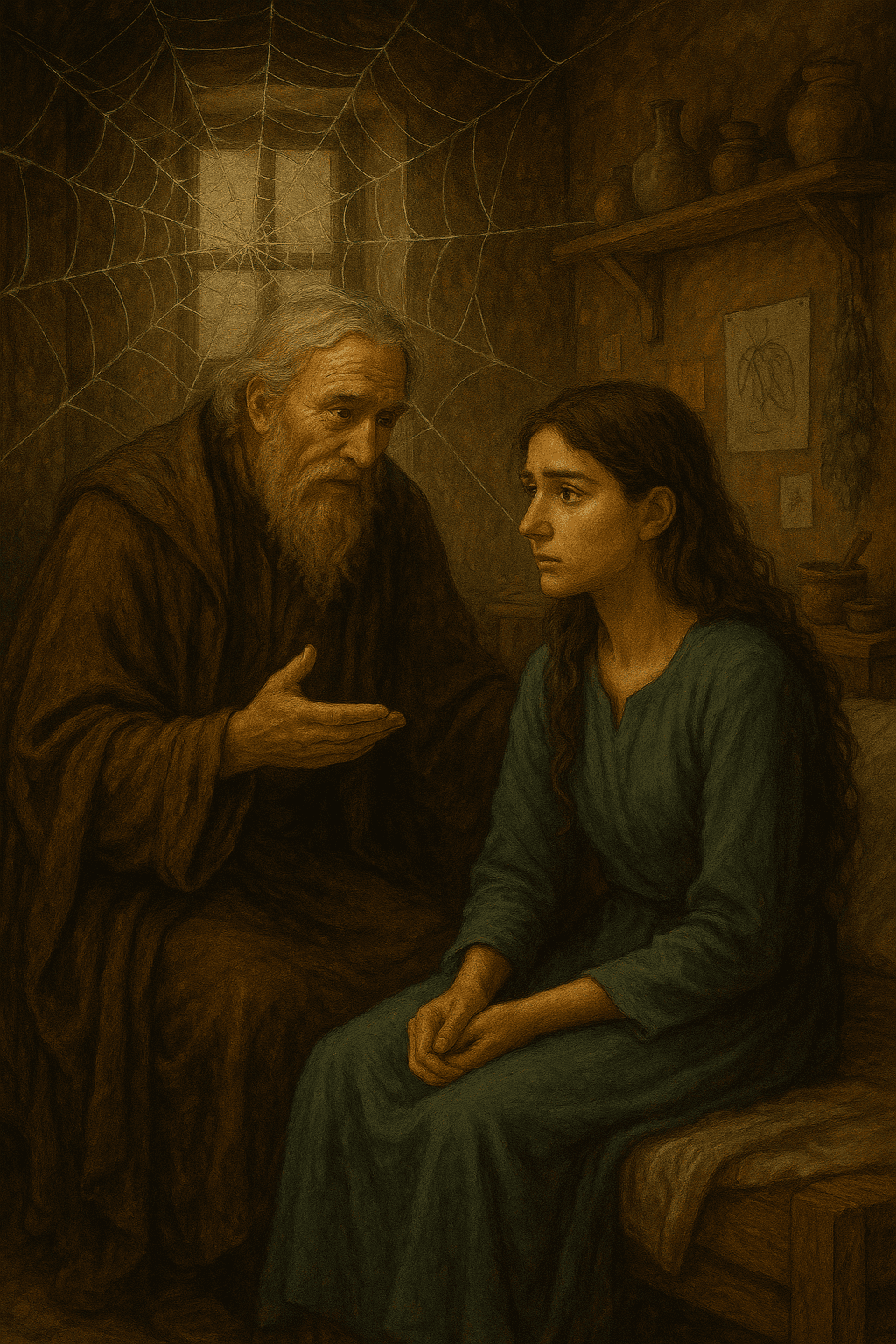
A Depiction of Aksungur and Aybike (Generated by Artificial Intelligence)
Aybike sat up and asked:
-What am I supposed to learn from this?
Aksungur replied:
-How do you form bonds with people and animals?
Without thinking, Aybike answered:
-I form bonds based on strong, unbreakable love and trust.
At that moment, her eyes widened in realization. She understood.
Aksungur smiled:
-That is exactly what you have done since you were a child. Each time we meet another person or animal, we build a bridge between our souls. You, like the first architect, built bridges of steel—unbreakable bonds. These bridges were strong enough to carry love and trust, but when separation came, they could not be destroyed without tearing your soul apart. That is why, with every friend’s departure or death, a piece of your heart sank with them, and your spirit slowly died. You must build your bridges from spiderweb: so love and trust may flow easily, but when the time comes to part, your soul will not be destroyed.
Aybike answered hopelessly:
-But the bridges are already built and broken. What good is this knowledge when I can never get back the pieces I lost?
Aksungur seemed to have expected this question:
-You do not die because the bridges to those who left were broken. You die because you have destroyed all the bridges built for you. If you allow me, you can build new bridges with your friends and your father—they can heal you. Just as the people need food and water, your soul needs to feel. If you tear down all bridges and raise walls, you too will sink into the sea with your city.
Aksungur finished speaking and left the room. He believed this was his final meeting with Aybike—but he was wrong.
Five years after his conversation with Aybike, Aksungur was teaching his students when someone knocked at the door. It was his friend İlbilge. After class, they sat together and drank mint tea. İlbilge spoke first:
-I owe you a debt of gratitude. My daughter is marrying today. I do not know what you said to her, but without you, I might have lost her. She sent you this gift. Take it…
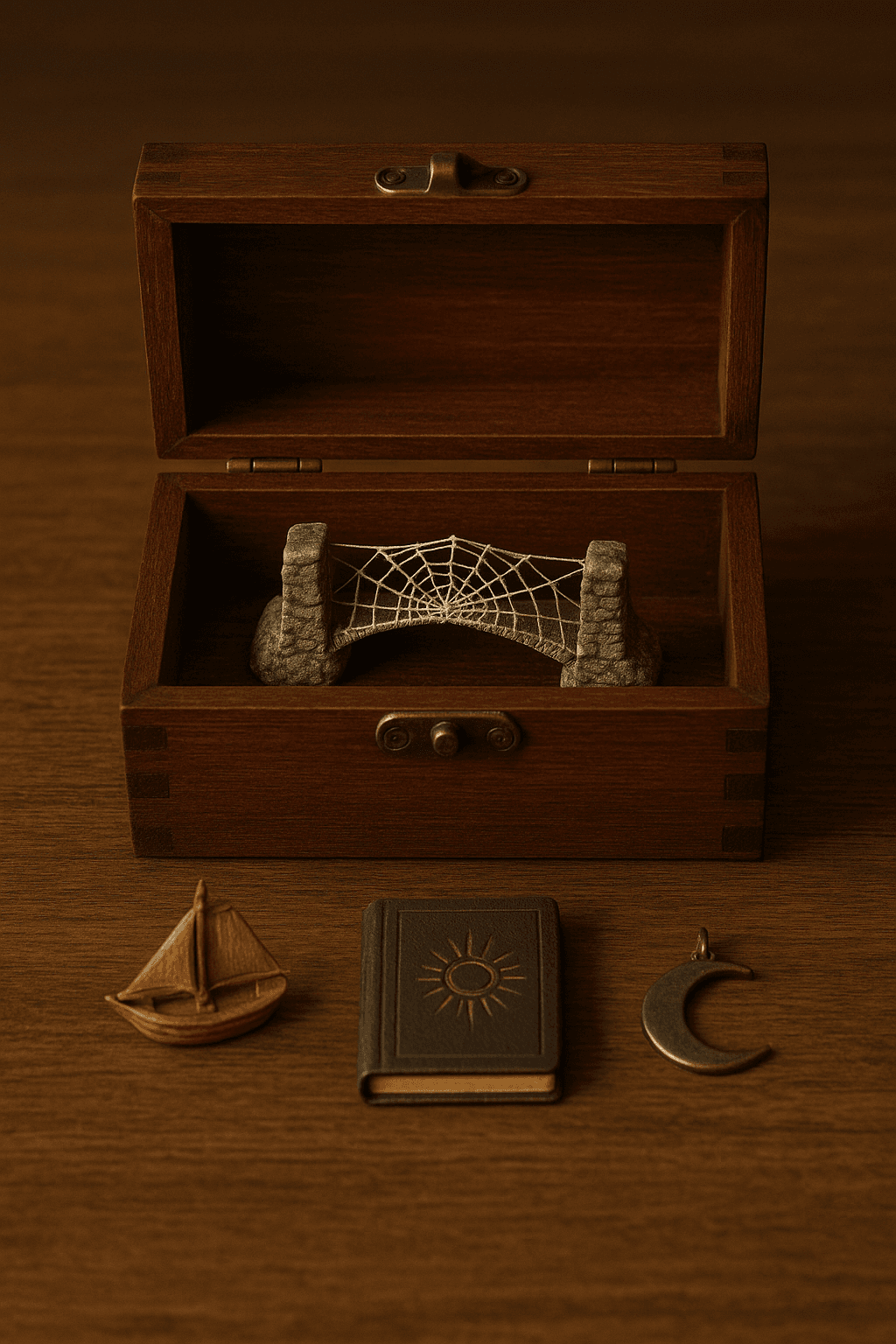
Aybike and Other Patients’ Gifts (Generated by Artificial Intelligence)
Aksungur placed the small gift box on the table and opened it before İlbilge’s eyes. Inside was a miniature bridge—but its structure was woven from spiderweb. İlbilge looked in astonishment and laughed:
-What an unusual girl. How did she ever come up with this?
Aksungur smiled briefly, then called one of his students:
-My son, place this with the others.
The boy took the bridge and placed it beside a wooden ship, a book with a sun illustration, and a crescent-shaped necklace…
Kızılgerdan
Gündoğdu
Aksungur and İlbilge
Soul and Words
Spiderweb
What the Years Brought
