This article was automatically translated from the original Turkish version.
+2 More
Location | Florence Italy | ||||||||
|---|---|---|---|---|---|---|---|---|---|
Architect(s) | Filippo Brunelleschi (1377–1446) | ||||||||
Construction Years | 1420–1436 | ||||||||
Period(s) | Early Renaissance | ||||||||
Building Type | Stone-brick dome, Religious structure | ||||||||
Material(s) | Brick Iron chain support system Stone | ||||||||
Height(s) | Approximately 114 metres (from ground to summit) | ||||||||
Base Shape | Octagonal | ||||||||
Building Layer | Double-shelled (inner and outer dome) | ||||||||
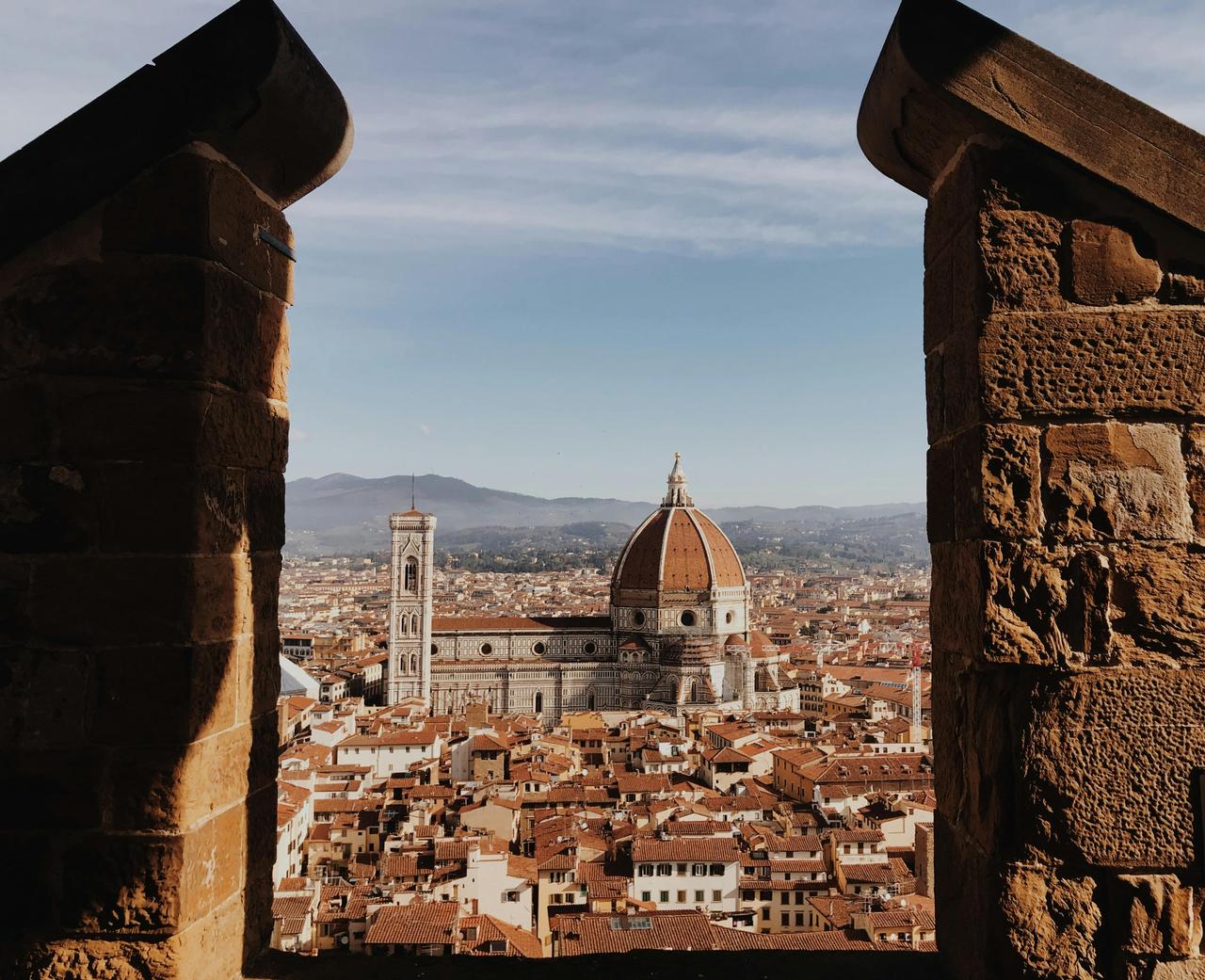
The Dome of Brunelleschi is a central dome constructed atop the octagonal drum of the Florence Cathedral (also known as Santa Maria del Fiore and the Duomo), designed by Filippo Brunelleschi (1377–1446). Built between 1420 and 1436, the structure holds a pivotal position in the history of architecture and structural engineering due to its use of techniques distinct from traditional Gothic construction methods, its vast span, and its simultaneous inner and outer shell system.
The Florence Cathedral was constructed following an understanding that continued the Italian Gothic architectural tradition throughout the 13th and 14th centuries. While the nave and apse sections reflected the stylistic features of this period, the large opening above the choir posed a major engineering challenge, as it was too vast to be closed using conventional stone domes or full-scale wooden centering. This issue was recognized by the Florentine authorities and the cathedral commission as the most significant architectural problem of the era, making the need for a new technical solution a central concern.
In this context, Filippo Brunelleschi (1377–1446) emerged as the proponent of an innovative solution. Brunelleschi proposed a novel approach, distinct from known construction methods of the time, to build a shell dome without centering and with a double-shell system atop the existing octagonal drum. This proposal was accepted by the cathedral commission due to its engineering feasibility and its ability to preserve the aesthetic integrity of the building.
Construction of the dome, following Brunelleschi’s proposal, began in the early 1420s and was completed around 1436 after approximately fifteen years of work. The resulting structure not only completed the Florence Cathedral but also became a landmark symbolizing the beginning of Renaissance architecture.

The Dome of Brunelleschi (Justine Lauzon, Pexels)
The dome rests on an octagonal tambour and consists of two concentric shells. The inner shell serves a structural function, while the outer shell provides aesthetic and protective roles. The space between them acts as a buffer zone that balances load distribution.
The dome’s form is based on a complex geometry defined by horizontal rings and vertical ribs. This arrangement directs loads from the tambour to the supporting piers. The curved profile on the exterior surface creates a distinctive visual impact within the Florence skyline. At the dome’s apex, the lantern serves both as the final element in the structural load path and as a symbolic completion.
The construction of the Dome of Brunelleschi employed innovative techniques that diverged from the methods known at the time:
Thanks to these methods, the structure rose gradually as a self-supporting system balanced under its own weight.

Interior View of the Dome of Brunelleschi (Eric Kilby, Flickr)
The dome was constructed using approximately four million bricks and 37,000 tons of material. Brick was preferred over stone due to its lighter weight and workability. The mortar mixture consisted of lime, sand, and crushed brick dust.
Structural loads are transmitted through the octagonal tambour to the underlying piers. Both the shell geometry and stone rings were employed to limit horizontal thrust. This structural organization has enabled the dome to remain standing without significant deformation for over five centuries.
The Dome of Brunelleschi presents static challenges due to the horizontal thrust generated by its large span and internal stresses within the shells.

The Dome of Brunelleschi (Jean-Baptiste Terrazzoni, Pexels)
Brunelleschi designed the most advanced lifting and transportation systems of his time for the construction process. Particularly, reversible cranes, pulleys, and block-and-tackle systems were used to transport bricks and stone to upper levels. These mechanisms enhanced the continuity and safety of the construction process.
Brunelleschi also systematized site organization: workers’ shifts, material distribution, and production rates were regulated according to a precise plan. This approach is considered one of the earliest examples of modern construction management.
The lantern placed atop the dome serves as both an aesthetic and structural finishing element. It caps the apex of the dome, concluding the load path and completing the external appearance. The construction of the lantern required a final assessment of the dome’s stability and the implementation of protective measures.

Cathedral Facade (Mike Kit, Pexels)
The Dome of Brunelleschi is not merely a technical achievement; it occupies a symbolic position in the urban silhouette of Florence, the institutionalization of Renaissance aesthetics, and the chronology of European architectural history. The dome was also used as a symbol of social status and civic identity, alongside its technical mastery. It laid the groundwork for the reevaluation of architectural theory and practice in early modern Europe.
Historical records indicate that since its completion, the dome has required ongoing repair, conservation, and restoration efforts. Contemporary conservation approaches aim to preserve original materials while ensuring structural safety through modern engineering methods. Furthermore, understanding Brunelleschi’s original construction techniques remains fundamental to making informed restoration decisions.
Accessed November 26, 2025.
Duomo Firenze. "Discover the Dome | Brunelleschi’s Dome." Accessed October 23, 2025. https://duomo.firenze.it/en/discover/dome?utm_source=chatgpt.com
Kilby, Eric. “Under the Dome JPG.” Flickr. Accessed October 23, 2025. https://flic.kr/p/2nVAcBn
Kit, Mike. “Kent Şehir Sanat Kent Simgesi JPG.” Pexels. Accessed October 23, 2025. https://www.pexels.com/tr-tr/fotograf/kent-sehir-sanat-kent-simgesi-17392174/
Lauzon, Justine. “Kent Şehir Kent Simgesi Görülecek Yer JPG.” Pexels. Accessed October 23, 2025. https://www.pexels.com/tr-tr/fotograf/kent-sehir-kent-simgesi-gorulecek-yer-16401034/
Neal, Mark. "Tuğladan Görülen Kahverengi Kübbe Binasi JPG." Pexels. Accessed October 23, 2025.
Terrazzoni, Jean-Baptiste. “İtalya Mimari Toskana Masaüstü Arka Planları JPG.” Pexels. Accessed October 23, 2025. https://www.pexels.com/tr-tr/fotograf/italya-mimari-toskana-masaustu-arka-planlari-13568156/
Toptaş, Rahşan. “Erken Rönesans Dönemi Mimarlarından Filippo Brunelleschi’nin (1376-1446) Eserlerinde Matematiksel Oranlar ve Perspektif.” *Dicle Üniversitesi Sosyal Bilimler Enstitüsü Dergisi* 32 (2023): 1042-1062. Accessed October 23, 2025. https://dergipark.org.tr/en/pub/diclesosbed/issue/76043/1230601
Öztürkler, Cenan. “Vincent Desiderio Resimlerinde Alegorik Anlatım.” *Otuzyedi Sanat ve Tasarım Dergisi* 3, no. 1 (2024): 59–88. Accessed October 23, 2025. https://dergipark.org.tr/en/download/article-file/3752106
Ülger, Kani. “Paleolitik Dönemden Neoklasisizme Resim Sanatı Değişiminin İllüstrasyon Görsellerinde İncelenmesi.” *Lokum Sanat ve Tasarım Dergisi* 3, no. 2 (2025): 282-303. Accessed October 23, 2025. https://dergipark.org.tr/en/download/article-file/4725531

Location | Florence Italy | ||||||||
|---|---|---|---|---|---|---|---|---|---|
Architect(s) | Filippo Brunelleschi (1377–1446) | ||||||||
Construction Years | 1420–1436 | ||||||||
Period(s) | Early Renaissance | ||||||||
Building Type | Stone-brick dome, Religious structure | ||||||||
Material(s) | Brick Iron chain support system Stone | ||||||||
Height(s) | Approximately 114 metres (from ground to summit) | ||||||||
Base Shape | Octagonal | ||||||||
Building Layer | Double-shelled (inner and outer dome) | ||||||||
No Discussion Added Yet
Start discussion for "Brunelleschi's Dome" article
Historical Context and Initiative
Architectural Design: Form and Geometry
Construction Techniques and Innovative Methods
Materials and Structural Organization
Static Challenges and Solutions
Mechanical Equipment, Cranes, and Work Organization
The Lantern and Completion
Cultural and Architectural Significance
Conservation, Restoration, and Current Status