

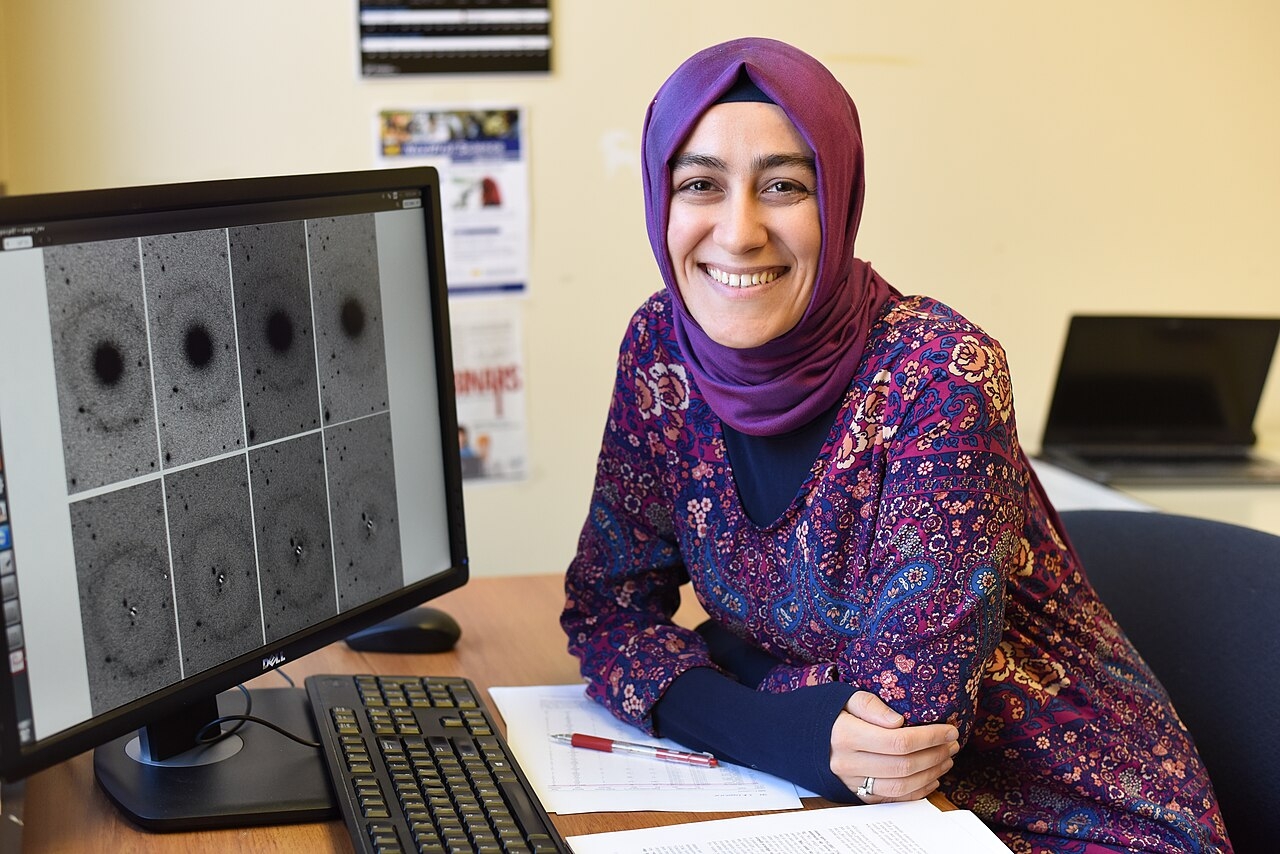


Burçin Mutlu-Pakdil is an astrophysicist born in Türkiye in the late 1980s. Her early fascination with the night sky led her to pursue a career immersed in scientific research. She began her education in Türkiye and later completed her graduate and doctoral studies in the United States. Her academic work focuses on galaxy morphology, supermassive black holes, and dark matter. In addition to her scientific career, she has actively participated in various social initiatives and contributed significantly to science communication.
Burçin Mutlu-Pakdil was born in Türkiye in the late 1980s. Her childhood wonder at the night sky introduced her to science. Her particular curiosity about stars, black holes, and galaxies shaped her into a scientist dedicated to studying the building blocks of the universe. Her scientific journey began with her education at Beşiktaş Atatürk Anadolu High School. As the first person in her family to attend university, she established a personal commitment to academic excellence.
In 2009, she graduated with distinction from the Department of Physics at Bilkent University. During her undergraduate studies, she developed interests in both theoretical physics and observational astronomy. She completed her master’s degree in the United States at Texas Tech University. During this period, she solidified her decision to focus on astrophysics and prepared for doctoral applications.
Her doctoral research at the University of Minnesota became a turning point in her career. Her dissertation, titled “Testing Supermassive Black Hole Scaling Relations and Galaxy Scaling Relations in Low-Mass Galaxies,” contributed to models of early galaxy formation in the universe by examining the behavior of supermassive black holes in low-mass galaxies.
However, the discovery that brought her international recognition was her study of an unusual galaxy named PGC 1000714. This galaxy exhibited an atypical appearance: a central elliptical structure surrounded by two prominent rings. Previously unknown, this galaxy type was classified under the theoretical category of ringed elliptical galaxies and quickly gained public attention as “Burçin’s Galaxy.”
This discovery generated significant反响 both within the scientific community and among the general public. It was featured in prestigious media outlets such as The New York Times, National Geographic, and BBC. The galaxy prompted a reevaluation of many theories concerning galaxy evolution and morphology.
After completing her doctorate, she worked as a postdoctoral researcher at the Steward Observatory of the University of Arizona. During this time, she analyzed observational data on galactic rings, dwarf galaxies, galaxy mergers, and supermassive black holes. Her research focused on the distribution of dark matter, structural properties of galaxies, and their relationship to evolutionary processes.
Since 2021, she has served as an associate professor of physics and astronomy at Dartmouth College. There, she investigates how galaxies evolve and the role of dark matter in this process, using large observational datasets and imaging surveys. Her work on low-mass, local group galaxies has enriched our understanding of galaxy formation and evolution.
Burçin Mutlu-Pakdil has gained prominence not only through her scientific contributions but also through her efforts to foster scientific awareness in society. In 2018, she was selected as a TED Fellow, and in 2020, she became a TED Senior Fellow. Her TED talk, “A rare galaxy that’s challenging our understanding of the universe,” has been viewed over 2.6 million times, reaching a broad audience. In this talk, she not only described her scientific discovery but also addressed the challenges she faced as a Muslim woman in science and the power of perseverance.
In 2019, she was named an IF/THEN Ambassador by the American Association for the Advancement of Science (AAAS). In this role, she participated in projects aimed at encouraging young girls to pursue careers in science, technology, engineering, and mathematics (STEM). She appeared in the science program “Mission Unstoppable” and featured in the short film “Breakthrough: The Galaxy Hunter,” which is exhibited at the Smithsonian National Museum of Natural History.
No Discussion Added Yet
Start discussion for "Burçin Mutlu Pakdil" article
Life and Education
Doctoral Studies and Burçin’s Galaxy
Academic Career and Scientific Contributions
Social Role and Inspirational Identity