This article was automatically translated from the original Turkish version.
+2 More
Origin(s) | Burdur Türkiye | ||||||||
|---|---|---|---|---|---|---|---|---|---|
Product / Product Group(s) | Chocolate Confectionery and Related Products | ||||||||
Registration Date | 13 October 2009 | ||||||||
Registration Number | 117 | ||||||||
Registration Type | Mahreç mark | ||||||||
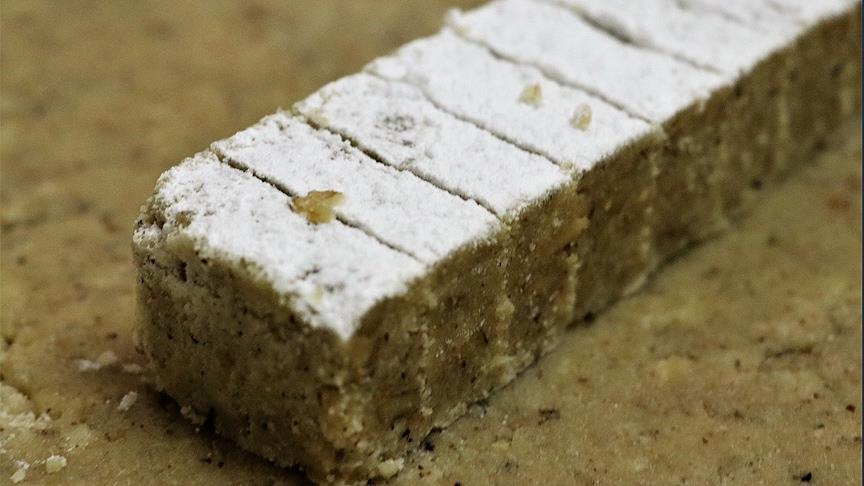
Burdur walnut paste is a traditional dessert from Burdur, made by mixing walnuts, semolina, and sugar in equal proportions without any heat treatment. Distinct from other types of crushed desserts, it is prepared by adding semolina and crushed walnuts to a syrup that is not boiled. The mixture is shaped, cut into pieces, coated with powdered sugar, and left to rest before serving. Due to the preservation of the natural structure of walnuts and semolina, it is high in nutritional value, free from additives, and valued as a light delicacy.
The uniqueness of Burdur walnut paste stems from both the regional qualities of its raw materials and the simplicity of its production method. Walnuts grown in the Lake Region possess a more intense flavor profile due to their low moisture content (6.3%). Similarly, Burdur semolina, derived from hard wheat, determines the texture and quality of the paste. The production process does not involve cooking, roasting, or frying; thus, the walnuts and semolina retain their natural aromas and nutritional value. According to the original recipe, equal measures of sugar, semolina, and walnuts are used.

Burdur Walnut PasteTurkish Patent and Trademark Office)
• 1 measure powdered sugar (approximately 1000 g)
• 1 measure semolina (approximately 800 g)
• 1 measure crushed walnuts (approximately 1600 g)
• For syrup: One-quarter the weight of sugar in water
• For top and bottom coating: Powdered sugar
Note: A tolerance of ±5% is permitted for these measurements. No additives such as glucose, starch, or flour are used.
First, powdered sugar is placed in a tin-lined copper pot, and water amounting to one-quarter of the sugar’s weight—clean water from a low-lime source—is added. The mixture is continuously stirred over medium heat until the sugar fully dissolves and forms a thick syrup. The syrup reaches the correct consistency when a drop from a spoon stretches rather than falls immediately.
Meanwhile, walnuts are shelled and their inner skins removed. Part of the walnuts are crushed into very fine particles, while another part is crushed into coarser pieces. This method imparts both flavor and varied texture to the paste. The crushed walnuts and semolina are thoroughly mixed in a separate container to allow the natural oils of the walnuts to be absorbed by the semolina.
Once the syrup has reached the desired consistency, it is removed from heat and the prepared walnut-semolina mixture is slowly added. The combined mixture is stirred rapidly and continuously until fully integrated. The pot is then covered and left to rest for several minutes.
Before pouring the mixture, an even layer of powdered sugar is sprinkled onto the baking tray. The rested mixture is spread evenly over the tray using the back of a spoon or a rolling pin. Another layer of powdered sugar is then sprinkled on top, and the dessert is cut into baklava-style pieces. It is recommended that the dessert rest for at least one day to allow the flavors to fully meld and the texture to stabilize.
Finally, the rested and sliced Burdur walnut paste can be stored in a dry, airtight environment to preserve its freshness and flavor for an extended period.
Due to its natural walnut content, walnut paste is a rich source of phosphorus, potassium, magnesium, iron, and vitamin E. Semolina provides energy as a complex carbohydrate. The absence of thermal processing preserves the biological value of the ingredients, making it a healthy snack or offering.
Burdur walnut paste, due to its unique composition and traditional production method, was officially registered as a geographical indication under the category of “protected designation of origin” on 13 October 2009 (Registration No: 117). This registration aims to safeguard the product’s origin and guarantee its quality. Under the geographical indication, the walnuts, semolina, and sugar used in production must be sourced from designated regional sources and used in specified proportions. The production, packaging, and marketing of the product must also conform to traditional methods and are subject to oversight. Regular inspections are conducted by a commission composed of relevant public institutions, professional associations, and producer representatives, coordinated by the Burdur Chamber of Commerce and Industry. These inspections prevent unauthorized use of the geographical indication and ensure the maintenance of production quality and product authenticity. Thus, both the cultural heritage and economic value of Burdur walnut paste are protected.
Anadolu Ajansı. “Bayramların Hafif Tatlısı Ceviz Ezmesi.” Accessed July 11, 2025. https://www.aa.com.tr/tr/yasam/bayramlarin-hafif-tatlisi-ceviz-ezmesi-/847685.
Burdur Ticaret of Commerce and Industry. "Burdur Ceviz Ezmesi." Burdur Chamber of Commerce and Industry. Accessed July 11, 2025. https://www.butso.org.tr/cografi-isaretlerimiz/burdur-ceviz-ezmesi.
Burdur İl Directorate of Culture and Tourism. "Burdur Ceviz Ezmesi." T.C. Kültür veTurizm Bakanlığı. Accessed July 11, 2025. https://burdur.ktb.gov.tr/TR-154672/ceviz-ezmesi.html.
Culture Portal. "Burdur Ceviz Paste." Ministry of Culture and Tourism of the Republic of Türkiye. Accessed July 11, 2025. https://www.kulturportali.gov.tr/portal/burdurcevizezmesi.
Turk Patent and Trademark Office. "Burdur Ceviz Ezmesi." Turk Patent and Trademark Office. Accessed July 11, 2025. https://ci.turkpatent.gov.tr/cografi-isaretler/detay/37998.
Turkish Patent and Trademark Office. *Burdur Ceviz Ezmesi Coğrafi İşaret Tescil Belgesi*. Accessed July 11, 2025. https://ci.turkpatent.gov.tr/Files/GeographicalSigns/117.pdf.

Origin(s) | Burdur Türkiye | ||||||||
|---|---|---|---|---|---|---|---|---|---|
Product / Product Group(s) | Chocolate Confectionery and Related Products | ||||||||
Registration Date | 13 October 2009 | ||||||||
Registration Number | 117 | ||||||||
Registration Type | Mahreç mark | ||||||||
No Discussion Added Yet
Start discussion for "Burdur Walnut Paste" article
Distinctive Characteristics
Ingredients (by Measure Ratios)
Preparation
Nutritional and Health Value
Geographical Indication and Oversight