

This article was automatically translated from the original Turkish version.
+1 More
Eye Color | Sapphire blue | ||||||||
|---|---|---|---|---|---|---|---|---|---|
Feather Structure | Semi-long, Single-layer, Silky | ||||||||
Color Options | Seal brown, Blue, Chocolate, Lavender, Red, Cream | ||||||||
Character | Calm, Social, People-oriented | ||||||||
The Burmese cat is a semi-longhaired domestic cat breed known for its distinctive physical features and calm temperament. It attracts attention with its sapphire-blue eyes, silky coat, and paws that appear as if wearing white gloves. This breed is recognized for its social nature and openness to human interaction, making it well-suited to household environments. The Burmese cat’s genetic makeup, behavioral traits, and breed standards have been defined by international organizations, endowing it with unique physical and behavioral characteristics.
The origin of the Burmese cat is traced to Southeast Asia, particularly the region of Burma (modern-day Myanmar). According to a popular narrative, Burmese cats descended from sacred cats kept in temples in Burma. Modern-defined Burmese cats first emerged in France in the early 20th century, where they were selectively bred. The breed was officially registered in France in the 1920s, experienced a decline in numbers during World War II, and was subsequently revived after the war. It was formally recognized in the United States by the Cat Fanciers’ Association (CFA) in 1967.
Burmese cats have a medium-sized, well-proportioned body structure. Their bone structure is strong and their muscular development is pronounced. Their bodies are rectangular in shape, exhibiting clear balance and symmetry. The white fur at the tips of their paws is a defining characteristic of the breed.
The Burmese cat’s coat is single-layered, fine, and silky in texture. The fur is semi-long and requires minimal grooming. The tail is proportionate in length to the body and well-furred. The body color is expected to be light, while the extremities—such as the face, ears, legs, and tail—are darker. This color pattern is known as “point” coloring. Accepted color varieties in the breed include seal, blue, chocolate, lilac, red, and cream. Tortoiseshell (tortie) and lynx-point (striped) patterns are also present.

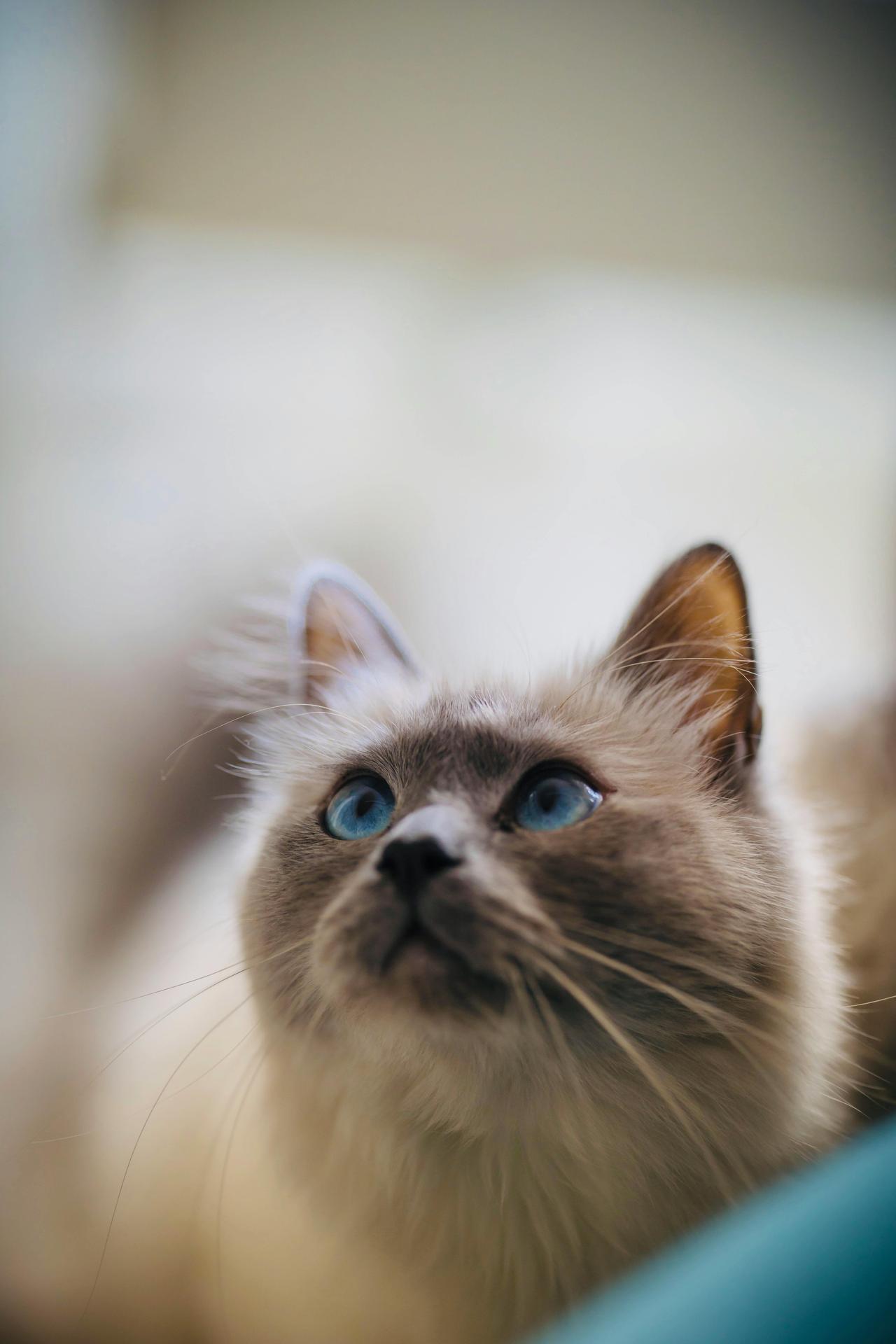
Burmese cat (Pexels)
Burmese cats have eyes that are distinctly round and always sapphire blue. Eye color is a critical criterion in breed standards. The ears are medium in size, with rounded tips, and are set in harmony with the skull.
The Burmese cat is a social domestic animal that forms easy bonds with humans. Thanks to its calm nature, it adapts well to both individual and family living environments. Its playfulness is balanced; it is not overly active but enjoys interactive play. Its vocalizations are soft and gentle, and it does not meow frequently. It prefers human interaction and generally gets along well with other pets and children.

Burmese cat (Pexels)
Due to its single-layered coat, the Burmese cat’s fur is easy to groom, and weekly brushing is sufficient. The coat does not mat easily. Regular nail, ear, and dental care are necessary. Overall, the breed is robust and healthy. However, some individuals may inherit heart conditions, particularly hypertrophic cardiomyopathy (HCM). For this reason, regular veterinary check-ups are essential.
The Burmese cat is recognized by the Cat Fanciers’ Association (CFA), The International Cat Association (TICA), and various other cat breed associations. These organizations have established detailed standards for the breed’s appearance and behavioral traits. According to TICA, an ideal Burmese cat should possess a balanced body structure, symmetrical point coloration, and well-defined white paws.
Cat Fanciers’ Association. “Birman.” CFA Breeds. Accessed June 26, 2025.
Pexels. “Close-Up Portrait of a Fluffy Himalayan Cat.” Accessed June 26, 2025.
Pexels. “Hayvan Evcil Hayvan Portre Modu Portre.” Accessed June 26, 2025.
Pexels. “Hayvan Evcil Hayvan Sevimli Tatlı.” Accessed June 26, 2025.
The International Cat Association (TICA). "Birman Breed Introduction." Accessed June 26, 2025.

Eye Color | Sapphire blue | ||||||||
|---|---|---|---|---|---|---|---|---|---|
Feather Structure | Semi-long, Single-layer, Silky | ||||||||
Color Options | Seal brown, Blue, Chocolate, Lavender, Red, Cream | ||||||||
Character | Calm, Social, People-oriented | ||||||||
Origin and History
Physical Characteristics
Coat and Color Characteristics
Eyes and Ear Structure
Temperament Traits
Care and Health
Breed Standards