+2 More

Doğum tarihi | 1904-03-20 | ||||||||
|---|---|---|---|---|---|---|---|---|---|
Ölüm tarihi | 1990-08-18 | ||||||||
Area(s) | Psychology | ||||||||
Current | Behaviorism | ||||||||
Major Works | The Behavior of Organisms, Walden Two, Science and Human Behavior | ||||||||
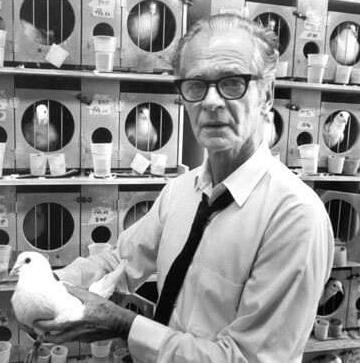
Burrhus Frederic Skinner was an American psychologist associated with the behaviorist movement in the 20th century. He is particularly known for his theory of operant conditioning and his radical behaviorist approach. He sought to explain human and animal behavior through environmental factors and their consequences, employing experimental methods in psychology.
Skinner was born on 20 March 1904 in Susquehanna, Pennsylvania, United States. In his youth, he showed interest in writing, but after initial efforts in this field, he turned to psychology. He received a bachelor’s degree in English from Hamilton College in 1926. He completed his doctoral training in psychology at Harvard University. During his time at Harvard, he engaged with Pavlov’s work on classical conditioning and John B. Watson’s behaviorist approach. Skinner died on 18 August 1990 at the age of 86.
Skinner’s work was shaped within the framework of operant conditioning theory. According to this theory, behaviors are shaped by environmental stimuli and the consequences of those stimuli. Reinforcement and punishment processes are regarded as fundamental mechanisms for directing behavior. Skinner also argued within the framework of radical behaviorism that internal processes could be examined through a behavioral perspective. His research, centered on experimental methodology, contributed significantly to the study of behavior through measurable and observable data.
Skinner’s work has been applied in various fields:
Skinner’s behaviorist approach has been criticized, particularly for its limited consideration of internal processes. Some critics argue that explaining human behavior solely through observable responses and environmental conditions fails to reflect the complexity of experience. Additionally, the insufficient attention given to concepts such as freedom, responsibility, and cultural context has also been a subject of criticism.
Aladağ, Hüseyin Hakkı. “Tarihî Figürlerin Psikobiyografisi: Tarihî Analizlerde Psikolojik Yaklaşımların Entegrasyonu.” *Vakanuvis*, 2022. Accessed August 15, 2025. https://dergipark.org.tr/en/pub/vakanuvis/issue/83944/1415401
Kapluhan, Erol. “Sosyal Beşeri ve Eğitim Bilimlerine Genel Bakış.” Accessed August 15, 2025. https://www.researchgate.net/publication/357328645_SOSYAL_BESERI_VE_EGITIM_BILIMLERINE_GENEL_BAKIS
Moloney, Sean. “B.F. Skinner (1904–1990).” *Pennsylvania Center for the Book.* Accessed August 15, 2025. https://pabook.libraries.psu.edu/literary-cultural-heritage-map-pa/bios/skinner__bf
Üsküdar University. "B.F. Skinner." Accessed August 15, 2025. https://uskudar.edu.tr/tr/bilim-insani/b-frederic-skinner

Doğum tarihi | 1904-03-20 | ||||||||
|---|---|---|---|---|---|---|---|---|---|
Ölüm tarihi | 1990-08-18 | ||||||||
Area(s) | Psychology | ||||||||
Current | Behaviorism | ||||||||
Major Works | The Behavior of Organisms, Walden Two, Science and Human Behavior | ||||||||
No Discussion Added Yet
Start discussion for "Burrhus Frederic Skinner" article
Life and Education
Academic Contributions and Theoretical Approach
Major Works
Applications
Criticisms and Limitations