


This article was automatically translated from the original Turkish version.
+2 More
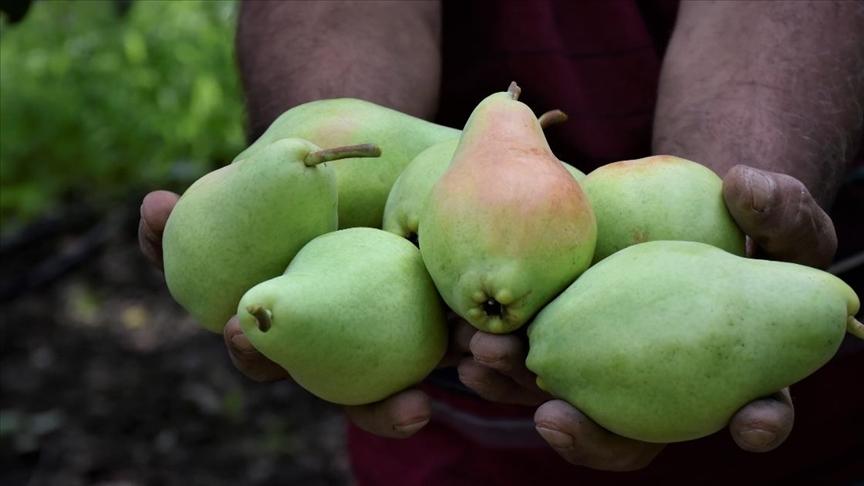
Bursa Santa Maria Pear is a summer variety of Pyrus communis with a geographical indication registered in the province of Bursa, Türkiye. This fruit, known as the Santa Maria variety, is large and conical in shape, distinguished at maturity by its pale yellow skin and pinkish-red blush on sun-exposed surfaces. Its white, moderately juicy, and sweet flesh exhibits low acidity and high firmness, enabling long-term storage. Bursa Santa Maria pear is propagated exclusively by grafting onto rootstocks and is cultivated in the permeable, organic matter-rich soils and specific climatic conditions of the Bursa Plain, which directly contribute to the fruit’s quality and aromatic profile.

Bursa Santa Maria Pear (AA)
This pear, cultivated in the province of Bursa and specific districts of Türkiye, is registered under the geographical indication category for processed or unprocessed fruits and vegetables and mushrooms. Registration number: 1290, registration date: 16.12.2022, application number: C2021/000492, application date: 24.11.2021. The registering institution is the Gürsu Chamber of Agriculture.
Bursa Santa Maria pear is cultivated in the district of Gürsu in Bursa; in the neighborhoods of Narlıdere, Dudaklı, Serme and Barakfaki in the district of Kestel; in the neighborhoods of İsabey, Vakıf and Samanlı in the district of Yıldırım; and in the neighborhoods of Armutköy, Çukurcaköy, Dereçavuşköy, İsmetiye, Panayır, Yeniceabat and Yunuseli in the district of Osmangazi. This geographical boundary corresponds to a depression basin formed by alluvial deposits carried from Uludağ and Katırlı Dağları. The region lies at an elevation of 155 meters above sea level. The climatic and soil characteristics of the area directly influence the pear’s morphological and biochemical properties.
The annual average air temperature in the Bursa Plain is 14.4 °C, while the soil temperature averages 16.6 °C. The region is protected from cold northerly winds originating from Uludağ and Katırlı Dağları. The frost-free climate of the plain and the groundwater supplied by snowmelt from the surrounding mountains are decisive for fruit development. The soil structure is rich in organic matter and nutrients due to the influence of lacustrine deposits. Santa Maria pear thrives in permeable, deep, warm and organic matter-rich soils.
Bursa Santa Maria pear is large, large-medium or medium-sized and conical in shape; its surface is smooth, with a long neck and a broad base. At maturity, the skin is pale yellow, with pink and red blush on sun-exposed areas. The flesh is white, sweet and moderately juicy. Skin thickness ranges from 0.34–0.43 mm, background color hue from 112–117, fruit weight from 180–200 g, flesh firmness from 5.5–6.7 kg/cm², soluble solids content from 10.4–12.0%, malic acid content from 0.56–0.62 ml/100 ml, fruit juice pH from 3.70–4.32, and total phenolic compound content from 1.075–1.105 mg/100 g GAE. The fruit is distinguished by its thin skin, light color, low acidity and high gloss. High levels of soluble solids and flesh firmness enable prolonged storage; the fruit can be stored for up to 10 months in cold storage facilities.
The fruit’s aromatic profile consists of aldehydes (%8.41), alcohols (%6.37), esters (%44.99) and other compounds (%16.33 α-farnesene). Key aroma compounds include hexanal, E-2-hexenal, 1-hexanol, ethyl butanoate, hexyl acetate and α-farnesene. Esters constitute the most abundant group of aromatic compounds.

Bursa Santa Maria Pear (AA)
As a cultivated variety, Bursa Santa Maria pear is propagated exclusively by grafting onto rootstocks, not by seed or cutting. The rootstocks used in production are dwarf or semi-dwarf types (BA29, MC, Queens A, OHF333) or wild pear rootstocks.
Soil preparation is carried out prior to orchard establishment. Healthy, grafted, one-year-old saplings are preferred for planting. Spacing varies according to rootstock type: 4.00 x 1.25 m for BA29 and Queens A rootstocks; 4.00 x 0.50 m for MC; 4.50 x 2.00 m for OHF333; and 5.00 x 5.00 m for wild pear rootstocks. These spacings may be adjusted based on soil structure and management practices. Saplings are planted between November and February with the graft union kept above soil level. Pruning is applied during planting.
Soil Management: Orchards are surface-treated in autumn after harvest using a rotary hoe or disc harrow. In spring, before bud break, a shallow tillage is performed to control weeds.
Irrigation: Irrigation is applied from early April to mid-July. Drip irrigation is preferred for dwarf and semi-dwarf trees; the spring method is used for standard-sized trees. As this is a summer variety, excessive irrigation negatively affects storage life.
Fertilization: Compost fertilizers are applied during autumn soil preparation. Nitrogenous and other nutrient fertilizers are applied in spring and summer either through soil application or drip irrigation. Fertilizer quantities are determined based on soil analysis results.
Pest and Disease Control: Major pests and diseases include fire blight, black spot, mammalian rust, codling moth, pear leaf blister mite, pear psylla and scale insects. Spraying is carried out at dosages prescribed by the Ministry of Agriculture and Forestry’s early warning system. In young orchards, selective and careful weed control measures are applied.
Pruning and Thinning: Pruning systems appropriate to the rootstock type are applied. Excessive pruning is avoided in shaping. Annual dormant pruning is performed to improve fruit quality and facilitate pest and disease control. In years of high yield, thinning is carried out in early June while fruits are still small; excess fruits are removed so that no more than two fruits remain per spur or one fruit per 20–30 leaves.
Harvest timing varies according to elevation; it begins in mid-July and shifts to later weeks at higher altitudes. Harvest timing is determined by skin color, ease of detachment from the branch, flesh firmness and sugar content. Harvesting is done manually with the fruit stem attached. Collected fruits are placed in 6–7 kg buckets and then sorted into 4–4.5 kg or 18–20 kg crates.
Crated fruits are transported exclusively to cold storage facilities designated for Bursa Santa Maria pear. Fruits are pre-cooled to 0°C in a pre-cooling room and then stored at temperatures of -1 or -1.5 °C with 80–90% relative humidity. Under these conditions, fruits can be stored for approximately 10 months.
In packing houses, fruits are sorted in crates according to firmness, shape, color and quality criteria. Fruits are graded by size and packed into ventilated or deep crates according to market demand.
Inspection is coordinated by the Gürsu Chamber of Agriculture and carried out by an inspection board comprising one expert each from Bursa Uludağ University Faculty of Agriculture, Bursa Provincial Directorate of Agriculture and Forestry, and Çanakkale Onsekiz Mart University Lapseki Vocational School Food Processing Program. A regular inspection is conducted once annually during the harvest period in July–August. For newly established orchards, two inspections are carried out annually: one in February or March and another at the start of the harvest season in July. The inspection board may conduct additional inspections when necessary, upon complaint or suspicion.
Inspection records include inventory data such as number of producers, orchard size and location (island, parcel), number of trees, irrigation methods and quantity of product delivered from storage to market. The condition of saplings, irrigation conditions, harvest timing determination and harvesting process are inspected in newly established or newly planted areas of existing orchards.
The inspection board verifies the suitability of pear varieties used; the conformity of orchard establishment, cultivation practices, harvesting, storage and marketing stages with the approved production method. It also examines the fruit’s shape, weight, skin color and quality characteristics, as well as the correct use of the designation “Bursa Santa Maria Pear,” its logo and geographical indication emblem.
The board may obtain support or purchase services from public or private institutions or their designated experts as needed. The registered institution manages legal procedures to protect the geographical indication rights.

Bursa Santa Maria Pear (generated by artificial intelligence.)
Turk Patent and Trademark Office. "Bursa Santa Maria Armudu Coğrafi İşaret Dosyası (PDF)." Turk Patent and Trademark Office. Accessed May 29, 2025. https://ci.turkpatent.gov.tr/Files/GeographicalSigns/b58572ba-42fc-43c2-9d8f-dc1764f0d081.pdf.
Turk Patent and Trademark Office. "Bursa Santa Maria Armudu – Coğrafi İşaretler Detayı." Turk Patent and Trademark Office. Accessed May 29, 2025. https://ci.turkpatent.gov.tr/cografi-isaretler/detay/5522.
Çelikler, Elif Özlem. “Bursa Ovası’nda Hasadı Süren Santa Maria Armudu Dalında Satılıyor.” Anadolu Ajansı. Accessed May 29, 2025. https://www.aa.com.tr/tr/yasam/bursa-ovasinda-hasadi-suren-santa-maria-armudu-dalinda-satiliyor/2659683.

No Discussion Added Yet
Start discussion for "Bursa Santa Maria Armudu" article
Variety and Registration
Geographical Boundary and Cultivation Area
Climatic and Soil Characteristics
Morphological and Biochemical Characteristics
Aromatic Compounds
Production Method
Propagation and Rootstock Production
Orchard Establishment
Cultural Practices
Harvesting Operations
Storage
Market Preparation
Inspection