

This article was automatically translated from the original Turkish version.
+2 More
Construction Date(s) | 1548 (Hijri 955) | ||||||||
|---|---|---|---|---|---|---|---|---|---|
Architectural Style(s) | Classical Ottoman Bath Architecture | ||||||||
Material(s) | Rubble stone Brick Cut stone | ||||||||
Location | Erzincan/Merkez Beybağı Mahallesi | ||||||||
Other Name(s) | Çadırcı Şeyh Ahmed Hamamı Hacı Ahmed Bey Hamamı | ||||||||
Current Use | Local product sales center and restaurant | ||||||||
Registration Status | Cultural Asset to be Preserved (28.04.1988) | ||||||||
Plan Schema | Four-iwan with corner cells (halvetli) | ||||||||
Building Type | Single bath | ||||||||
Patron | Mahmud's son Şeyh Ahmed | ||||||||
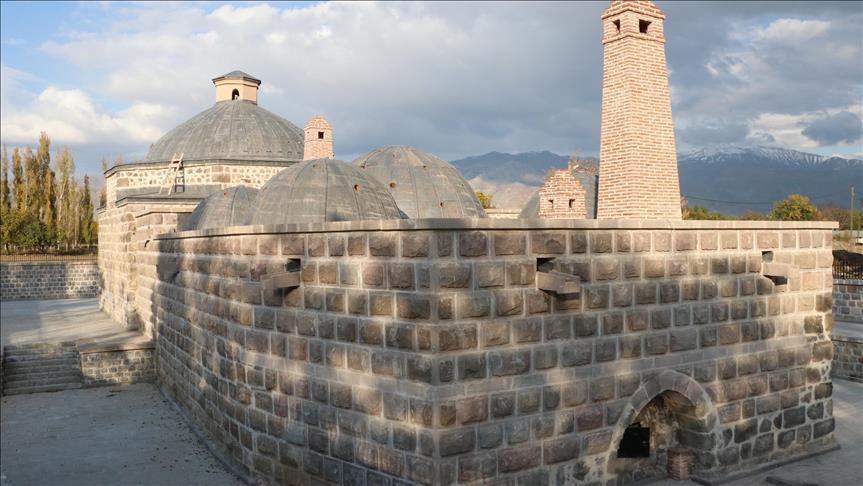
Çadırcı Hamamı is a historical structure located in the Beybağı neighborhood (formerly known as Gerek Gerek) of Erzincan city center, exhibiting characteristics of classical Ottoman bath architecture. It is also known locally as Çadırcı Şeyh Ahmed Hamamı or Hacı Ahmed Bey Hamamı.
According to the foundation inscription on the building, it was constructed in 1548 (Hijri 955) by Mahmud’s son Şeyh Ahmed.【1】 A record dated 1591 indicates that the building was endowed for the soul of the Prophet Muhammad. According to a second inscription on the entrance door, the structure underwent extensive repairs between 1677 and 1678 (Hijri 1088) by Kızılcanlı Murtaza Bey.【2】
Traces of the bath appear in historical documents and chronicles related to Erzincan; it is listed among the active baths in the Erzurum Vilayet chronicles of 1871, 1875, and 1894. Additionally, its location is marked on the 1904 city map. Severely damaged in the 1939 Erzincan earthquake, the structure fell into disrepair for many years and was used as a warehouse and stable. It was registered as a "Cultural Asset Requiring Protection" on 28 April 1988. Restoration work initiated in 2016 through a collaboration between the Erzincan Governorship and the Eastern Anatolia Regional Development Agency was completed in 2018, and the building was reopened for use.
Çadırcı Hamamı belongs to the single-bath category in architectural terms. It is built on a rectangular mass oriented north-south and consists of the following sections: cold room (changing area), warm room, hot room, water reservoir, and furnace room.
The main walls of the structure were built using rubble stone, while regular cut stone was used for door and window openings. The domes and vaults are entirely constructed of brick. Lighting was provided without windows in the walls, to preserve privacy, through "eye of the elephant" light openings in the domes and a lantern in the cold room dome.
Following its 2018 restoration, Çadırcı Hamamı has been repurposed beyond its original function. Today it serves as a center displaying regional products of Erzincan. Due to its status as one of the rare surviving Ottoman structures from the old city that withstood the post-earthquake destruction, it holds significant historical value.
Anadolu Ajansı. "470 yıllık Çadırcı Hamamı gelecek kuşaklara aktarılacak." Accessed February 18, 2026. https://www.aa.com.tr/tr/turkiye/470-yillik-cadirci-hamami-gelecek-kusaklara-aktarilacak/1301957
Erzincan Valiliği. "Çadırcı Hamamı Vatandaşların Hizmetine Açılacak." erzincan.gov.tr. Accessed February 18, 2026.
Naldan, Funda. "Erzincan’da Osmanlı Dönemi Hamamları." *BELLETEN* 83, (2019): 297, 585–604. Accessed February 18, 2026. https://www.ttk.gov.tr/Dergiler/Belleten/297-Belleten/8-FundaNaldan.pdf
TRT Haber. "Erzincan'daki 470 yıllık Çadırcı Hamamı hizmete sunulacak." Accessed February 18, 2026. https://www.trthaber.com/haber/kultur-sanat/erzincandaki-470-yillik-cadirci-hamami-hizmete-sunulacak-392352.html
Türkiye Kültür Portalı. "Çadırcı Hamamı - Erzincan." *T.C. Turizm ve Kültür Bakanlığı.* Accessed February 18, 2026.
[1]
Türkiye Kültür Portalı, "Çadırcı Hamamı - Erzincan," T.C. Kültür ve Turizm Bakanlığı, Access date: 18 February 2026, https://www.kulturportali.gov.tr/turkiye/erzincan/kulturenvanteri/cadirci-hamami
[2]
Funda Naldan, "Erzincan’da Osmanlı Dönemi Hamamları," BELLETEN. 83, (2019). p 587, https://www.ttk.gov.tr/Dergiler/Belleten/297-Belleten/8-FundaNaldan.pdf
[3]
A.e., p 588
Construction Date(s) | 1548 (Hijri 955) | ||||||||
|---|---|---|---|---|---|---|---|---|---|
Architectural Style(s) | Classical Ottoman Bath Architecture | ||||||||
Material(s) | Rubble stone Brick Cut stone | ||||||||
Location | Erzincan/Merkez Beybağı Mahallesi | ||||||||
Other Name(s) | Çadırcı Şeyh Ahmed Hamamı Hacı Ahmed Bey Hamamı | ||||||||
Current Use | Local product sales center and restaurant | ||||||||
Registration Status | Cultural Asset to be Preserved (28.04.1988) | ||||||||
Plan Schema | Four-iwan with corner cells (halvetli) | ||||||||
Building Type | Single bath | ||||||||
Patron | Mahmud's son Şeyh Ahmed | ||||||||
History and Documents
Architectural Features
Materials and Techniques
Current Condition