


This article was automatically translated from the original Turkish version.
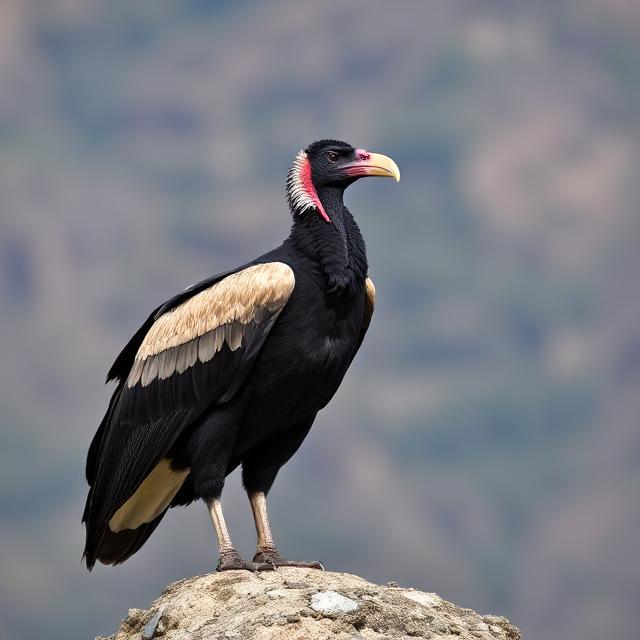
California Condor
Name(s) | California Condor | ||||||||
|---|---|---|---|---|---|---|---|---|---|
Scientific Name(s) | Gymnogyps californianus | ||||||||
Status | Critically Endangered | ||||||||
Habitat | USA and Mexico | ||||||||
Wingspan | ~3 metres | ||||||||
Diet(s) | Scavenger | ||||||||
California condor (Gymnogyps californianus) is the largest flying land bird in North America and belongs to the New World vulture family (Cathartidae). This species is notable for its extensive wingspan, feather structure, and long lifespan, and is classified among animals at risk of extinction. Due to its morphological characteristics and ecological importance, it is the subject of numerous biological studies.
The California condor is classified at the species level as Gymnogyps californianus and is the only living representative of its genus. Adult individuals can have a wingspan of up to 2.7 to 3 meters. Their weight typically ranges between 8 and 14 kilograms. Their plumage is black with white patches on the undersides of the wings. The head and neck are featherless; in adults, these areas are reddish-orange in color.
Historically, this species was found across a wide area of western North America. Today, it is observed only in specific regions of California, Arizona, Utah, and Baja California, primarily as individuals reintroduced into the wild through conservation programs. Rocky cliffs, caves, and elevated forested areas are preferred habitats for nesting and roosting.

California Condor (Generated by Artificial Intelligence)
The California condor is a scavenger that feeds on the carcasses of dead animals. It locates food primarily through its highly developed sense of vision. These birds exhibit social behaviors, with a clear hierarchical order observed especially during feeding. They are monogamous and typically lay one egg every two years. After hatching, the chick requires parental care for approximately one year.
The California condor is classified as “Critically Endangered” by the International Union for Conservation of Nature (IUCN). In 1987, the last wild individuals were captured, leaving the species to survive only in captivity. Thanks to intensive conservation and breeding programs, reintroductions into the wild have been carried out, but the species remains under serious threat. Lead poisoning (primarily from carcasses contaminated with lead ammunition), power lines, and illegal hunting are among the most significant threats.
The small population size and loss of genetic diversity pose risks to the long-term viability of the species. As a result, genetic management plays a crucial role in modern conservation biology efforts for this species. Controlled breeding, individual tracking, and genetic data analysis are employed to ensure the species’ survival.
BirdLife International. “Gymnogyps californianus.” Datazone BirdLife. Accessed May 3, 2025. https://datazone.birdlife.org/species/factsheet/california-condor-gymnogyps-californianus.
Cornell Lab of Ornithology. "California Condor." All About Birds. Accessed May 3, 2025. https://www.allaboutbirds.org/guide/California_Condor.
IUCN Red List. “Gymnogyps californianus.” *IUCN Red List of Threatened Species*. Accessed May 3, 2025. https://www.iucnredlist.org/species/22697636/181151405.
U.S. Fish & Wildlife Service. “California Condor Recovery Program.” U.S. Fish & Wildlife Service. Accessed May 3, 2025. https://www.fws.gov/media/california-condor.

California Condor
Name(s) | California Condor | ||||||||
|---|---|---|---|---|---|---|---|---|---|
Scientific Name(s) | Gymnogyps californianus | ||||||||
Status | Critically Endangered | ||||||||
Habitat | USA and Mexico | ||||||||
Wingspan | ~3 metres | ||||||||
Diet(s) | Scavenger | ||||||||
No Discussion Added Yet
Start discussion for "California Condor (Gymnogyps californianus)" article
Taxonomy and Morphology
Habitat and Distribution
Diet and Behavior
Conservation Status
Genetics and Conservation Biology