

This article was automatically translated from the original Turkish version.

“Ahmet came.”
“Ahmet has come.”
There are only a few letters between them. But for someone who knows Turkish, the distance between them is far greater.
In the first sentence, the speaker implies direct knowledge of Ahmet’s arrival in most contexts. In the second, a different source of knowledge is suggested: we may have heard it from someone else, or inferred it from seeing shoes at the door. Turkish does not merely ask, when speaking of the past, “What happened?” It also embeds a second question within the sentence:
“How do you know that?”
Perhaps we should begin our inquiry into “Can artificial intelligence think in Turkish?” right here.
Because today it is not difficult to make an AI say “Ahmet gelmiş.” The harder question is this: when the machine places this suffix correctly, does it also represent the distinction in the source of knowledge behind it? Or is it merely a flawless imitator that has learned from billions of sentences in which “gelmiş” appears in certain contexts?
The more fundamental question is this:
Is speaking a language the same as seeing the world through that language?
This question predates artificial intelligence by a long margin.
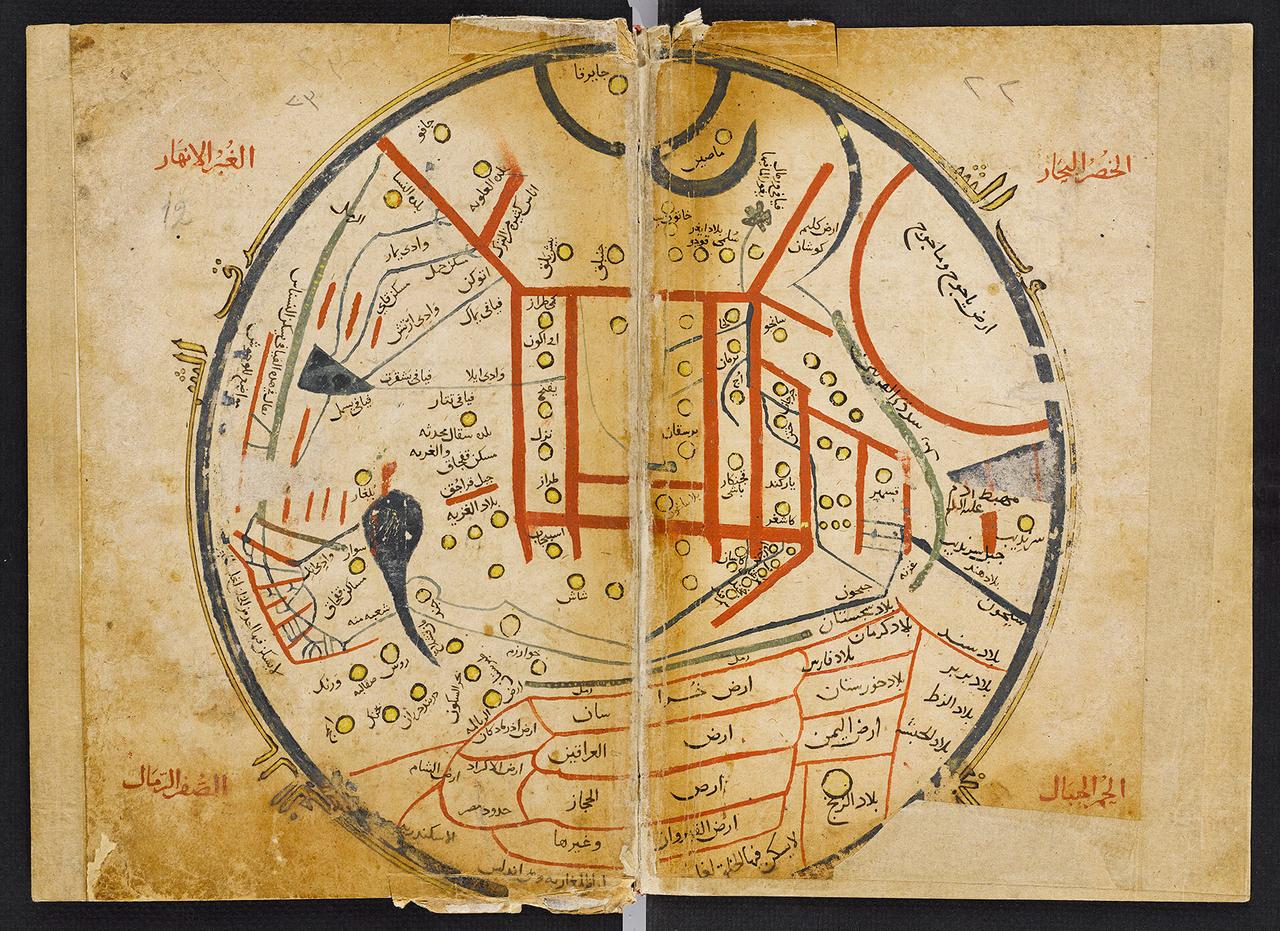
Dîvânu Lugâti’t-Türk (Türkiye Yazma Eserler Kurumu Başkanlığı)
People have long debated whether the language we speak alters how we perceive the world. At one time, this relationship was thought to be very strong: as if our language drew the boundaries of our mind, preventing us from thinking thoughts for which we had no words.
Today, it is difficult to defend such a rigid view.
The human mind does not live imprisoned in its language. It can learn new concepts, grasp distinctions from other languages, and think about things that had no name before. But the reverse is also untrue: language is not a neutral vessel for everything passing through the mind.
A more nuanced possibility exists.
Language may not tell us what we can think; but while speaking, it can influence what we pay attention to.
The Turkish distinction between “geldi” and “gelmiş” is one of its finest examples. When speaking of past events, Turkish uses the -DI and -mIş forms to differentiate between direct and indirect knowledge. In English, the same information can of course be expressed, but the speaker is not required to mark it on the verb each time. 【1】
Does such a linguistic habit also change our minds?
Research does not offer a simple “yes” or “no.” Some findings suggest that Turkish’s source-of-knowledge markers are linked to certain memory and source-monitoring tasks. At the same time, Turkish and English speakers behave similarly in many non-linguistic source-memory tasks.【2】
Perhaps the true effect of language lies here:
It does not determine our worldview from start to finish; but it repeatedly brings certain distinctions to our attention.
Can we say the same for a machine?
When a human says “Ahmet gelmiş,” there is a lived world behind the sentence.
A phone call, shoes seen at the door, a friend’s remark, perhaps a vague inference...
Human language is not learned only from other sentences. We learn the word “rain” by getting wet under it, heat by touching it, hesitation by seeing it on a person’s face.
But the language experience of large language models is different.
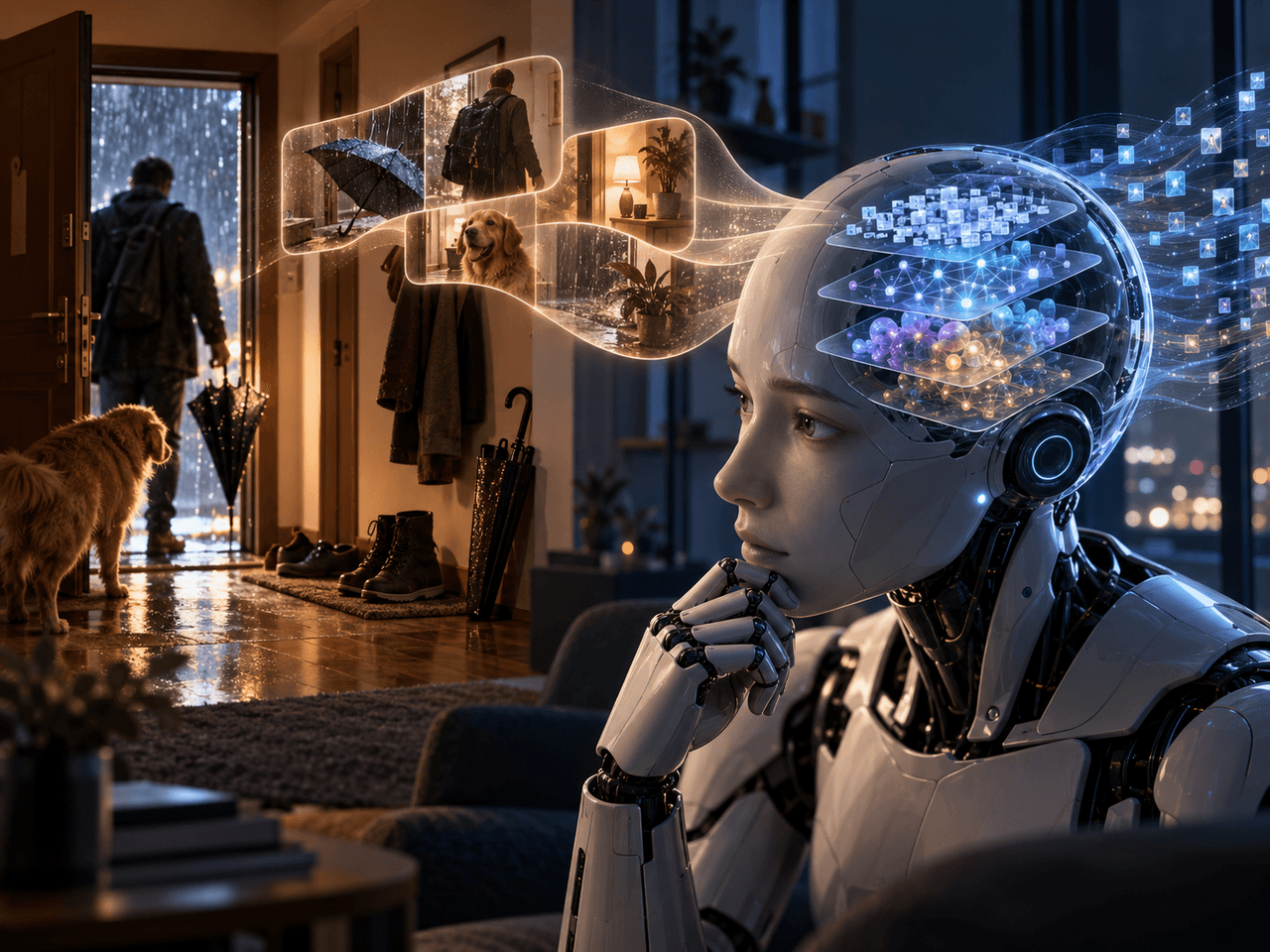
Makinenin Dilsel Veriyi İşleme Sürecini Temsil Eden Görsel (Yapay Zekâ ile Oluşturulmuştur.)
They learn which linguistic forms appear alongside others in vast quantities of text. The remarkable success of these systems makes the old question—how language relates to meaning—even more intriguing.
Here, the important distinction made by Emily M. Bender and Alexander Koller comes into play: Successfully using a linguistic form is not the same as understanding its meaning in the world.【3】
But today’s research is taking this debate into even stranger territory.
Because now we can look not only at what language an AI speaks externally, but also at what happens internally as it generates a response.
And what we see is not as simple as “Turkish in, Turkish thought, Turkish out.”
Let us pose a question in Turkish to a multilingual AI.
A Turkish answer appears on screen.
What did the model do between these two moments?
In 2024, researchers examining the intermediate layers of the Llama-2 family observed an intriguing pattern. When inputs in languages other than English were processed, the model’s intermediate layers often showed stronger activation for the English equivalent of the correct concept than for the input language’s own term. The researchers suggested that in models trained predominantly on English data, the abstract “concept space” may be closer to English than to other languages.【4】
It is tempting to interpret this finding as “AI secretly thinks in English.”
But science often spoils the most elegant sentence.
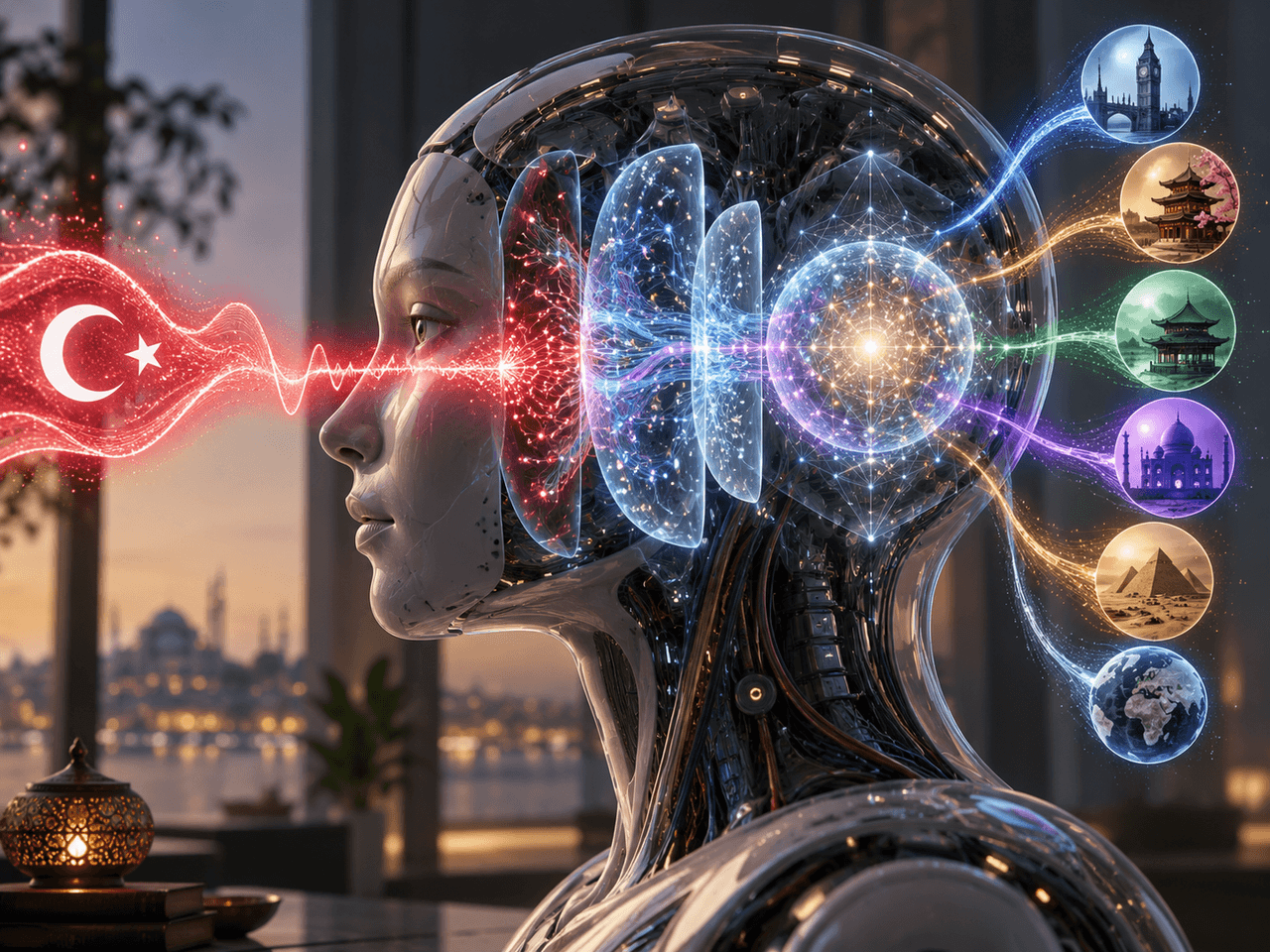
Çok Dilli Yapay Zekâda Kavram Uzayını Temsil Eden Görsel (Yapay Zekâ ile Oluşturulmuştur.)
Subsequent studies provided evidence that concept and language are not entirely identical within the model. Researchers found they could change the concept while preserving the language, and change the language while preserving the concept. It was observed that representations of the same concept across different languages might share a common layer that cannot be reduced to any single natural language. 【5】
In other models, the picture changed again. Systems trained predominantly on English leaned more heavily on English in their internal representations, while models trained more evenly across languages could use multiple “hidden languages.” Evidence also emerged that this difference might be linked to responses to culturally specific questions.【6】
Perhaps the machine does not think in English or Turkish at all.
Perhaps beneath the words, a conceptual space is forming that resembles none of our natural languages. Turkish, English, or Japanese then act like different doors opening into this space.
If so, our question changes:
Is Turkish merely one of these doors, or does it also contribute to shaping the concepts within?
This question is more than theoretical for Turkish.
An AI can generate flawless Turkish sentences; but if the bulk of the world’s knowledge is formed in other languages, Turkish may become merely a successful translation layer applied at the final stage.
To understand this possibility, we need only look at Turkish’s structure.
“I can do it.”
Again, a single word.
But it contains information about action, ability, future tense, and person. The language model, however, need not perceive this word as a single unit as we do. It first breaks the text into smaller units called “tokens.”
These tokens are not random. They are statistical units learned from training data. The model can learn relationships between these units. But the boundaries drawn by a tokenizer do not necessarily align with the morphological structure a human intuitively perceives, such as “yap + abil + ecek + im.” Recent studies on Turkish show that this mismatch and the tokenization method are critical factors in evaluating model performance.【7】
So the issue with Turkish is not merely showing the model more Turkish sentences.
How a language is tokenized, which texts represent it, and what kinds of questions are used to test it also matter greatly.
And the real problem becomes clearer here.
Let us perform a thought experiment.
Let us perfectly translate a million questions originally written in English into Turkish.
Now we have a million Turkish questions.
But do we now have a Turkish world of a million questions?
If the questions do not engage with Turkish literature, do not touch Turkey’s historical memory, and do not carry Turkish idioms, everyday associations, or debates that have developed within the language, is what we have truly Turkish—or merely an English-constructed world wearing a Turkish face?
The strength of the TurkishMMLU study lies precisely in taking this distinction seriously. Over ten thousand questions were developed directly from Turkey’s high school curriculum by subject experts, including local knowledge domains such as Turkish literature and the history of the Republic of Türkiye.【8】
This is not merely a testing technique.
Behind it lies a much larger idea:
You can translate a language’s words. You cannot reconstruct its memory through translation.

Dilbilimsel Şemaları Temsil Eden Görsel (Yapay Zekâ ile Oluşturulmuştur.)
Indeed, a 2025 study examining 17 widely used Turkish evaluation datasets found that 70 percent of them failed to meet necessary quality standards according to their own criteria.
The researchers particularly highlighted the lack of linguistic and cultural appropriateness in datasets translated and adapted from other languages.【9】
This finding forces us to reconsider a crucial word in the age of artificial intelligence:
Data.
The true richness of a language may not lie in how many billions of words are stored.
True richness lies in which lives, which knowledge, which thoughts, and which concepts have been turned into data.
Perhaps we must be honest about the question in our title.
Today, scientifically, there is no clearly defined state of an “AI that thinks in Turkish.” It is not enough for a model to answer in Turkish.
Seeing Turkish words in its internal layers is also not sufficient. Even the goal of creating a “pure Turkish-thinking” machine untouched by any other language is debatable.
The human mind does not work this way either.
A bilingual person sometimes finds it easier to think of a concept in one language and express it better in another. Languages borrow words, concepts, and associations from each other. The richness of thought often grows through these transitions.
So we can set a more meaningful goal:
That Turkish not be a second-class input and output language in the AI’s conceptual world.
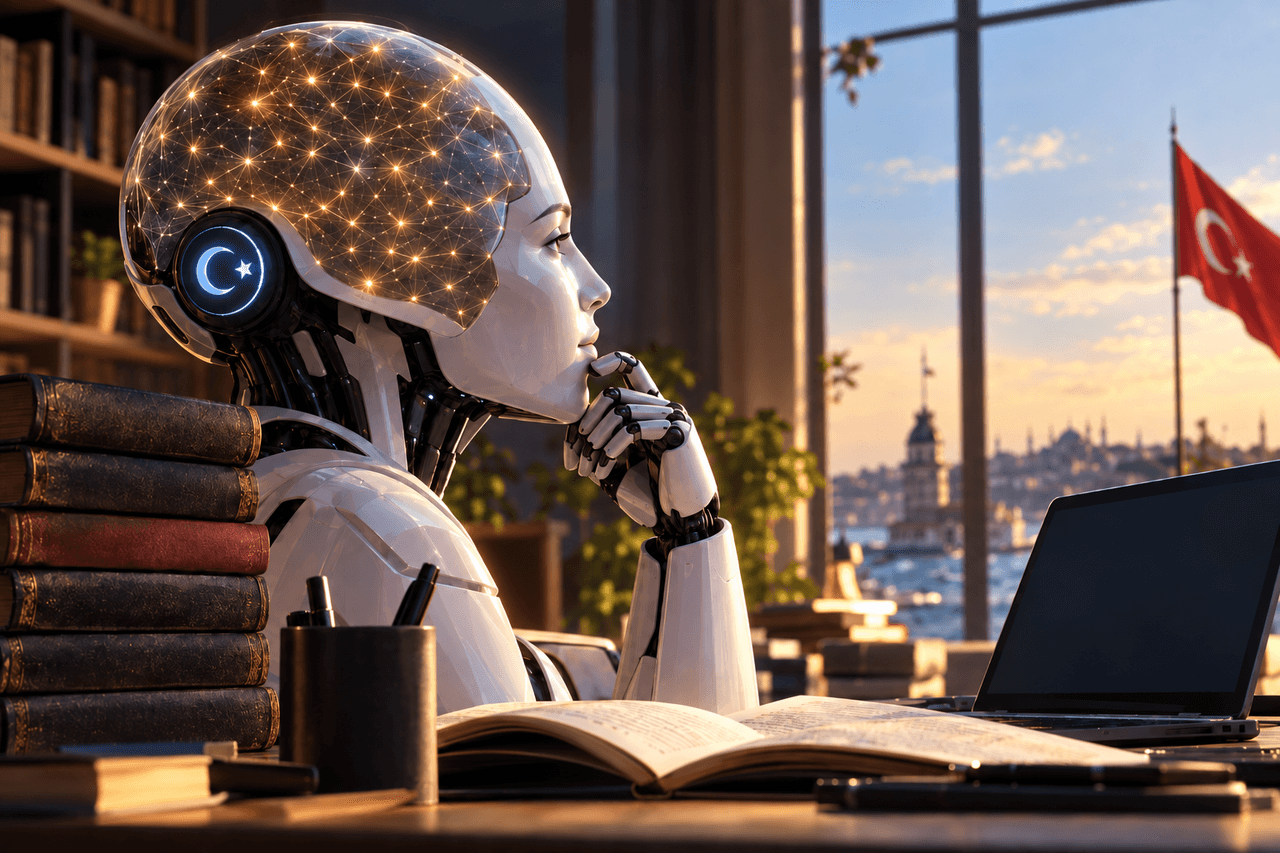
Türkçe Düşünen Yapay Zekâyı Temsil Eden Görsel (Yapay Zekâ ile Oluşturulmuştur.)
Turkish should not be merely the interface through which we ask questions and receive answers. Scientific, historical, literary, legal, educational, and everyday knowledge produced in Turkish must also become part of the conceptual world built by the models.
This cannot be achieved by producing a single “native ChatGPT.”
We need high-quality Turkish data. We need language technologies that account for Turkish’s structure. We need tools capable of measuring how much Turkish a model truly understands. We need computing infrastructure, researchers, linguists, engineers, and institutions that continuously generate new knowledge.
Therefore, Turkish large language model efforts in Türkiye should not be seen merely as an attempt to develop a new product. The use of tens of billions of Turkish tokens in training and foundational model research under TÜBİTAK BİLGEM are parts of a broader quest for technological capacity.【10】
Because technological independence is not merely about replicating someone else’s product. Sometimes independence means refusing to settle for the questions others ask.
Here, the question “Can it think in Turkish?” becomes a matter of technology policy.
Türkiye’s 2030 Industry and Technology Strategy links Turkish Large Language Model efforts to reducing external dependency in AI and developing Turkish-specific generative AI solutions. The 2026 Artificial Intelligence Action Plan also states that Turkish Large Language Model initiatives will continue to strengthen digital sovereignty.【11】
“Digital sovereignty” may sound like a concept tied to servers, data centers, and processors. But language is part of it too.
Because increasingly, AI will mediate between what we seek and the information we find. Systems that explain history to students, summarize medical texts, assist lawyers in document review, suggest code to programmers, or recommend sources to researchers will not merely carry information; they will determine which information becomes visible.
If Turkish becomes only the final destination where information thought in other languages is translated, what we lose will be more than a few words.
A language’s power to generate knowledge will weaken.
Perhaps the central issue of Türkiye’s National Technology Initiative in the linguistic domain is not merely keeping Turkish alive in the digital world, but participating in the construction of the digital world through Turkish.
Let us return one final time to the two sentences with which we began.
Ahmet came.
Ahmet has come.
For a human, the difference between them is not merely two past-tense forms. It is a small window opening onto the path of the knowledge behind the sentence.
Today’s AI is learning increasingly well which sentence requires this window to open. But it is still too early to say whether the machine sees the world through that window as we do. Perhaps when we ask “what language does AI think in,” we imagine too human an image: we search for a quiet voice inside the machine speaking Turkish or English.
Yet research points to another possibility: beneath language, there may be a conceptual space where different languages intersect. Some models may lean more heavily on English within this space; others may move fluidly between multiple linguistic representations.
Therefore, the real issue is not whether we hear a Turkish voice inside the machine.
The real issue is how deeply Turkish reaches into the conceptual world the machine constructs.
If one day we say “This AI thinks in Turkish,” the measure will not be its correct use of suffixes, its knowledge of idioms, or its fluent conversation with us.
Turkish must be one of the languages through which knowledge is produced, concepts are formed, questions are asked, and the world is explained within that system.
Because a language’s future is not determined solely by how many people speak it.
In the age of artificial intelligence, there is one more question:
Will that language be present where the knowledge of the future is produced?
“Can artificial intelligence think in Turkish?”
The most honest answer we can give today:
We do not yet know.
But it is within our power to ensure that Turkish is not merely one of the languages the AI speaks, but one of the languages through which it thinks and generates knowledge.
Perhaps the real competition is not about teaching the machine Turkish;
but about preserving Turkish as one of the languages of future thought.
Başar, Ezgi, and Arianna Bisazza. “A Morphology-Aware Evaluation of Turkish Syntax in Large Language Models.” *Proceedings of the Second Workshop Natural Language Processing for Turkic Languages (SIGTURK 2026)*, 95–102. Association for Computational Linguistics, 2026. Accessed September 2, 2026.https://doi.org/10.18653/v1/2026.sigturk-1.9.
Bender, Emily M., and Alexander Koller. “Climbing towards NLU: On Meaning, Form, and Understanding in the Age of Data.” *Proceedings of the 58th Annual Meeting of the Association for Computational Linguistics*, 5185–5198. Association for Computational Linguistics, 2020. Accessed September 2, 2026.https://doi.org/10.18653/v1/2020.acl-main.463.
Dumas, Clément, Chris Wendler, Veniamin Veselovsky, Giovanni Monea, and Robert West. “Separating Tongue from Thought: Activation Patching Reveals Language-Agnostic Concept Representations in Transformers.” *Proceedings of the 63rd Annual Meeting of the Association for Computational Linguistics (Volume 1: Long Papers)*, 31822–31841. Association for Computational Linguistics, 2025. Accessed September 2, 2026.https://doi.org/10.18653/v1/2025.acl-long.1536.
Kandemirci, Birsu, Anna Theakston, Ditte Boeg Thomsen, and Silke Brandt. “Does Evidentiality Support Source Monitoring and False Belief Understanding? A Cross-Linguistic Study with Turkish- and English-Speaking Children.” *Child Development* 94, no. 4 (2023): 889–904. Accessed September 2, 2026.https://doi.org/10.1111/cdev.13905.
Samo, Giuseppe, and Paola Merlo. “Modelling the Morphology of Verbal Paradigms: A Case Study in the Tokenization of Turkish and Hebrew.” *Proceedings of the Second Workshop Natural Language Processing for Turkic Languages (SIGTURK 2026)*, 82–94. Association for Computational Linguistics, 2026. Accessed September 2, 2026.https://doi.org/10.18653/v1/2026.sigturk-1.8.
T.C. Cumhurbaşkanlığı İletişim Başkanlığı. "Cumhurbaşkanı Erdoğan Türkiye Yapay Zekâ Eylem Planı’nı Açıkladı." June 13, 2026. Accessed September 2, 2026.
T.C. Ministry of Industry and Technology. *2030 Industry and Technology Strategy*. 2025. Accessed September 2, 2026.https://www.sanayi.gov.tr/assets/pdf/plan-program/2030SanayiveTeknolojiStratejisi.pdf.
Türkiye Bilimsel and Technological Research Council (TÜBİTAK). “TÜBİTAK’la Bilim ve Teknolojide Başarılarla Dolu 2025 Yılı.” January 1, 2026. Accessed September 2, 2026.https://tubitak.gov.tr/tr/haber/tubitakla-bilim-ve-teknolojide-basarilarla-dolu-2025-yili.
Türkiye Yazma Eserler Kurumu Başkanlığı. "Dîvânu Lugâti’t-Türk." Accessed September 2, 2026.https://www.yek.gov.tr/Home/Index_?n_id=152.
Umutlu, Elif Ecem, Ayse Aysu Cengiz, Ahmet Kaan Sever, Seyma Erdem, Burak Aytan, Busra Tufan, Abdullah Topraksoy, Esra Darıcı, and Cagri Toraman. “Evaluating the Quality of Benchmark Datasets for Low-Resource Languages: A Case Study on Turkish.” *Proceedings of the Fourth Workshop on Generation, Evaluation and Metrics (GEM²)*, 471–487. Association for Computational Linguistics, 2025. Accessed September 2, 2026.https://aclanthology.org/2025.gem-1.41/.
Wendler, Chris, Veniamin Veselovsky, Giovanni Monea, and Robert West. “Do Llamas Work in English? On the Latent Language of Multilingual Transformers.” *Proceedings of the 62nd Annual Meeting of the Association for Computational Linguistics (Volume 1: Long Papers)*, 15366–15394. Association for Computational Linguistics, 2024. Accessed September 2, 2026.https://doi.org/10.18653/v1/2024.acl-long.820.
Yüksel, Arda, Abdullatif Köksal, Lütfi Kerem Senel, Anna Korhonen, and Hinrich Schuetze. “TurkishMMLU: Measuring Massive Multitask Language Understanding in Turkish.” *Findings of the Association for Computational Linguistics: EMNLP 2024*, 7035–7055. Association for Computational Linguistics, 2024. Accessed September 2, 2026.https://doi.org/10.18653/v1/2024.findings-emnlp.413.
Zhong, Chengzhi, Qianying Liu, Fei Cheng, Junfeng Jiang, Zhen Wan, Chenhui Chu, Yugo Murawaki, and Sadao Kurohashi. “What Language Do Non-English-Centric Large Language Models Think in?” *Findings of the Association for Computational Linguistics: ACL 2025*, 26333–26346. Association for Computational Linguistics, 2025. Accessed September 2, 2026.https://doi.org/10.18653/v1/2025.findings-acl.1350.
Ünal, Ercenur, and Anna Papafragou. “Relations Between Language and Cognition: Evidentiality and Sources of Knowledge.” *Topics in Cognitive Science* 12, no. 1 (2020): 115–135. Accessed September 2, 2026.https://doi.org/10.1111/tops.12355.
[1]
Ercenur Ünal ve Anna Papafragou, “Relations Between Language and Cognition: Evidentiality and Sources of Knowledge,” Topics in Cognitive Science 12, sy. 1 (2020): 115–135, erişim 2 Eylül 2026, https://doi.org/10.1111/tops.12355; Birsu Kandemirci vd., “Does Evidentiality Support Source Monitoring and False Belief Understanding? A Cross-Linguistic Study with Turkish- and English-Speaking Children,” Child Development 94, sy. 4 (2023): 889–904, erişim 2 Eylül 2026, https://doi.org/10.1111/cdev.13905.
[2]
Ünal ve Papafragou, “Relations Between Language and Cognition,” 115–135; Kandemirci vd., “Does Evidentiality Support Source Monitoring,” 889–904.
[3]
Emily M. Bender ve Alexander Koller, “Climbing towards NLU: On Meaning, Form, and Understanding in the Age of Data,” Proceedings of the 58th Annual Meeting of the Association for Computational Linguistics (Association for Computational Linguistics, 2020), 5185–5198, erişim 2 Eylül 2026, https://doi.org/10.18653/v1/2020.acl-main.463.
[4]
Chris Wendler, Veniamin Veselovsky, Giovanni Monea ve Robert West, “Do Llamas Work in English? On the Latent Language of Multilingual Transformers,” Proceedings of the 62nd Annual Meeting of the Association for Computational Linguistics (Volume 1: Long Papers) (Association for Computational Linguistics, 2024), 15366–15394, erişim 2 Eylül 2026, https://doi.org/10.18653/v1/2024.acl-long.820.
[5]
Clément Dumas, Chris Wendler, Veniamin Veselovsky, Giovanni Monea ve Robert West, “Separating Tongue from Thought: Activation Patching Reveals Language-Agnostic Concept Representations in Transformers,” Proceedings of the 63rd Annual Meeting of the Association for Computational Linguistics (Volume 1: Long Papers) (Association for Computational Linguistics, 2025), 31822–31841, erişim 2 Eylül 2026, https://doi.org/10.18653/v1/2025.acl-long.1536.
[6]
Chengzhi Zhong vd., “What Language Do Non-English-Centric Large Language Models Think in?,” Findings of the Association for Computational Linguistics: ACL 2025 (Association for Computational Linguistics, 2025), 26333–26346, erişim 2 Eylül 2026, https://doi.org/10.18653/v1/2025.findings-acl.1350.
[7]
Ezgi Başar ve Arianna Bisazza, “A Morphology-Aware Evaluation of Turkish Syntax in Large Language Models,” Proceedings of the Second Workshop Natural Language Processing for Turkic Languages (SIGTURK 2026) (Association for Computational Linguistics, 2026), 95–102, erişim 2 Eylül 2026, https://doi.org/10.18653/v1/2026.sigturk-1.9; Giuseppe Samo ve Paola Merlo, “Modelling the Morphology of Verbal Paradigms: A Case Study in the Tokenization of Turkish and Hebrew,” Proceedings of the Second Workshop Natural Language Processing for Turkic Languages (SIGTURK 2026) (Association for Computational Linguistics, 2026), 82–94, erişim 2 Eylül 2026, https://doi.org/10.18653/v1/2026.sigturk-1.8.
[8]
Arda Yüksel, Abdullatif Köksal, Lütfi Kerem Senel, Anna Korhonen ve Hinrich Schuetze, “TurkishMMLU: Measuring Massive Multitask Language Understanding in Turkish,” Findings of the Association for Computational Linguistics: EMNLP 2024 (Association for Computational Linguistics, 2024), 7035–7055, erişim 2 Eylül 2026, https://doi.org/10.18653/v1/2024.findings-emnlp.413.
[9]
Elif Ecem Umutlu vd., “Evaluating the Quality of Benchmark Datasets for Low-Resource Languages: A Case Study on Turkish,” Proceedings of the Fourth Workshop on Generation, Evaluation and Metrics (GEM²) (Association for Computational Linguistics, 2025), 471–487, erişim 2 Eylül 2026, https://aclanthology.org/2025.gem-1.41/.
[10]
Türkiye Bilimsel ve Teknolojik Araştırma Kurumu (TÜBİTAK), “TÜBİTAK’la Bilim ve Teknolojide Başarılarla Dolu 2025 Yılı,” 1 Ocak 2026, erişim 2 Eylül 2026, https://tubitak.gov.tr/tr/haber/tubitakla-bilim-ve-teknolojide-basarilarla-dolu-2025-yili.
[11]
T.C. Sanayi ve Teknoloji Bakanlığı, 2030 Sanayi ve Teknoloji Stratejisi (2025), erişim 2 Eylül 2026, https://www.sanayi.gov.tr/assets/pdf/plan-program/2030SanayiveTeknolojiStratejisi.pdf; T.C. Cumhurbaşkanlığı İletişim Başkanlığı, “Cumhurbaşkanı Erdoğan Türkiye Yapay Zekâ Eylem Planı’nı Açıkladı,” 13 Haziran 2026, erişim 2 Eylül 2026, https://www.iletisim.gov.tr/turkce/haberler/detay/cumhurbaskani-erdogan-turkiye-yapay-zeka-eylem-planini-acikladi.
From Language Data to Digital Sovereignty
Does Language Tell Us What to Think?
What Does a Machine Know When It Says “Gelmiş”?
We Ask in Turkish; What Language Is Spoken Inside?
If Turkish Is Only an Output Language
Can a Language’s World Be Translated?
What Does It Mean for an AI to “Think in Turkish”?
From Language Data to Digital Sovereignty
So, Can Artificial Intelligence Think in Turkish?