This article was automatically translated from the original Turkish version.
+1 More
Location | Çankırı | ||||||||
|---|---|---|---|---|---|---|---|---|---|
Elevation(s) | 150 metres | ||||||||
Historical Periods | Ottomans Seljuks Danishmendids Byzantine Roman | ||||||||
Archaeological Remains | pottery shards settlement remains Rock tomb from the Roman period | ||||||||
Monumental Structure | Tomb of Çankırı's founder, Emir Karatekin Bey | ||||||||
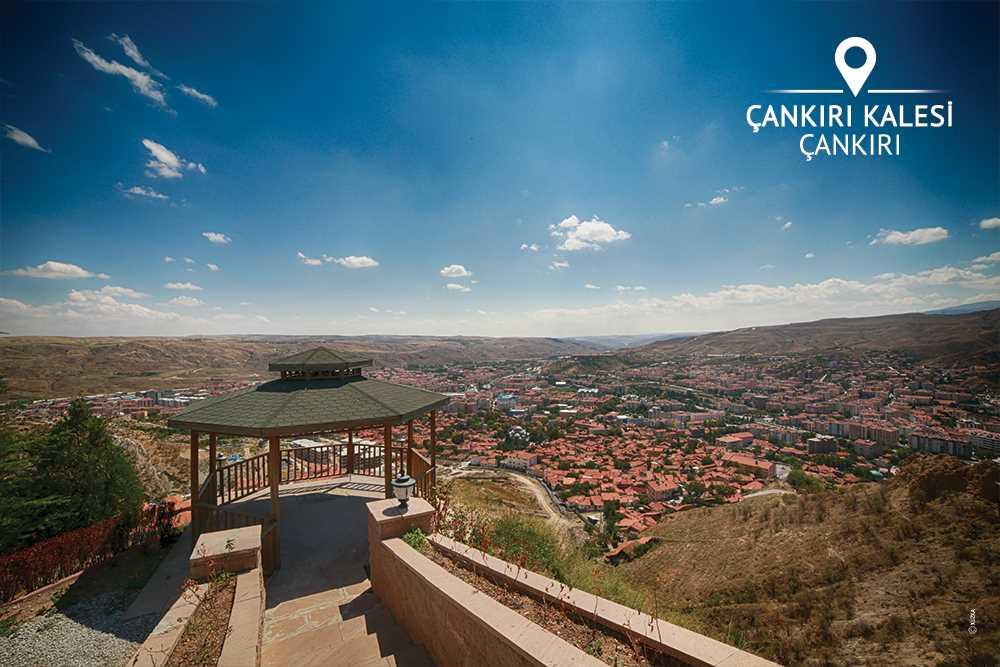
Çankırı Castle is situated on a small hill north of the city center of Çankırı in the Central Anatolia Region. The castle has been under the control of various civilizations across different periods and was inhabited during the Roman, Byzantine, Danişmentli, Seljuk, and Ottoman eras, known for its robust construction. Today, only fragments of its walls remain.
The castle has a rectangular plan. Its walls were built using a mixture of rubble stone and brick. The castle is located approximately 150 meters above the stream at its base. Within its grounds, alongside settlement remains and fragments of baked clay pottery dating to the Roman period, there is a tomb belonging to Emir Karatekin Bey, the Danişmentli commander associated with the conquest of Çankırı. The area surrounding the castle was formerly wooded and later used as a recreational and visitation site. The Ministry of Culture and Tourism has carried out restoration works on the castle during various periods.

Çankırı Castle (Türkiye Culture Portal)
The ancient name of Çankırı was Gangra. The city lies within the region of Paphlagonia and was first mentioned by Eratosthenes in the 3rd century BCE. Gangra played a significant role as a settlement during the Hellenistic and Roman periods. During the Hellenistic era, it served as the center of local kingdoms and became one of the administrative centers of Paphlagonia under Roman rule. In this period, Gangra adopted the name Germanicopolis and continued its development under Roman influence. During the Byzantine period, the city reverted to the name Gangra and became an important religious and administrative center within the Paphlagonia theme. Particularly in the 4th century CE, a bishopric was established here.
Archaeological evidence indicates that the castle and its surroundings were inhabited across multiple periods. Settlement traces have been found in the region dating back to the Paleolithic era, albeit intermittently. Numerous mounds, tumuli, and settlement sites have been identified from the Chalcolithic, Early Bronze Age, Middle Bronze Age, Late Bronze Age, and Iron Age periods. Late Bronze Age Hittite settlements are particularly concentrated around the castle. Although Phrygian influence is evident during the Iron Age, the local culture persisted. In the Hellenistic period, Gangra became a princely center, and during the Roman period, the city gained prominence for its military and religious functions.
After the Battle of Manzikert in the 11th century, Çankırı was conquered by the Danişmentlids and came under Turkish rule under the leadership of Kara Tekin (Karatekin) Bey. Kara Tekin died shortly after the conquest of Çankırı and was buried in the tomb within the castle. Information about this period is also recorded in the Danişmendnâme, a legendary source compiled in the 13th century, which refers to Çankırı as “Mankuriyye” and provides detailed accounts of the castle’s capture.
Following the Danişmentlids, Çankırı came under the control of the Seljuks, then the Candaroğulları, and finally the Ottomans, gaining prominence due to its strategic and military significance. During the Ottoman period, Çankırı was organized as a sanjak subordinate to the Anatolia Eyalet.
Çankırı Castle stands out for its multi-layered historical and cultural heritage spanning both the Roman-Byzantine and Turkish periods. Archaeological findings and written sources demonstrate that the castle was not merely a military structure but also fulfilled residential, religious, and economic functions. The rock-cut tomb found near the castle points to the Roman period, while the Tomb of Emir Karatekin Bey is one of the symbolic structures of the Turkish era. With all these features, Çankırı Castle serves as a carrier of a multi-layered history extending from prehistoric times to the Ottoman period.
Ministry of Culture and Tourism of the Republic of Türkiye. "Çankırı Kalesi ve Karatekin Bey Türbesi." *Kültür Portalı*. Accessed July 15, 2025. https://www.kulturportali.gov.tr/turkiye/cankiri/gezilecekyer/cankiri-kalesi-ve-karatekin-bey-turbesi.
Ministry of Culture and Tourism. "Çankırı." *Döner Sermaye İşletmesi Merkez Müdürlüğü (DÖSİMM), Ministry of Culture and Tourism of the Republic of Turkey*. Accessed July 15, 2025. https://dosim.ktb.gov.tr/TR-321135/cankiri.html.
Ministry of Environment, Urbanization and Climate Change. “İlimiz Tarihi.” *Republic of Turkey Ministry of Environment, Urbanization and Climate Change, Çankırı Provincial Directorate*. Accessed July 15, 2025. https://cankiri.csb.gov.tr/ilimiz-tarihi-i-112158.

Location | Çankırı | ||||||||
|---|---|---|---|---|---|---|---|---|---|
Elevation(s) | 150 metres | ||||||||
Historical Periods | Ottomans Seljuks Danishmendids Byzantine Roman | ||||||||
Archaeological Remains | pottery shards settlement remains Rock tomb from the Roman period | ||||||||
Monumental Structure | Tomb of Çankırı's founder, Emir Karatekin Bey | ||||||||
Historical Background and Archaeological Context
Turkish Period and Emir Karatekin Bey