


This article was automatically translated from the original Turkish version.
+1 More
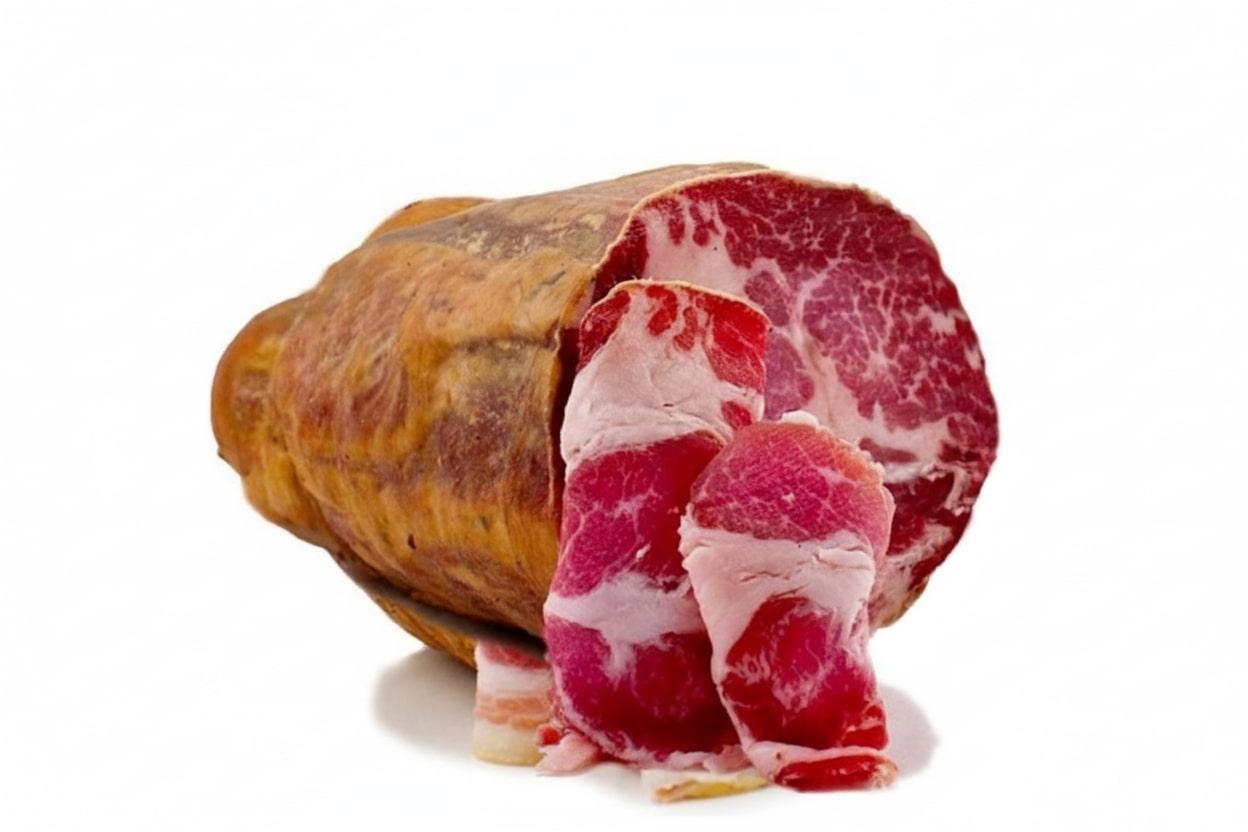
Capocollo di Calabria (Generated by Artificial Intelligence.)
Name(s) | Capocollo di Calabria | ||||||||
|---|---|---|---|---|---|---|---|---|---|
Protection Type | Protected Designation of Origin (D.O.P.) - Protected Origin Name | ||||||||
Production Region | Calabria Region | ||||||||
Shape | Cylindrical, wrapped in natural casing and tied with string | ||||||||
Salting Duration | 4 to 14 days | ||||||||
Capocollo di Calabria is a cured meat product unique to Italy’s Calabria region. This product is obtained exclusively from the upper loin (lombo) of pigs raised in Calabria.
The production and processing of Capocollo di Calabria under its Denominazione di Origine Protetta (D.O.P.) protection must take place within the territory of the Calabria region, designated as the traditional production area. This geographic area features a warm-temperate climate, low rainfall concentrated in winter, and a landscape combining mountainous and hilly terrain with a coastal strip.
Capocollo di Calabria is produced exclusively from the meat of pigs raised in Calabria, and all preparation and processing steps must occur on Calabrian soil. Breeding boars (verro) and sows (scrofa) are not used in its production. The genetic requirements of the pigs must conform to the characteristics of the Italian heavy pig. Permitted breeds include Apulo-Calabrese; Large White and Italian Landrace (bred by the Italian Stud Book); offspring of crosses between these breeds; offspring of Duroc boars; and offspring of other breeds or crossbreeds compatible with stud book objectives. Pigs carrying undesirable traits such as Porcine Stress Syndrome (PSS), as well as purebred animals of the Belgian Landrace, Hampshire, Pietrain, and Spot breeds, are excluded. Pigs may be slaughtered from the eighth month after birth. The average batch weight at slaughter must be at least 140 kg. The pigs must bear the “raised in Calabria” quality stamp or a marking indicating their farm of origin.

Capocollo di Calabria (generated by artificial intelligence.)
The compound feed used for pigs must contain components such as barley, broad beans, maize, fava beans, and chickpeas, which together must constitute at least 50 percent of the feed. The feed should be sourced as much as possible from the region of origin (Calabria). The use of cassava, potatoes, or by-products that may impart undesirable flavors to the meat is prohibited. In the final two months before slaughter, the protein content of the feed must be at least 12 percent. The “broth feeding” method (alimentazione a brodo), which involves the use of dairy by-products such as whey to achieve firmer meat, is forbidden.
Capocollo di Calabria is prepared by dry-salting or brining the deboned upper loin (lombo) with coarse table salt. The fresh meat must weigh between 3.5 and 5.5 kg. The meat cut must retain a layer of fat approximately 3 to 4 mm thick to ensure tenderness during aging. The salting period varies between four and fourteen days. After salting, the meat is rinsed with water, moistened with wine vinegar, and subjected to “massaging” and “pressing.” Subsequently, natural ingredients—salt, black pepper, red pepper or pepper paste, vinegar, and spices—are added, and the meat is wrapped in the pig’s parietal diaphragm (natural membrane). Traditionally, it is tied with string, and the membrane is perforated; the use of characteristic wooden sticks during tying is permitted. The product is hung in well-ventilated areas with controlled humidity and temperature for drainage and aging.
The aging (stagionatura) period must last at least one hundred days under natural conditions in a hygienically suitable environment, starting from the date of salting. This process occurs under controlled temperature and humidity conditions that support slow maturation. When ready for consumption, Capocollo di Calabria has a cylindrical shape, wrapped in its natural membrane and bound with string. Its appearance ranges from pale to intense pink or red, depending on the presence of black pepper or red pepper. The cut surface exhibits a lively pink color with characteristic fat marbling typical of the pig’s loin. The flavor becomes more refined with aging, while the aroma is intense. The product may be marketed whole, sliced, vacuum-packed, or in modified atmosphere packaging.
The quality and characteristics of Capocollo di Calabria derive from natural factors such as the region’s warm-temperate climate, low rainfall, and geographical location, as well as human factors rooted in producers’ expertise. This link is particularly evident in the use of heavy pigs fed on typical regional plant products and in the use of natural aromatic ingredients—black pepper and red pepper—during processing, which influence the sensory qualities of the product. Every stage of the production chain (farmers, slaughterhouses, processors, packagers) is monitored through registered lists and control mechanisms. Inputs and outputs at each stage are documented to ensure full forward and backward traceability of the product.
MASAF – Ministry of Agriculture, Food and Forestry Policies. "Jambo Toskana'nız." MASAF. Accessed October 20, 2025. https://www.masaf.gov.it/flex/cm/pages/ServeAttachment.php/L/IT/D/7%252F8%252Fc%252FD.30ca8b98cc4cb977c838/P/BLOB%3AID%3D3339/E/pdf?mode=download

Capocollo di Calabria (Generated by Artificial Intelligence.)
Name(s) | Capocollo di Calabria | ||||||||
|---|---|---|---|---|---|---|---|---|---|
Protection Type | Protected Designation of Origin (D.O.P.) - Protected Origin Name | ||||||||
Production Region | Calabria Region | ||||||||
Shape | Cylindrical, wrapped in natural casing and tied with string | ||||||||
Salting Duration | 4 to 14 days | ||||||||
No Discussion Added Yet
Start discussion for "Capocollo di Calabria" article
Production Area
Raw Materials and Pig Breeds
Animal Feeding
Processing Methods
Aging and Final Characteristics
Geographical Link and Traceability