

This article was automatically translated from the original Turkish version.
Cappadocia
Location | Central Anatolia Region Kırşehir) Kayseri Niğde Nevşehir (also Aksaray | ||||||||
|---|---|---|---|---|---|---|---|---|---|
UNESCO Status | World Heritage Site since 1985 | ||||||||
Visit Period | Open year round | ||||||||
Activities | Nature walks hot air balloon cultural tours handicrafts | ||||||||
Region(s) | Central Anatolia Region | ||||||||
Most Famous Places | Göreme, Ürgüp, Avanos, Uçhisar, Ihlara Valley, Zelve Valley | ||||||||
Within the boundaries of Nevşehir province, the Cappadocia region, encompassing the place area, is recognized as a major tourist and archaeological site due to its underground cities, rock-carved churches, and monastery complexes. This geological building led to the inclusion of Cappadocia in the UNESCO World World Heritage List in 1985, thereby officially recognizing it as a cultural and natural heritage requiring protection at both national and international levels.
Promotional Video (Republic of Türkiye Presidency of Communication)
The Cappadocia region lies within the Central Anatolia section of the Middle Kızılırmak and is a natural heritage site notable for its geological structure. Millions of years of volcanic activity resulted in lava and tuff layers deposited by the extinct volcanoes Erciyes, Hasan Mountain and Güllüdağ like. These layers were shaped by wind and water erosion into distinctive formations known as “fairy chimneys” original. The soft nature of the tuff allowed human hands to easily carve it throughout history, leading to the emergence of rock-cut structures used for habitation, worship and protection. The region also hosts its own unique ecosystem supporting diverse biological species house.
The volcanic activity during the Tertiary Geological Period (Miocene period) played a decisive role in shaping Cappadocia’s present-day landscape. Lava and tuff ejected by stratovolcanoes such as Erciyes (3,917 m), Hasandağı (3,268 m) and Güllüdağ formed the region’s fundamental geological structure. Over millions of years, these volcanic materials were eroded by ice, wind and river erosion, giving rise to today’s fairy chimneys, valleys and unusual rock formations.
The region’s most significant river is the Kızılırmak, Türkiye’s longest river. Other rivers such as the Melendiz Çayı and Damsa Çayı have also contributed to the region’s hydrographic structure. Cappadocia exhibits typical continental climate characteristics. Temperatures can reach up to 30°C during Summer months and drop as low as -15°C in winter. Annual precipitation averages between 350 and 400 mm.
Archaeological findings indicate human settlement in the region since the Paleolithic period. Known as “Katpatuka” during the Hittite era, the region became an important satrapal center under Persian rule. With the spread of Christianity during the Roman Empire, together the region transformed into a religious center center.
From the 4th century AD, Cappadocia became a significant retreat center for Christian monks. Hundreds of church churches, monasteries and dwellings were carved into the rock during this period. Structures such as the Tokalı Kilise, Elmalı Kilise and Darkness Kilise in the Göreme Open Air Museum are among the most important examples reflecting the artistic and architectural features of the era.
With the arrival of Turks in Anatolia in the 11th century, Islamic architectural works emerged in the region. Caravanserais, madrasas and mosques were constructed during the Seljuk period. During the Ottoman era, the region maintained its strategic importance due to its location along trade trade routes.
Among the most remarkable structures of Cappadocia are the underground cities, constructed to meet defensive needs. Derinkuyu Underground City, with its eight levels and 55-meter depth, is the largest underground settlement in the region. Equipped with air shafts, water wells, churches and stables, these structures were designed to sustain thousands of people for extended duration periods, providing opportunity shelter and security.
Rock dwellings and settlements in Uçhisar, Ortahisar and Ürgüp form essential components of the region’s defensive system. Uçhisar Castle, located at the highest point of the region, offers panoramic views over a wide area.
During the Byzantine period, Cappadocia was recognized as a major center of Christianity. Structures such as the Tokalı Kilise, Elmalı Kilise, Karanlık Kilise and Yılanlı Kilise in the Göreme Open Air Museum are adorned with frescoes reflecting the religious art outlook of the time. These Word structures, thanks to rock-carved architecture, retained their durability against external influences and have survived to the present day. These frescoes, containing iconographic depictions, hold significant theological and artistic importance.
Avanos district has been a pottery center for thousands of years due to the fertile red soil brought by the Kızılırmak River. Artifacts produced using traditional pottery wheels are among the region’s most important handicrafts.
Cappadocia is one of the key centers of Turkish carpet and kilim art. Carpets woven in Ürgüp and Mustafapaşa are renowned for their original patterns and high-quality wool.
The region’s volcanic soils and favorable climatic conditions are ideal for grape cultivation. Cappadocia wines, particularly those made from Emir and Kalecik Karası grapes, are increasingly gaining international recognition.
Today, Cappadocia is among Türkiye’s most important tourist destinations, with the regional economy heavily reliant on tourism revenue. Hot air balloon tours, nature walking trails, traditional handicrafts and local gastronomy are key attractions for visitors. Avanos district stands out for its pottery tradition, while wine production in the region is another traditional activity contributing to economic vitality. Over 400 rock churches, countless historical settlements and open-air museums serve as important recording centers for tourism. Zelve Open Air Museum, Ihlara Valley and Soğanlı Village are among the most visited sites.
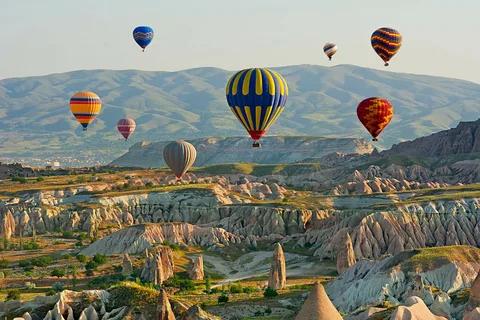
Balloon Tourism: Considered one of the world’s best hot air balloon routes.
At Safaris and Nature Walks
Bicycle and ATV Tours
Thermal tourism (Kozaklı Spas)
Gastronomy tourism (local delicacies such as testi kebabı and mantı)
Congress Tourism: Four- and five-star hotels in the region, along with the Nevşehir Hacı Bektaş Veli University Culture and Congress Center and municipal cultural centers, provide suitable infrastructure for congress tourism. However, improvements in transportation infrastructure and increased promotional activities are needed.
Hot air balloon flights, now one of Cappadocia’s iconic tourist symbols, offer visitors a bird’s-eye view of the region’s unique geological and historical landscape. These flights, typically conducted at day sunrise, provide a visual experience of fairy chimneys, valleys and ancient settlements. Numerous balloons ascending simultaneously form a key element of the region’s promotional imagery. These activities contribute significantly to the economy and hold great importance for sustainable tourism policies.
The region is 290 km from Ankara and 80 km from Kayseri. The Nevşehir-Kayseri motorway and Aksaray-Nevşehir road have improved accessibility to the region.
Nevşehir Cappadocia Airport and Kayseri Erkilet Airport provide air connections to the region. Flights are available from Istanbul.
Kayseri Station offers the closest rail connection to the region. However, there is no direct rail link to Nevşehir.
Declared a UNESCO World Heritage Site in 1985 under the name “Göreme National Park and the Rock Sites of Cappadocia,” registration the region has benefited from a vital process for its preservation and transmission to future generations.
Restoration projects carried out by the Turkish Ministry of Culture and Tourism and local administrations aim to protect historical structures. Ongoing efforts focus particularly on preserving the frescoes within the rock churches.
Eco-tourism activities in the region are increasing. Traditional rock houses are being converted into boutique hotels, and local production and organic agriculture are being encouraged.
Akgöz, Erhan, Gamze Temizel, and Ayşen Otal. “Kapadokya Bölgesi’nin Kongre Turizm Potansiyelinin Belirlenmesine Yönelik Bir Çalışma.” *Pamukkale Üniversitesi İşletme Araştırmaları Dergisi* 9, no. 1 (2022): 143–162. https://doi.org/10.47097/piar.1115400. Accessed April 19, 2025.
Kapadokya Alan Directorate. "2020 Administrative Activity Report." Kapadokya Regional Directorate. Accessed April 19, 2025. https://kapadokyaalan.ktb.gov.tr/Eklenti/81883,2020-idari-faaliyet-raporupdf.pdf?0.
Kazancı, Nizamettin, and Yaşar Suludere. “Kapadokya’nın Litolojik Yapısı ve Sınırları, Türkiye.” *Türkiye Jeoloji Bülteni* 63, no. 3 (June 2020): 373–380. Accessed April 19, 2025. https://dergipark.org.tr/tr/pub/tjb/issue/55103/695327.
Nevşehir Hacı Bektaş Veli Üniversitesi. “Kapadokya.” ECTS Bilgi Paketi. Accessed April 19, 2025. https://ects.nevsehir.edu.tr/ects/index/dil/tr/sayfa/76.
T.C. Communication Presidency. *Kapadokya*. YouTube video. Accessed April 19, 2025. https://youtu.be/0ZeCAo8nxo8.
Turkish Ministry of Culture and Tourism, General Directorate of Promotion. "Kapadokya." tanitma.ktb.gov.tr. Accessed April 19, 2025. https://tanitma.ktb.gov.tr/tr-22783/kapadokya.html.


Cappadocia
Location | Central Anatolia Region Kırşehir) Kayseri Niğde Nevşehir (also Aksaray | ||||||||
|---|---|---|---|---|---|---|---|---|---|
UNESCO Status | World Heritage Site since 1985 | ||||||||
Visit Period | Open year round | ||||||||
Activities | Nature walks hot air balloon cultural tours handicrafts | ||||||||
Region(s) | Central Anatolia Region | ||||||||
Most Famous Places | Göreme, Ürgüp, Avanos, Uçhisar, Ihlara Valley, Zelve Valley | ||||||||
Geological Formation and Geographic Features
Volcanic Activity and the Formation of Fairy Chimneys
Hydrography and Climate Characteristics
Historical Development and Cultural Heritage
From Prehistory to Rome
The Byzantine Period and the Development of Christian Architecture
The Seljuk and Ottoman Periods
Underground Cities and the Evolution of Defensive Architecture
Derinkuyu and Kaymaklı Underground Cities
Defensive Rock Settlements
Religious Life in Cappadocia
Traditional Life and Handicrafts
Pottery and Ceramics
Carpet and Kilim Weaving
Wine Production
Economic and Touristic Value
Alternative Tourism Types
Hot Air Balloon Activities in Cappadocia
Transportation and Infrastructure
Road Transportation
Air Transportation
Rail Transportation
Conservation Efforts and Sustainable Tourism
UNESCO Process and Conservation Policies
Restoration Projects
Eco-Tourism and Sustainability