

This article was automatically translated from the original Turkish version.
+2 More
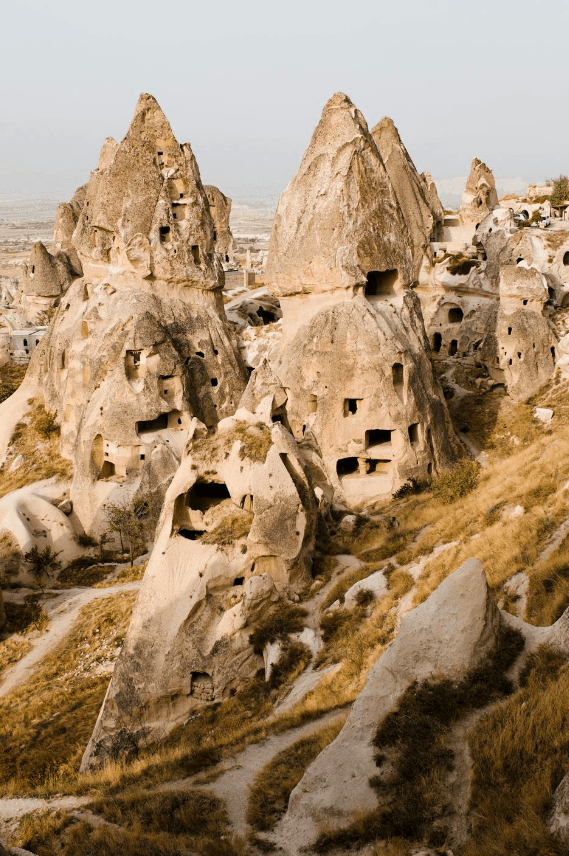
Cappadocia Fairy Chimneys are natural formations unique to the Cappadocia region in Türkiye’s Central Anatolia Region, known for their geomorphological structures. These formations are spread across a wide area encompassing the provinces of Nevşehir, Kayseri, Aksaray, Niğde and Kırşehir, and are particularly concentrated in the centers of Göreme, Uçhisar, Ürgüp, Avanos, Derinkuyu, Kaymaklı and Ihlara like. The Göreme National Park and the Cappadocian Rock Sites were inscribed on the UNESCO World World Heritage List in 1985 for both their natural and cultural heritage value.

Cappadocian Fairy Chimneys (Culture Portal)
The formation of the Cappadocian Fairy Chimneys is the result of a multi-stage natural process spanning millions of years on a geological scale. They are located within the Cappadocian Volcanic Area (CVA), a north-east to south-west trending volcanic belt approximately 250–300 km long and one of Türkiye’s most significant Neogene-Quaternary volcanic zones.
This area was shaped by successive eruptions from major volcanoes such as Erciyes (3916 m), Hasan Mountain (3268 m) and Melendiz Dağı.
The geological foundation of the region consists of rocks formed by volcanic activity, including tuff, ignimbrite, tuffite and lahar. Most of these rocks are stacked in volcanic-sedimentary layers with varying resistance levels. The layers, collectively known as the Ürgüp Formation, feature extensive ignimbrite strata that acted as protective caps over the softer tuff layers, playing a crucial role in the shaping of the fairy chimneys.

Cappadocian Fairy Chimneys (Pexels)
This layered structure rendered the region highly susceptible to erosion. Wind and fluvial erosion, beginning in the Quaternary period, progressed selectively due to the soft nature of the tuff layers. Differential erosion occurred between the resistant upper layers and the softer underlying strata, resulting in the formation of conical structures rising in a fairy chimney shape. The more durable ignimbrite or basalt-like rocks at the tops served as “caps” protecting the softer tuff beneath from external weathering agents.
Tectonic movements also played a significant role in this process. The Cappadocia region is surrounded by active fault lines including the Central Anatolian Fault Zone (CAFZ), the Tuz Gölü Fault Zone (TFZ) and the Derinkuyu Fault, which triggered volcanic activity and fragmented the landscape into blocks, thereby increasing topographic diversity.
The gradual deepening of volcanic plateaus into narrow valleys and canyons led to the formation of structures such as the Ihlara Valley. These valleys lie within areas densely populated by fairy chimneys and serve as indicators of the region’s hydrological regime and topographic evolution.
According to geological studies, the main factors determining the formation of fairy chimneys are:
The history of Cappadocia extends back to the Chalcolithic Era period and has been home to numerous civilizations including the Romans, Byzantines, Seljuks and Ottomans. Beginning in the 4th century, Christian hermits settled in the region and carved dwellings, chapels and monastery complexes into the rock. The frescoes found in these structures reflect some of the earliest examples of Byzantine art after the period of iconoclasm. Structures such as the Darkness Church, the Apple Church and the Tokalı Church within the Göreme Open Air Museum bear witness to this era.
Cappadocia has been designated by UNESCO as a site of “outstanding universal value” (natural and cultural) heritage. This status reflects both the region’s geological uniqueness and its contribution to human history. The coexistence of the Göreme National Park, underground cities, natural rock formations and cultural fabric renders the area unique. UNESCO conservation reports have identified challenges related to education, traffic, legal regulation and administrative weaknesses in the region; improvements in these areas are recommended.
TRT 2 Anatolian Archaeology
The Cappadocia Regional Directorate has undertaken science-based restoration projects in recent years to protect the fairy chimneys, which are increasingly threatened by environmental pressures. Techniques such as 3D scanning, geological analysis and the use of compatible materials are employed to enhance the resilience of the structures against climate change and human impacts. Fourteen fairy chimneys have been identified as requiring urgent repair, and restoration work has already begun on four of them.
Thanks to its fairy chimneys, Cappadocia is one of Türkiye’s most important tourist destinations. Regional tourism, diversified by nature walks, rock hotels, faith-based tourism and winemaking activities, forms the backbone of the local economy in centers such as Ürgüp. In 2022, over 3.6 million tourists visited the region, demonstrating the economic benefits of preserving and sustainably utilizing cultural heritage.
Fairy chimneys form on sloping terrains where rocks with differing lithological resistance are present. They typically develop in areas where harder rocks such as ignimbrite or conglomerate cap softer tuff layers. However, these structures are increasingly at risk due to natural erosion, tourism pressure and unregulated construction. In Cappadocia, the presence of minerals such as erionite, found in tuff layers and hazardous to human health, has also raised public health concerns.
The fairy chimneys of Kapadokya attract attention not only for their geological and cultural significance but also for the unique ecosystem they harbor. The region’s semi-arid climate and volcanic rock formations have created microhabitats that have enabled the development of endemic plant and animal species. Particularly rocky slopes, valley interiors, and tuff soils stand out as areas where drought-resistant plants (step flora) thrive. Among these plants are rare species such as Astragalus cappadocicus (Kapadokya milkvetch) and Centaurea cappadocica.
Areas near water sources within the valleys support a greater diversity of local fauna. Kapadokya serves as an important habitat for both migratory and resident bird species, particularly as a nesting ground for storks, rock pigeons, owls, and kestrels. Some valleys are also rich in butterfly and bee diversity, and the pollination activities of these organisms are vital for maintaining the continuity of the region’s plant diversity.
The caves and subterranean cavities of Kapadokya are used as shelters not only by humans but also by numerous mammal species. Bat colonies are commonly found in underground cities, and these animals contribute to the ecosystem’s sustainability by regulating insect populations.
Increasing tourism activity has reached levels that can threaten biological diversity. High visitor numbers can lead to problems such as trampling of endemic plants, reduction of animal habitats, and degradation of natural pathways. In response, the Kapadokya Regional Directorate and environmental NGOs are developing new strategies in line with principles of sustainable tourism. Measures include visitor capacity limits, designated hiking trails, the creation of flora and fauna protection maps, and the implementation of ecotourism practices.
Akpınar, Gülsüm, and Hakan Koç. “Kapadokya Turizminin SWOT Analizi ile İncelenmesi ve Bölgede Turizmi Geliştirmek İçin Öneriler.” *Türk Turizm Araştırmaları Dergisi* 7, no. 2 (2023): 316–334. Accessed April 22, 2025. https://tutad.org/index.php/tutad/article/view/669/640.
Anadolu Ajansı. “Kapadokya’da Zamana Direnen Peribacaları Restorasyonla Geleceğe Taşınıyor.” Date Published: October 4, 2024. Accessed April 22, 2025. https://www.aa.com.tr/tr/kultur/kapadokyada-zamana-direnen-peribacalari-restorasyonla-gelecege-tasiniyor/3351148.
Cappadocia Regional Administration. "UNESCO Dünya Heritage Fairy Chimneys." Accessed April 22, 2025. https://kapadokyaalan.ktb.gov.tr/tr-288336/unesco-dunya-mirasi-peri-bacalari.html.
Demirçivi, Burak Murat. “Göreme Millî Parkı ve Kapadokya Kayalık Bölgeleri’ne İlişkin UNESCO Raporu Değerlendirmeleri ve Öneriler.” *Turizm Akademik Dergisi* 4, no. 2 (2017): 91–106. Accessed April 22, 2025. https://dergipark.org.tr/en/download/article-file/394236.
Dirik, Kadir. “Kapadokya Bölgesi’nin Jeolojisi, Jeomorfolojisi ve Bunların Bölgedeki Medeniyetler Üzerindeki Etkisi.” 1. Tıbbi Jeoloji Çalıştayı, October 30 – November 1, 2009, Ürgüp Kültür Merkezi, Nevşehir. Accessed April 22, 2025. https://www.jmo.org.tr/resimler/ekler/0e6cbab5a5b7ea2_ek.pdf?tkepcoaaakbtmyuo.
Ministry of Culture and Tourism of the Republic of Türkiye. "Kapadokya." Accessed April 22, 2025. https://tanitma.ktb.gov.tr/tr-22783/kapadokya.html.
Pexels. “City Dawn Landscape Mountains.” Photograph. Accessed April 22, 2025. https://www.pexels.com/photo/city-dawn-landscape-mountains-9636064/.
T.C.Ürgüp Kaymakamlığı Governorship. “Turizm.” Accessed April 22, 2025. http://www.urgup.gov.tr/turizm.
Turkish Ministry of Culture and Tourism Culture Portal. "Kapadokya Fotoğrafları." Accessed April 22, 2025. https://www.kulturportali.gov.tr/medya/fotograf/fotodokuman/7970/kapadokya.
YouTube. "Kapadokya Belgeseli." Video. Accessed April 22, 2025. https://www.youtube.com/watch?v=Dzru69n3IMU.
Zengin, Burhanettin, and Nuray Eker. *İkonalarıyla Kapadokya*. Edited by İbrahim Cihan. Sakarya: Değişim Yayınları, 2021. Accessed April 22, 2025. https://www.researchgate.net/publication/351939119_CAPPADOCIA_WITH_ITS_ICONS_-_IKONALARIYLA_KAPADOKYA.


No Discussion Added Yet
Start discussion for "Cappadocia Fairy Chimneys" article
Geological Formation Process
Cultural and Historical Layers
UNESCO World Heritage Status and Conservation
Current Conservation and Restoration Efforts
Tourism and Economic Value
Geomorphological Significance and Threats
Kapadokya Ecosystem and Biological Diversity
Sustainable Tourism and Preservation of Natural Balance